
Syria’s Mothers are Fighting to Rebuild Their Homes
One year after the end of a long war, they tell journalist Tara Kangarlou what coming home has really been like
By Tara Kangarlou
“There are very few mothers here who haven’t lost a child or a spouse, and very few children who haven’t lost a mother or a wife,” says 62-year-old Khadijah as she sits on the floor of a heavily bombed building—flattened, except for the one room where she now lives with her 75-year-old husband, Khaled. Like most of her neighbors, Khadijah, her husband, and her children—previously displaced across Syria and neighboring Lebanon and Turkey—are now returning to their devastated hometown of Zabadani, wondering how to pick up fragments of a life uprooted.
The nearly 13-year-long war in Syria is known as one of the worst humanitarian crises of the 21st century. According to the United Nations High Commissioner for Refugees, the conflict displaced more than 13 million Syrians, including the six million people who fled to neighboring countries. For years, the war functionally dismantled the country’s healthcare and infrastructure and robbed an entire generation of school-aged children of their childhood and education—losses that ripple through every fabric of Syrian society today. The UN Human Rights Office has documented over 300,000 civilian deaths, with some estimates approaching half a million. Multiple mass graves have been found across the country, and Bashar al-Assad’s deployment of chemical weapons in Ghouta and Duma against his own people marked the deadliest use of such agents in decades.
This month marks a year since the fall of Bashar al-Assad, and over that time, millions of Syrians have been adjusting to their newly liberated reality. More than four million have made their way back to their villages across Syria—their homes reshaped by years of siege, bombardment, and civil war. In Zabadani, Eastern Ghouta, Madaya, Duma, and other hard-hit regions across the country, mothers—like Khadijah—are navigating these losses firsthand as they work to restore a semblance of stability for their families.
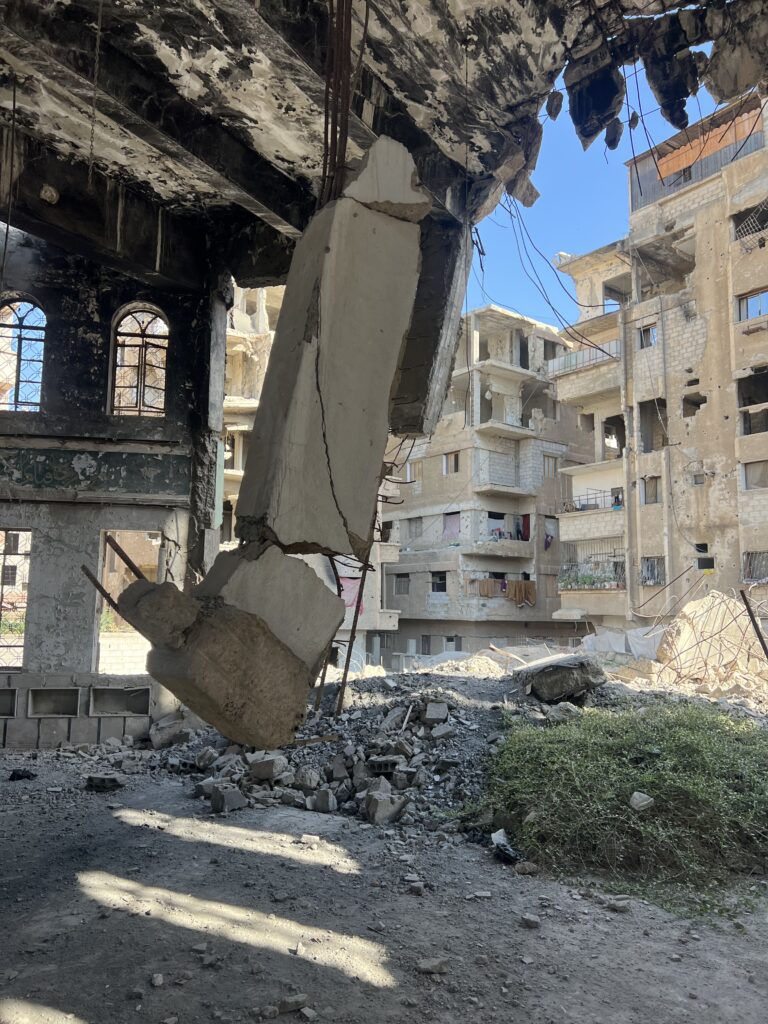
It should be a time of celebration, but for those living among the remnants of destruction, grief is pervasive. “Before the war, I would always wear white, but ever since the first death in our family, I’ve not taken off my black scarf,” Khadijah says. “I continue to be in mourning,”
Like so many others in Syria’s Zabadani region, Khadijah and her family hail from generations of experienced, hard-working farmers. But the land, once celebrated for its apple orchards, vineyards, and lush farmland that helped feed Damascus, endured one of Syria’s longest and most punishing sieges. Between 2015 and 2017, barrel bombs, airstrikes, and artillery shells rained down, destroying irrigation systems, flattening farmland, and contaminating the earth with heavy metals, TNT, and fuel residues. The blockade also choked off agricultural inputs—seeds, fertilizers, and clean water, leading to the collapse of a once-thriving rural economy.
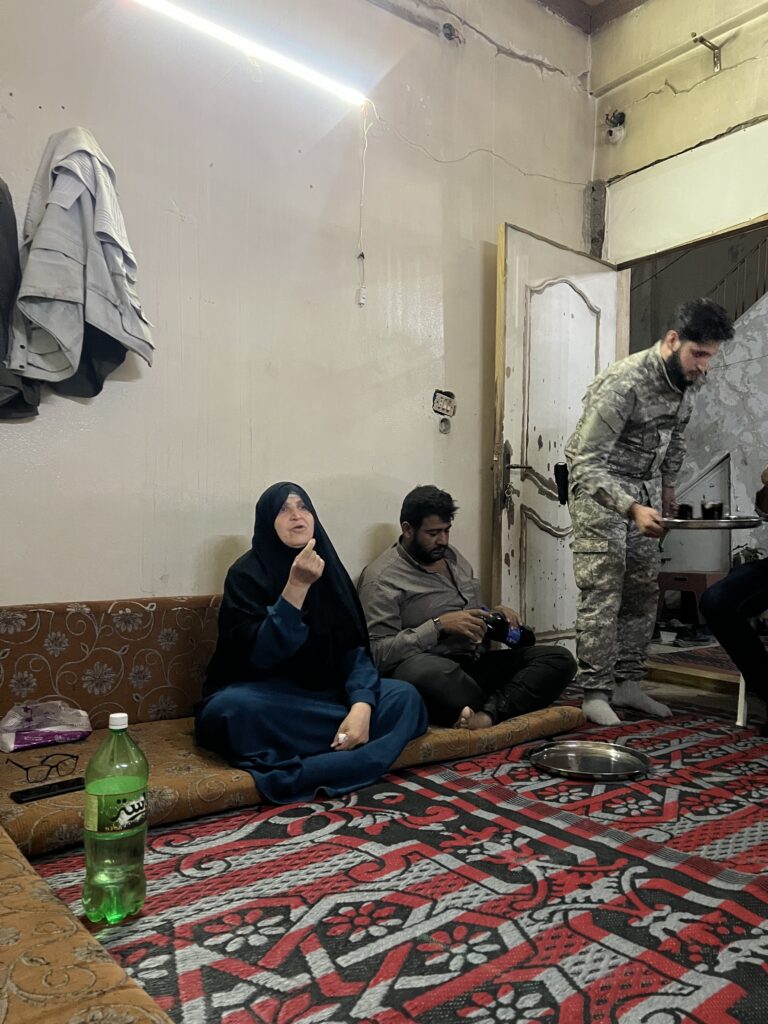
“We’d feed an entire town with our fruits and vegetables, but now, we barely have enough to feed our own family,” says Khadijah, whose grievances are evident when you visit her farm, where the soil is depleted and infrastructure destroyed.
“The only people whose farmland was spared were the people who cooperated with the Assad regime,” Khadijah explains. “We’re grateful to be alive, and we will rebuild, even though right now, we just don’t know how.” Later, she recalls the harrowing days in 2015 when she, her two daughters, and her then two-year-old grandson, Ammar, were displaced to nearby Madaya as the Assad army besieged Zabadani. Soon, those under siege in Madaya were facing severe food shortages and starvation under a blockade imposed by Assad’s forces and his allies Russia and Iran-backed Hezbollah.
“Ammar’s father [my son-in-law] was just killed…when we were forcefully moved to Madaya,” she says. “We had so much grief. “For the nearly two years that followed, we had nothing to survive on except rationed sugar, bread, and at times animal feed and grass.”
It wasn’t until 2017, following months of siege, that Khadijah and her family were relocated to opposition-held Idlib where they continued to live in displacement with little means to support the family.
Now 22, Ammar is studying to be a medical technician in Idlib—a city that remained the only lifeline for hundreds of thousands of displaced Syrians during the war. Visiting his grandparents in Zabadani, he brings in freshly made Arabic coffee and sits next to his grandmother and 37-year-old uncle Omar, who lost an eye in the war. Both men look at Khadijah with deep respect and endearment. “Every single mother in Syria has suffered tremendously, including my own mother and my grandmother; but we are of this land, and we’re happy to be back,” said Ammar.
The Flowers Still Bloom
Across Syria, the devastating impact of warfare is as environmental as it is emotional.
Just an hour’s drive from Damascus, 35-year-old Hiba walks through her hometown of Duma in Eastern Ghouta, stopping at a perfume shop to buy rose-scented oils—a defiant joy after surviving years of siege, bombardment, and chemical attacks. “Everything above ground was destroyed,” she says, recalling giving birth during the war in a half-collapsed clinic with no medicine, water, or electricity. Today, Hiba calls her 7-year-old daughter, Sally, her best friend and the person who makes life meaningful. “She loves riding her scooter and wants to be a pharmacist,” Hiba shares.
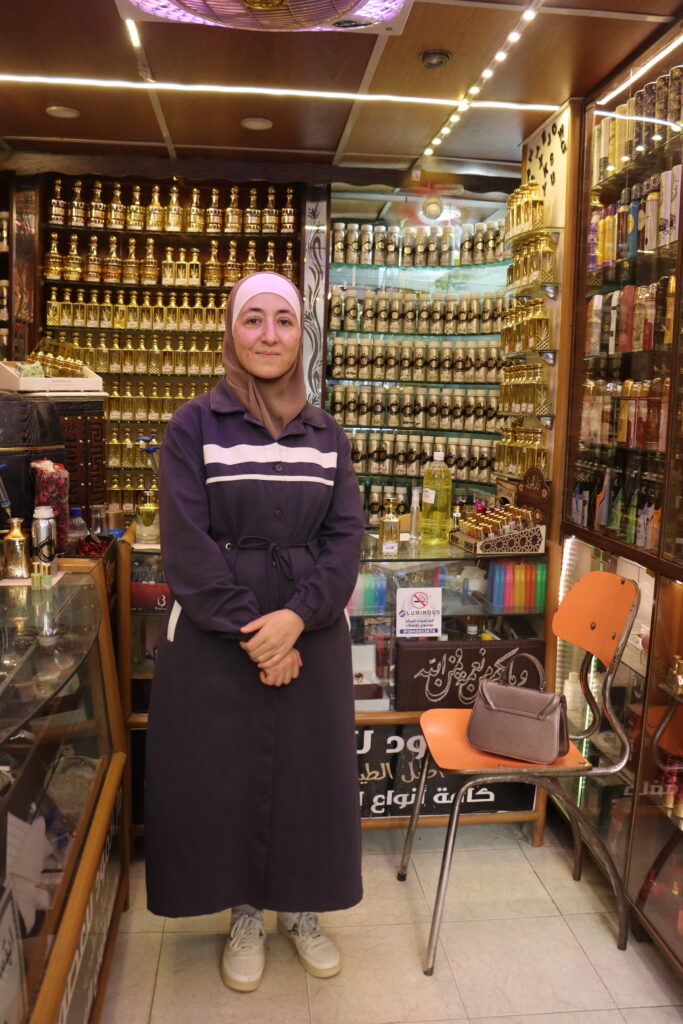
During the war, inspired by her family’s struggles caring for her younger brother with Down syndrome, Hiba began working with children with special needs—a profession she continues to this day, despite her own personal battles.
“People were disconnected from the world,” she says, pointing to what once was her house—a collapsed building lying under the weight of repeated barrel bombs and artillery strikes. “Our country is destroyed, but we mustn’t forget what happened to us. Our children must remember everything—so it doesn’t happen again.”
Both Zabadani and the Eastern Ghouta regions stand as stark evidence of how siege warfare and chemical weapons became tools of collective punishment—obliterating not just lives, but the ecosystems and livelihoods that sustained millions of ordinary civilians, including mothers, who are now searching for hope amidst rubble.
Back in Zabadani, 35-year-old Lana—a mother of two toddler boys—walks the grounds of her grandfather’s house and what was once her safe haven as a child.. She is a psychologist who has recently returned to her flattened town after years of life as a refugee in Lebanon. Today, along with her husband, she’s back “home,” doing what she once dreamed of doing for her own people and community.
“This is my grandfather’s home. My daddy grew up here,” she says. “We used to play here as children.”
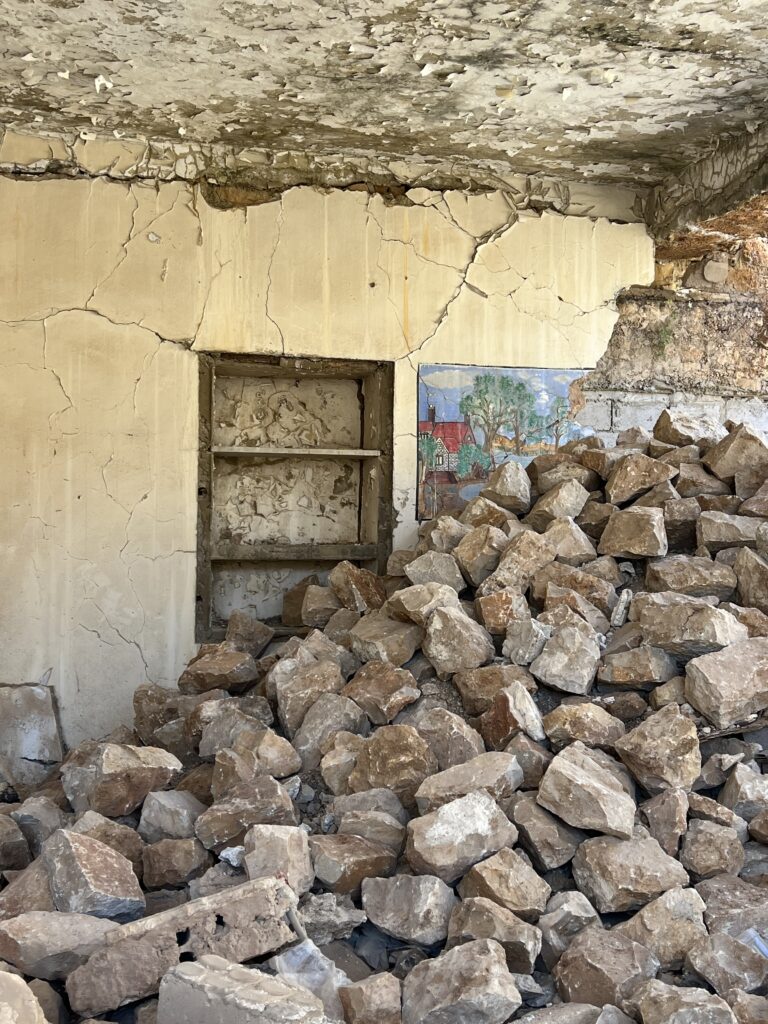
The building’s walls are pocked with shrapnel holes and its ceilings blown down into rubble, but as we climb up and walk into the remnants of the house, she suddenly turns around, tearing up. On a half-collapsed wall, a faint drawing survives—painted decades ago by Lana’s father as a child, and depicting a red house surrounded by trees and a bright blue lake—the last fragile trace of a family’s life before war.
“My daddy was an artist. I have to tell him this is still here.” She looks at the flowers growing from underneath a pile of stones and smiles: “See, even in the middle of this destruction, we still have flowers bloom. There is hope, Tara. We are here.”

Tara Kangarlou is an award-winning Iranian-American global affairs journalist who has produced, written, and reported for NBC-LA, CNN, CNN International, and Al Jazeera America. She is the author of The Heartbeat of Iran, an Adjunct Professor at Georgetown University, and founder of the NGO Art of Hope.