
Is ICE a reproductive health hazard?
  April 17, 2026 The “Toxic Legacy” of Operation Metro SurgeThis winter, in Minnesota and elsewhere around the country, ICE used tear gas on citizens. Now public health experts worry that these chemical weapons may be linked to reproductive problems. Yessenia Funes reports.BY YESSENIA FUNES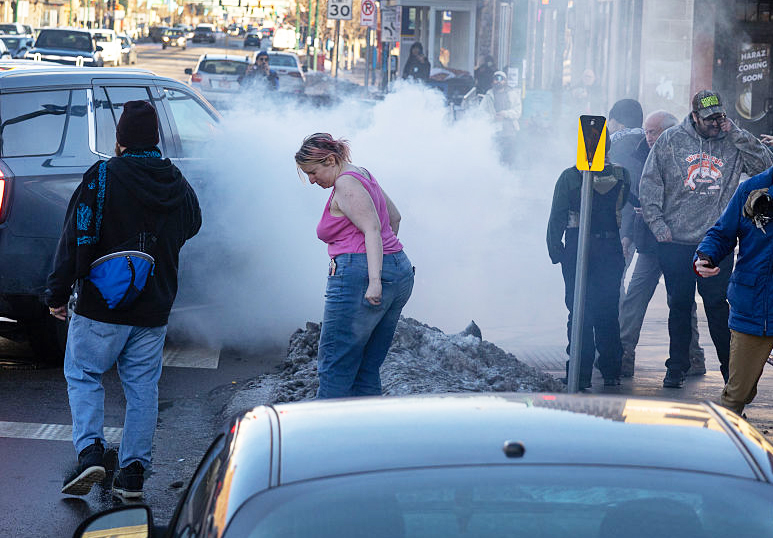 TEAR GAS ON A STREET IN MINNEAPOLIS THIS WINTER. EVEN THOSE NOT PROTESTING WERE AFFECTED, RESIDENTS SAY. (PHOTO BY SCOTT OLSON/GETTY IMAGES.) Asha kept a bag ready throughout most of January and February. Inside, she packed bandages, gauze, water, saline, tourniquets, and general first aid. The 30-year-old works as a healthcare professional in Minneapolis, and when she’s off the clock, she responds to community emergencies as a street medic, mostly treating her neighbors who have been exposed to chemical weapons. On the day in January when federal officers shot and killed 31-year-old nurse Alex Pretti, she says, “I watched a lot of elderly people get tear-gassed.” And that wasn’t the first or the last time Asha, who is sharing only her first name to protect her identity, saw law enforcement attack her neighbors. Since the Trump administration’s Operation Metro Surge, which deployed 3,000 federal immigration agents to the Twin Cities, the emergencies have felt nonstop to Asha. The administration concluded its Minnesota incursion on Feb. 12, firing Homeland Security Secretary Kristi Noem weeks later, partly for her failure to manage the fallout in the state. Minneapolis is seeing fewer agents than in prior months, but people are still scared. And the whole city still feels the surge’s effects in their bodies—perhaps literally. Public health experts fear that ICE’s actions will leave a toxic legacy for communities across the country. In cities like Los Angeles, Portland, and Washington, D.C., independent analysts have raised concerns over federal officers’ indiscriminate deployment of chemical agents like tear gas or pepper spray—and not just on protesters. People are being exposed while stepping out for work or errands, or even sometimes at home. Researchers can’t easily study the long-term impacts of these weapons—there’s no ethical way to expose people to these chemicals in a controlled experiment—but what they do know paints an alarming portrait for public health, especially in women, people with uteruses, and children. Asha Hassan, an assistant professor of women’s health at the University of Minnesota Medical School (not to be confused with the street medic), began collecting data on reproductive health impacts in 2020 when the Black Lives Matter uprisings sprang up across the country and, with them, a police response that often involved tear gas. She had heard whispers of menstrual irregularities and miscarriages, but after looking at the available literature, she realized scientists had ignored some key population groups. “A lot of the research that we do have on tear gas is from the ’50s and ’60s,” Hassan explains. “It’s on mostly healthy men who are in a military setting. It really hasn’t been tested on women, children, people with chronic conditions, people with any sort of disability.” Studies have focused on “this particular type of body: a cis, straight man who is serving in the military and has the ability to be healthy.”  A PROTESTER IN LOS ANGELES FLUSHES A FELLOW DEMONSTRATOR’S EYES OUT AFTER EXPOSURE TO TEAR GAS. (PHOTO BY JON PUTMAN/ANADOLU VIA GETTY IMAGES After putting out a social media call to hear from those who had been exposed to chemical weapons like tear gas, she received more than 600 emails from all over the world in just a few weeks. In 2023, she published a paper that included more than 1,200 responses from people exposed in the U.S. between 2020 and 2021. The findings confirmed Hassan’s fears: Tear gas exposure was linked to negative reproductive health impacts for anyone of reproductive age. “Even after one exposure, we started to see some impact,” she says.
The more a person had been exposed, the more likely they were to face a number of issues: breast tenderness, spontaneous bleeding, and cramping. The study also found an above-average rate of miscarriages, but the sample size didn’t include enough pregnant participants to make a strong conclusion about tear gas’s effect. AN “OBJECTIVELY CHILLING” USE OF TEAR GASIn the decades after World War II, the majority of world leaders agreed to ban riot control agents during war as part of the Chemical Weapons Convention. (The U.S. government shares limited information on the chemicals that make up these weapons, but they can include chlorobenzylidene malononitrile and dibenzoxazepine, which can harm the respiratory system.) However, U.S. police are still allowed to use these weapons to protect public safety, explains Rohini Haar, a public health professor at U.C. Berkeley and medical adviser at Physicians for Human Rights. But that’s not what’s happening in the U.S. under Trump, Dr. Haar believes. “You’re not seeing that these weapons are used to quell any sort of riot or protect public safety,” Dr. Haar says, emphasizing that ICE agents have fired tear gas as protesters were walking away, not to disperse a crowd. “They’re actually harming public safety.” Dr. Haar has treated tear gas patients across the globe, including at the Aida Refugee Camp in the West Bank. There, Palestinian families have been exposed to periods of near-daily tear-gas use by Israeli soldiers. No one is safe—not people cooking dinner at home or children walking to school. “That’s happening now in the U.S., too,” Dr. Haar says. “The experience in Aida is kind of a warning.” Indeed, a federal judge ordered ICE to stop its use of tear gas in Oregon last month after the American Civil Liberties Union filed a lawsuit on behalf of protesters. In his filing, U.S. District Court Judge Michael Simon wrote, “Defendants’ conduct – physically harming protesters and journalists without prior dispersal warnings – is objectively chilling.” At least one additional case also focuses on the federal government’s recent use of chemical weapons in Portland. The Meteor reached out to Customs and Border Protection to understand its reasoning behind officers’ liberal use of tear gas. The agency did not comment, but Gregory Bovino, the ICE official who led the Minnesota operation and lost his job in January, has defended the use of chemical weapons as a favorable alternative to “lethal devices.” In Minneapolis, ICE agents have also deployed tear gas outside people’s apartments and buildings, where the chemicals can and do seep indoors. The weapons are most toxic in enclosed spaces. The day officers killed Pretti, Asha, the street medic, fled into an apartment building to catch a break. “The air inside was almost as bad as the air outside,” she recalls. “You were standing inside and coughing,” Asha says. Tear gas “was seeping into every apartment in that hallway.”  PEOPLE IN MINNEAPOLIS RUN FROM TEAR GAS—WHICH FEDERAL AGENTS USED WIDELY THE DAY THEY KILLED NURSE ALEX PRETTI. (PHOTO BY STEPHEN MATUREN/GETTY IMAGES) For those who aren’t familiar with the chemicals, stepping outside of one’s home can feel completely normal—until the stinging, dry stench hits, explains Minneapolis resident Slime Seamstress, a 31-year-old trans seamstress using their soon-to-be legal name. They were exposed to tear gas twice in January. They never attended a protest; exposure occurred instead during routine walks to pick up groceries or meet a friend. About a week later, they menstruated for more than 30 days straight. After three weeks of bleeding, they went to see their doctor, who suggested that the tear gas had caused the disruption. “That’s what scared me,” Seamstress says. “They said that it seemed serious.” Seamstress didn’t have the means to purchase more menstrual products after their supply ran out, so they sewed their own reusable pads with the fabrics they had at home. They can’t afford a gas mask, a $40-230+ product which has become essential for many Minnesotans, either. At the height of protests, Seamstress avoided leaving the house. “A HIGHLY TENSE SOCIAL AND PSYCHOLOGICAL SITUATION”Staying home isn’t an option for everyone. Timothy Monko, a former post-doctoral researcher at the University of Minnesota, has investigated these chemicals, contributing to a 2021 paper scrutinizing the safety of tear gas. The research’s takeaway was clear: “We should not be using it without actually understanding its effects,” Monko says. Those findings were enough to scare him and his wife: They may want more children in the future, so his wife carried her gas mask everywhere when ICE officers were regularly facing off against local community responders this winter. Monko isn’t the only researcher to make similar conclusions. Public health expert Patricia Huerta has heard accounts of irregular menstrual cycles and miscarriages following tear gas exposure in Chile. The associate professor of public health and medicine at Chile’s University of Concepción published a 2023 paper focused on the 2019 social uprisings there, where police used crowd control agents during protests. She’s unsure whether chemical exposure alone is to blame for people’s symptoms—or whether it acts in combination with the trauma people experience during these law enforcement confrontations. “It’s a highly tense social and psychological situation,” Huerta says. “It’s quite stressful. It’s the smoke. It’s the smell. It’s a policeman pointing at you with a shotgun that you don’t know will shoot a tear gas canister or a rubber bullet.” Every researcher interviewed for this story agrees that there is a lot regulators still don’t understand about the long-term impacts of exposure to various types of chemical agents, but that they know enough to say with confidence that ICE’s recent use of tear gas and pepper spray isn’t safe. In the meantime, Seamstress is anxious over their next menstrual cycle. Asha, the street medic, remains available should her neighbors need her again. She’ll respond to emergencies however she can as long as her community is under attack. “Through all this, we’re just trying to meet the needs of our community,” she says. “We’re just looking after our neighbors….If it’s dropping off groceries or helping people pay rent, then it’s that. If it’s helping people who have been tear-gassed or pepper-sprayed, then we do that. We’re just helping in whatever way we can.”  ABOUT YESSENIA FUNESYessenia Funes is an environmental journalist focused on uplifting the voices of society’s most oppressed. She publishes a climate-justice newsletter called Possibilities, and has been published in The Guardian, The Verge, Yale Climate Connections, National Geographic, New York Magazine, and more.  ENJOY MORE OF THE METEOR Thanks for reading the Saturday Send. Got this from a friend? Don’t forget to sign up for The Meteor’s flagship newsletter, sent on Tuesdays and Thursdays.      |
