

AOC's eggs, and mine
  June 26, 2026 Dearest Meteor readers, For reasons that are still unclear to me, I rewatched the entirety of “The Handmaid’s Tale” this summer, then belatedly just finished Margaret Atwood’s 2019 follow-up to the novel, The Testaments. Not exactly a beach read, but! It did cause me to rethink one of the pet names I use for my daughter Pearl. Whoops.  Speaking of babies and obsessions with uterus-related content, we’re taking a closer look at AOC’s egg-freezing journey—and mine, too. Plus, some blunt words for the Kamala haters, and your Thursday mood booster. Blessed be the fruit, Nona Willis Aronowitz  WHAT'S GOING ONEggs in many baskets: Over the weekend Rep. Alexandria Ocasio Cortez shared, first on Instagram and then on ABC’s “This Week,” that she was freezing her eggs and would be documenting the experience on social media. Since then, the speculation has been deafening: She’s doing it because she’s running for president! Or wait, maybe it’s because she broke up with her fiancé and wants to wait until she finds a suitable partner! Whatever the reason, it’s “selfish” and “baffling.” No, it’s “bold and ethical.” Plus it helps her sidestep the “leftist single woman who hates men” stereotype. People can theorize all they want about AOC’s reasons, but she’s pointedly not giving them in her Q&As on Instagram, so we don’t know them, and we don’t need to know them. In fact, they are often, on some level, unknowable. I speak from experience: I’m another one of the hundreds of thousands of women who have frozen their eggs, and I didn’t even know what my eventual reason would be when I did it.  OHHH GOOD OL' GONAL F. DON'T FORGET THE 90-DEGREE ANGLE! (VIA INSTAGRAM) It was 2020, knee-deep in COVID. My partner Dom and I knew we eventually wanted two kids, but we didn’t feel ready yet—especially Dom, who was barely 30 and had no close peers with children. Like AOC, I was 36 and nervous that I’d struggle by the time we tried for that second kid. So, to give ourselves options, we pooled our cash and went through the process of egg-freezing, which had spiked during the pandemic. All in all, it cost about $11,000—none of that covered by insurance—and then about $800 a year in storage fees. Unlike AOC, I wasn’t public about the process. I felt ambivalent and sheepish as Dom gave me shots and I trudged to “morning monitoring” appointments. I had my own real concerns about the industry: I’d noticed the predatory marketing of egg-freezing companies, and thought it was dystopian that big corporations like Facebook and Apple had started to cover egg-freezing for their employees instead of, you know, improving a workaholic office culture that’s inhospitable to parenthood. I also had my own prejudices about what “kind” of woman freezes their eggs (not me!), no doubt influenced by the frankly sexist media framing of egg-freezing as a naive, girlbossy move. Dom and I maintained an ironic distance from the process, and gently mocked ourselves when I easily got pregnant (the old-fashioned way) with my first daughter less than a year after freezing my eggs. We started to refer to my oocytes as “the panic eggs.” But you know what? The “panic eggs” came in handy—although not for the reasons I thought they would. When my first daughter was two and I was 39, I got pregnant again fairly quickly. But 14 weeks in, we got some devastating news from a genetic test and decided to have an abortion. The trauma of that loss caused me to reconsider my little eggs on ice; if I used them, I realized, we could test the embryos before I got pregnant so I’d have reassurance that the baby was genetically normal. I was so grateful to have had that option, and doubly grateful that New York law required insurance companies to cover IVF (unlike the initial egg freezing, the fertilization and embryo transfer was considered IVF and thus completely paid for). And it worked. My second daughter turns one year old tomorrow. I tell this story now not to endorse egg-freezing as a magic bullet—people should absolutely pore over the data before deciding whether it’s worth it—but to emphasize how personal and complicated these choices are, and how fruitless second-guessing anyone’s motives is. The bottom line: The more reproductive choices we have, the better. That includes access to abortion and birth control, but also more ways of having babies. Anything that demystifies the process of egg-freezing will ultimately help make it as accessible and affordable as possible, and dispel the kinds of weird value judgments I initially put on it. No one needs to know anyone else’s reasons, but we all need, as AOC put it, “more depictions of women having full lives in every context and every choice.”  ME CELEBRATING THE END OF THE EGG-FREEZING PROCESS, WHEN I COULD FINALLY HAVE A DAMN DRINK. (PHOTO VIA JESSICA TAYLOR) AND:
 MOOD BOOSTEREvery Thursday, one of our editors shares a small thing that’s getting them through. If you’ve got something brightening your week, we want to know—reply to this email and share! This week I had a two-hour creative brainstorm with a woman I’ve known for several years. During that time, we worked together on one big, meaningful, and personal project, and remained friendly after that—but it wasn’t until this meeting that we realized how much we liked each other. The reasons we like each other tumbled out of our mouths, via ideas about our work, the media and entertainment industries, being Black women surviving being Black women, navigating adult mean girls, and choosing ourselves. In this era of doomscrolling and AI anarchy, it was a revelation to discover that we can still make meaningful connections, simply by sitting across from someone. —Rebecca Carroll  FOLLOW THE METEOR     Thank you for reading The Meteor! Got this from a friend? |


Is ICE a reproductive health hazard?
  April 17, 2026 The “Toxic Legacy” of Operation Metro SurgeThis winter, in Minnesota and elsewhere around the country, ICE used tear gas on citizens. Now public health experts worry that these chemical weapons may be linked to reproductive problems. Yessenia Funes reports.BY YESSENIA FUNES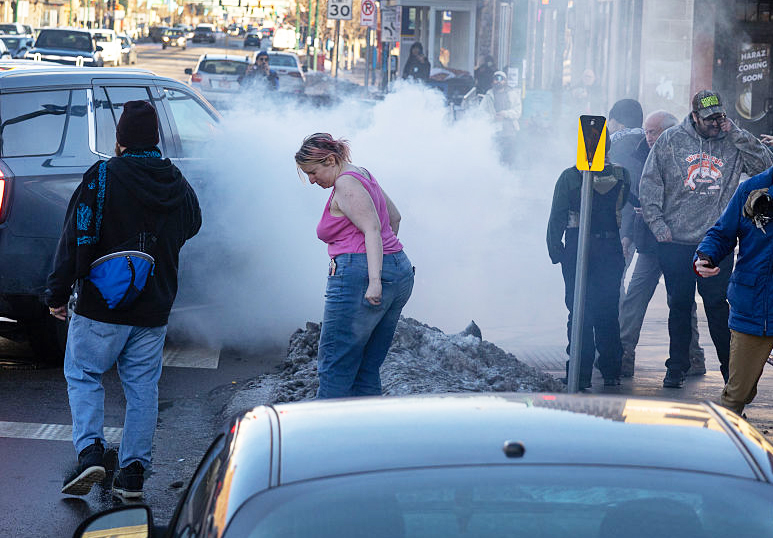 TEAR GAS ON A STREET IN MINNEAPOLIS THIS WINTER. EVEN THOSE NOT PROTESTING WERE AFFECTED, RESIDENTS SAY. (PHOTO BY SCOTT OLSON/GETTY IMAGES.) Asha kept a bag ready throughout most of January and February. Inside, she packed bandages, gauze, water, saline, tourniquets, and general first aid. The 30-year-old works as a healthcare professional in Minneapolis, and when she’s off the clock, she responds to community emergencies as a street medic, mostly treating her neighbors who have been exposed to chemical weapons. On the day in January when federal officers shot and killed 31-year-old nurse Alex Pretti, she says, “I watched a lot of elderly people get tear-gassed.” And that wasn’t the first or the last time Asha, who is sharing only her first name to protect her identity, saw law enforcement attack her neighbors. Since the Trump administration’s Operation Metro Surge, which deployed 3,000 federal immigration agents to the Twin Cities, the emergencies have felt nonstop to Asha. The administration concluded its Minnesota incursion on Feb. 12, firing Homeland Security Secretary Kristi Noem weeks later, partly for her failure to manage the fallout in the state. Minneapolis is seeing fewer agents than in prior months, but people are still scared. And the whole city still feels the surge’s effects in their bodies—perhaps literally. Public health experts fear that ICE’s actions will leave a toxic legacy for communities across the country. In cities like Los Angeles, Portland, and Washington, D.C., independent analysts have raised concerns over federal officers’ indiscriminate deployment of chemical agents like tear gas or pepper spray—and not just on protesters. People are being exposed while stepping out for work or errands, or even sometimes at home. Researchers can’t easily study the long-term impacts of these weapons—there’s no ethical way to expose people to these chemicals in a controlled experiment—but what they do know paints an alarming portrait for public health, especially in women, people with uteruses, and children. Asha Hassan, an assistant professor of women’s health at the University of Minnesota Medical School (not to be confused with the street medic), began collecting data on reproductive health impacts in 2020 when the Black Lives Matter uprisings sprang up across the country and, with them, a police response that often involved tear gas. She had heard whispers of menstrual irregularities and miscarriages, but after looking at the available literature, she realized scientists had ignored some key population groups. “A lot of the research that we do have on tear gas is from the ’50s and ’60s,” Hassan explains. “It’s on mostly healthy men who are in a military setting. It really hasn’t been tested on women, children, people with chronic conditions, people with any sort of disability.” Studies have focused on “this particular type of body: a cis, straight man who is serving in the military and has the ability to be healthy.”  A PROTESTER IN LOS ANGELES FLUSHES A FELLOW DEMONSTRATOR’S EYES OUT AFTER EXPOSURE TO TEAR GAS. (PHOTO BY JON PUTMAN/ANADOLU VIA GETTY IMAGES After putting out a social media call to hear from those who had been exposed to chemical weapons like tear gas, she received more than 600 emails from all over the world in just a few weeks. In 2023, she published a paper that included more than 1,200 responses from people exposed in the U.S. between 2020 and 2021. The findings confirmed Hassan’s fears: Tear gas exposure was linked to negative reproductive health impacts for anyone of reproductive age. “Even after one exposure, we started to see some impact,” she says.
The more a person had been exposed, the more likely they were to face a number of issues: breast tenderness, spontaneous bleeding, and cramping. The study also found an above-average rate of miscarriages, but the sample size didn’t include enough pregnant participants to make a strong conclusion about tear gas’s effect. AN “OBJECTIVELY CHILLING” USE OF TEAR GASIn the decades after World War II, the majority of world leaders agreed to ban riot control agents during war as part of the Chemical Weapons Convention. (The U.S. government shares limited information on the chemicals that make up these weapons, but they can include chlorobenzylidene malononitrile and dibenzoxazepine, which can harm the respiratory system.) However, U.S. police are still allowed to use these weapons to protect public safety, explains Rohini Haar, a public health professor at U.C. Berkeley and medical adviser at Physicians for Human Rights. But that’s not what’s happening in the U.S. under Trump, Dr. Haar believes. “You’re not seeing that these weapons are used to quell any sort of riot or protect public safety,” Dr. Haar says, emphasizing that ICE agents have fired tear gas as protesters were walking away, not to disperse a crowd. “They’re actually harming public safety.” Dr. Haar has treated tear gas patients across the globe, including at the Aida Refugee Camp in the West Bank. There, Palestinian families have been exposed to periods of near-daily tear-gas use by Israeli soldiers. No one is safe—not people cooking dinner at home or children walking to school. “That’s happening now in the U.S., too,” Dr. Haar says. “The experience in Aida is kind of a warning.” Indeed, a federal judge ordered ICE to stop its use of tear gas in Oregon last month after the American Civil Liberties Union filed a lawsuit on behalf of protesters. In his filing, U.S. District Court Judge Michael Simon wrote, “Defendants’ conduct – physically harming protesters and journalists without prior dispersal warnings – is objectively chilling.” At least one additional case also focuses on the federal government’s recent use of chemical weapons in Portland. The Meteor reached out to Customs and Border Protection to understand its reasoning behind officers’ liberal use of tear gas. The agency did not comment, but Gregory Bovino, the ICE official who led the Minnesota operation and lost his job in January, has defended the use of chemical weapons as a favorable alternative to “lethal devices.” In Minneapolis, ICE agents have also deployed tear gas outside people’s apartments and buildings, where the chemicals can and do seep indoors. The weapons are most toxic in enclosed spaces. The day officers killed Pretti, Asha, the street medic, fled into an apartment building to catch a break. “The air inside was almost as bad as the air outside,” she recalls. “You were standing inside and coughing,” Asha says. Tear gas “was seeping into every apartment in that hallway.”  PEOPLE IN MINNEAPOLIS RUN FROM TEAR GAS—WHICH FEDERAL AGENTS USED WIDELY THE DAY THEY KILLED NURSE ALEX PRETTI. (PHOTO BY STEPHEN MATUREN/GETTY IMAGES) For those who aren’t familiar with the chemicals, stepping outside of one’s home can feel completely normal—until the stinging, dry stench hits, explains Minneapolis resident Slime Seamstress, a 31-year-old trans seamstress using their soon-to-be legal name. They were exposed to tear gas twice in January. They never attended a protest; exposure occurred instead during routine walks to pick up groceries or meet a friend. About a week later, they menstruated for more than 30 days straight. After three weeks of bleeding, they went to see their doctor, who suggested that the tear gas had caused the disruption. “That’s what scared me,” Seamstress says. “They said that it seemed serious.” Seamstress didn’t have the means to purchase more menstrual products after their supply ran out, so they sewed their own reusable pads with the fabrics they had at home. They can’t afford a gas mask, a $40-230+ product which has become essential for many Minnesotans, either. At the height of protests, Seamstress avoided leaving the house. “A HIGHLY TENSE SOCIAL AND PSYCHOLOGICAL SITUATION”Staying home isn’t an option for everyone. Timothy Monko, a former post-doctoral researcher at the University of Minnesota, has investigated these chemicals, contributing to a 2021 paper scrutinizing the safety of tear gas. The research’s takeaway was clear: “We should not be using it without actually understanding its effects,” Monko says. Those findings were enough to scare him and his wife: They may want more children in the future, so his wife carried her gas mask everywhere when ICE officers were regularly facing off against local community responders this winter. Monko isn’t the only researcher to make similar conclusions. Public health expert Patricia Huerta has heard accounts of irregular menstrual cycles and miscarriages following tear gas exposure in Chile. The associate professor of public health and medicine at Chile’s University of Concepción published a 2023 paper focused on the 2019 social uprisings there, where police used crowd control agents during protests. She’s unsure whether chemical exposure alone is to blame for people’s symptoms—or whether it acts in combination with the trauma people experience during these law enforcement confrontations. “It’s a highly tense social and psychological situation,” Huerta says. “It’s quite stressful. It’s the smoke. It’s the smell. It’s a policeman pointing at you with a shotgun that you don’t know will shoot a tear gas canister or a rubber bullet.” Every researcher interviewed for this story agrees that there is a lot regulators still don’t understand about the long-term impacts of exposure to various types of chemical agents, but that they know enough to say with confidence that ICE’s recent use of tear gas and pepper spray isn’t safe. In the meantime, Seamstress is anxious over their next menstrual cycle. Asha, the street medic, remains available should her neighbors need her again. She’ll respond to emergencies however she can as long as her community is under attack. “Through all this, we’re just trying to meet the needs of our community,” she says. “We’re just looking after our neighbors….If it’s dropping off groceries or helping people pay rent, then it’s that. If it’s helping people who have been tear-gassed or pepper-sprayed, then we do that. We’re just helping in whatever way we can.”  ABOUT YESSENIA FUNESYessenia Funes is an environmental journalist focused on uplifting the voices of society's most oppressed. She publishes a climate-justice newsletter called Possibilities, and has been published in The Guardian, The Verge, Yale Climate Connections, National Geographic, New York Magazine, and more.  ENJOY MORE OF THE METEOR Thanks for reading the Saturday Send. Got this from a friend? Don’t forget to sign up for The Meteor’s flagship newsletter, sent on Tuesdays and Thursdays.  |


The FDA...Did Good?
  November 11, 2025 Greetings, Meteor readers, It’s 11/11, make a wish.  In today’s newsletter, we’re feeling optimistic about menopause. Plus, a stunning upset in Kansas City. 🥶🥶🥶🌷, The Meteor team  WHAT'S GOING ONWhat’s the HRTea?: Yesterday, Martin Makary, the FDA commissioner, announced that hormone therapies for menopause will no longer be required to carry the black box warning they’ve borne for nearly two decades. It was a difficult moment to process, mainly because it’s almost impossible to believe that a government agency overseen by a man so opposed to science actually appears to be…following the science. And for the benefit of women!? Let’s be clear: There were some fruit loops mixed in with the rational research presented by the FDA yesterday. In a breakdown of the event, reporters at Mother Jones highlighted some of the more dangerous claims, like the suggestion that untreated menopause symptoms lead to divorce (they do not) and that menopause kills women (also nope).  ACTRESS HALL BERRY, LAST YEAR, DURING A BIPARTISAN EFFORT TO INCREASE FEDERAL RESEARCH ON MENOPAUSE (VIA GETTY IMAGES) Makary and Co,’s antics aside, though, “this announcement was a step in the right direction,” says Claire Gill, founder of the National Menopause Foundation. “Removing the black box warning from low-dose vaginal estrogen products is a positive step toward improving women’s midlife health and beyond. And it’s something leading menopause experts and advocates have been trying to get corrected on labeling for more than 20 years.” If you’ve never seen one before, a black box warning (which is the highest form of warning the FDA can issue about prescription medication) lists the most severe risk factors in taking a drug. In addition to drugs used in hormone replacement therapies (HRT), the FDA has placed black box warnings on some antidepressants, opioids, and NSAIDs. In the case of HRT, the FDA issued its warnings—citing risk factors like heart attack, stroke, and breast cancer—following an initial women’s health study that began in 1991. But ”the risk and/or effectiveness of HRT was not something originally in the scope of the study,” Gill explains. When researchers at the time observed the data, there was a slight increase in breast cancer among women in the study who were on HRT versus those who were not. “What we now know,” Gill says, referencing an updated report from JAMA, “is that the women in that study at that time had initiated hormone therapy more than 10 years after they reached menopause. When the data was reviewed to determine the risk for women who started on HRT closer to the onset of menopause, it was shown that there was actually no additional risk for any of those conditions and, in fact, there were some very positive benefits [to taking HRT], in breast cancer risk reduction and osteoporosis prevention, among other things.” And as research since then has shown, HRT—while not a miracle drug, and not recommended for all women—can be an immense help in improving quality of life, reducing certain menopausal symptoms like vaginal dryness, pain during sex, and incontinence. And “an important next step,” Gill adds, “would be to convene medical societies whose members…treat women at midlife and beyond—gynecologists, internal medicine, family medicine, urologists, sexual medicine, geriatricians, etc.—and have a robust discussion to come to consensus on what all of them agree on when it comes to HRT and estrogen therapy. That would provide enormous benefit to advancing menopause care in the U.S.” AND:
 YOUR FAVORITE MUSIC GROUP'S FAVORITE MUSIC GROUP (VIA GETTY IMAGES)
 THE REASON PEOPLE STILL BELIEVE IN YOUNG LOVE. (VIA GETTY IMAGES)  FOLLOW THE METEOR     Thank you for reading The Meteor! Got this from a friend? |
