
The Toni Morrison approach to mothering
Black women deserve to claim and relish the depths of freedom motherhood can bring.
By Rebecca Carroll
When I was nursing my son as a baby, he started doing this thing where he would latch the little fingers of his free hand around my bottom lip, and then proceed to slowly knead at it in a small but persistent effort to pry open my mouth. It almost felt like he was trying to find some sort of entryway back into my body. Once, when he was about two, I softly placed my hand over his as he tugged at my lip, and asked in a whisper, “Does this feel like love to you?” He stared back at me with his beautiful, bright eyes, and nodded “yes.” It felt like love to me, too.
I am reminded of this hushed exchange of heartwork between us whenever I see one of these pieces about “styles of parenting” that crop up online every now and again, introducing or reintroducing terms like “attachment parenting,” “helicopter parenting,” “gentle parenting,” and “intensive parenting.” The methods they describe might sound fresh, but they’re often adjacent to the four Mayo Clinic-approved styles of parenting, which have been around since the 1960s—authoritative, authoritarian, permissive, and uninvolved. And they almost always feel white-coded, not just because labeling (or, let’s be honest, marketing) how parents interact with their children is about having the time and the income to ponder how you might like to categorize your “style” of parenting. These terms also dissociate and intellectualize what is, to me, and to many Black mothers I know, an emotionally freeing, visceral experience.
It is striking to me how little the experience of Black mothers factors into the standard offerings on how to parent today. Instead, we get media portrayals of Black mothers as struggling single moms and “modern-day mammies,” or neck-rolling, meme-friendly, “You got McDonald’s money?” kinds of stereotypes. But Black mothers are, and Black mothering is, so much more than that. And we deserve to claim and relish the depths of freedom mothering can bring——especially given the inherent, deeply harrowing history of when and if we were even able to keep our children.
Morrison offers this piece of advice: “When they walk in the room, my face says I’m glad to see them.”
No one knew that better than the late novelist Toni Morrison, who was herself a single mother of two boys. Becoming a mother, Morrison said in a 1989 conversation with Bill Moyers, “ was the most liberating thing that ever happened to me.” The demands of her children, she went on to explain, were not like those of her colleagues, friends, or lovers. “Somehow all of the baggage that I had accumulated as a person about what was valuable just fell away. I could not only be me—whatever that was—but somebody actually needed me to be that.” That’s exactly how I felt when I was nursing my son, when he needed me to be that person who would feel like love.
Later, years after I stopped nursing, I snuggled him often and regularly, let him sleep in the bed with us at night, and made myself available to him in ways that felt centered and honest. I seldom missed a call. I always allowed myself to be vulnerable even, and especially, when I didn’t have an answer to solve a problem—while also trying like hell to solve the problem. “If you listen to [your children],” said Morrison, in that same conversation with Moyers, “somehow you are able to free yourself from baggage and vanity… and deliver a better self, one that you like. The person that was in me that I liked best was the one my children seemed to want.” Obviously, we have to make choices, set boundaries, and act as moral compasses for our children, but isn’t that part of delivering the version of ourselves that we like best?
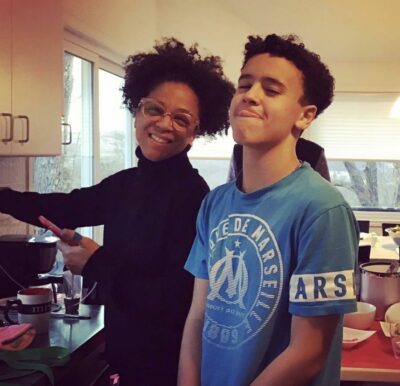
REBECCA AND HER SON, KOFI (COURTESY OF REBECCA CARROLL)
My friend Caryn and I raised our sons, who are just eight months apart, as cousin-brothers, and have frequently mused over the past 21 years about the ways in which parenting Black children is not just about “the talk” for our sons, or warnings about the oversexualization of Black girls for our friends with daughters. It’s about mitigating the harshness of their inevitable reality growing up in America, with the softness of our generational instincts.
Morrison’s approach to parenting squarely challenges the meme and media stereotypes (not that she would have paid them much mind), and blatantly disregards white mainstream guides. Black mothering doesn’t need a name or a category; it deserves a kind of reverence. In simpler terms, Morrison offers this one piece of salient advice: “Let your face speak what’s in your heart. When they walk in the room, my face says I’m glad to see them. It’s just as small as that, you see?”
The summer after my son went to college, I was really struggling with him being away. Like, actually grieving. We sat down one evening to talk about it. I told him how hard it was for me to be physically separated from him, almost as if a part of my body was missing. And he said, “Mom, I’m doing what I’m supposed to be doing. And that’s a testament to you and your mothering.” I’d like to think that is in no small part because my face has always said I’m glad to see him when he walks into a room.
More Mother’s Day reading and watching from The Meteor:
A Feminist Love Letter to Baby Formula
It’s Time to Rethink the Empty Nest
My Abortion Story Is Not What You Think
Three Questions For Tracy Clark-Flory About Motherhood and Sisterhood