
Syria's Mothers are Fighting to Rebuild Their Homes
One year after the end of a long war, they tell journalist Tara Kangarlou what coming home has really been like
By Tara Kangarlou
“There are very few mothers here who haven’t lost a child or a spouse, and very few children who haven’t lost a mother or a wife,” says 62-year-old Khadijah as she sits on the floor of a heavily bombed building—flattened, except for the one room where she now lives with her 75-year-old husband, Khaled. Like most of her neighbors, Khadijah, her husband, and her children—previously displaced across Syria and neighboring Lebanon and Turkey—are now returning to their devastated hometown of Zabadani, wondering how to pick up fragments of a life uprooted.
The nearly 13-year-long war in Syria is known as one of the worst humanitarian crises of the 21st century. According to the United Nations High Commissioner for Refugees, the conflict displaced more than 13 million Syrians, including the six million people who fled to neighboring countries. For years, the war functionally dismantled the country’s healthcare and infrastructure and robbed an entire generation of school-aged children of their childhood and education—losses that ripple through every fabric of Syrian society today. The UN Human Rights Office has documented over 300,000 civilian deaths, with some estimates approaching half a million. Multiple mass graves have been found across the country, and Bashar al-Assad’s deployment of chemical weapons in Ghouta and Duma against his own people marked the deadliest use of such agents in decades.
This month marks a year since the fall of Bashar al-Assad, and over that time, millions of Syrians have been adjusting to their newly liberated reality. More than four million have made their way back to their villages across Syria—their homes reshaped by years of siege, bombardment, and civil war. In Zabadani, Eastern Ghouta, Madaya, Duma, and other hard-hit regions across the country, mothers—like Khadijah—are navigating these losses firsthand as they work to restore a semblance of stability for their families.
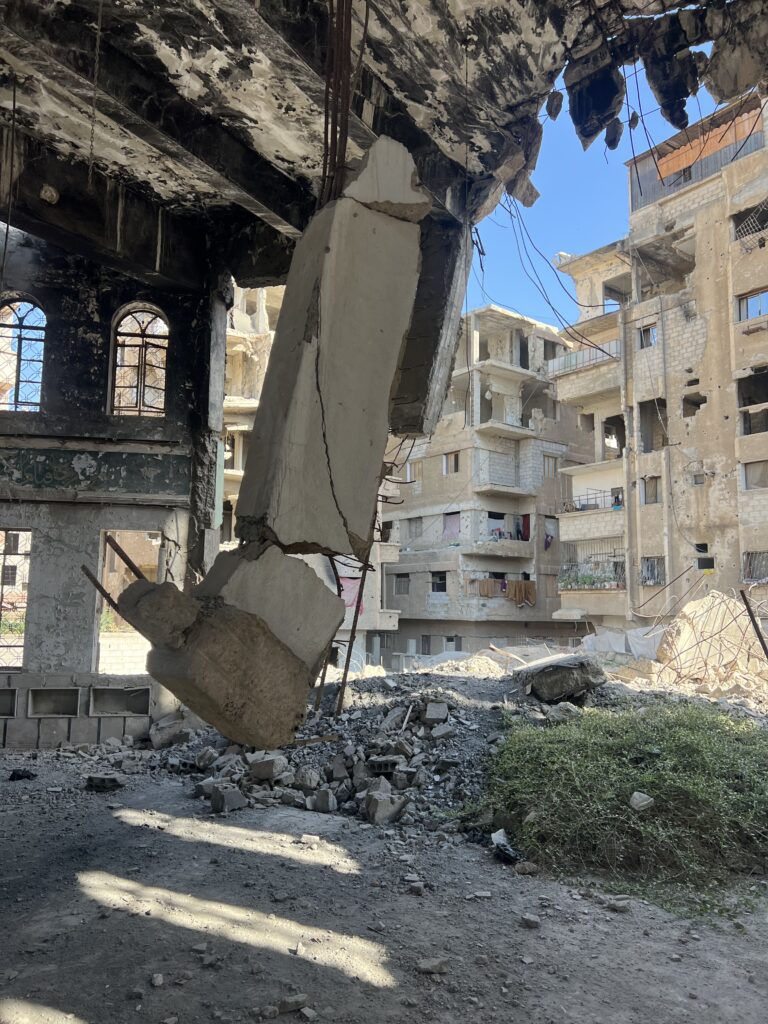
It should be a time of celebration, but for those living among the remnants of destruction, grief is pervasive. “Before the war, I would always wear white, but ever since the first death in our family, I’ve not taken off my black scarf,” Khadijah says. “I continue to be in mourning,”
Like so many others in Syria’s Zabadani region, Khadijah and her family hail from generations of experienced, hard-working farmers. But the land, once celebrated for its apple orchards, vineyards, and lush farmland that helped feed Damascus, endured one of Syria’s longest and most punishing sieges. Between 2015 and 2017, barrel bombs, airstrikes, and artillery shells rained down, destroying irrigation systems, flattening farmland, and contaminating the earth with heavy metals, TNT, and fuel residues. The blockade also choked off agricultural inputs—seeds, fertilizers, and clean water, leading to the collapse of a once-thriving rural economy.
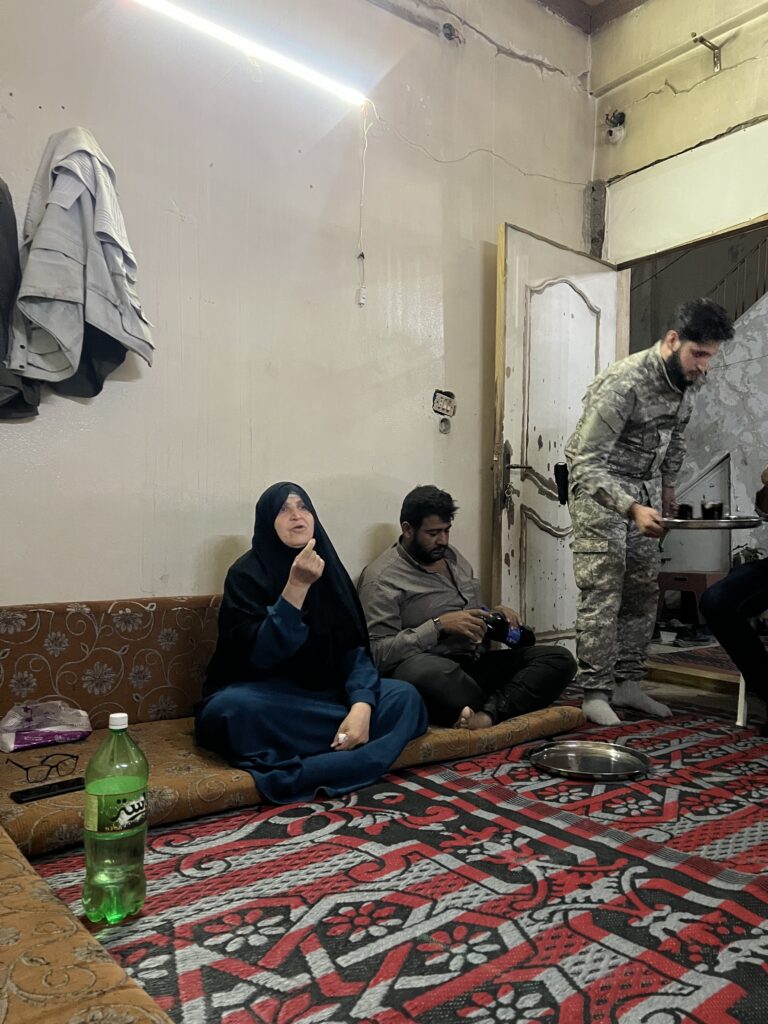
“We’d feed an entire town with our fruits and vegetables, but now, we barely have enough to feed our own family,” says Khadijah, whose grievances are evident when you visit her farm, where the soil is depleted and infrastructure destroyed.
“The only people whose farmland was spared were the people who cooperated with the Assad regime,” Khadijah explains. “We’re grateful to be alive, and we will rebuild, even though right now, we just don’t know how.” Later, she recalls the harrowing days in 2015 when she, her two daughters, and her then two-year-old grandson, Ammar, were displaced to nearby Madaya as the Assad army besieged Zabadani. Soon, those under siege in Madaya were facing severe food shortages and starvation under a blockade imposed by Assad’s forces and his allies Russia and Iran-backed Hezbollah.
“Ammar’s father [my son-in-law] was just killed…when we were forcefully moved to Madaya,” she says. “We had so much grief. “For the nearly two years that followed, we had nothing to survive on except rationed sugar, bread, and at times animal feed and grass.”
It wasn’t until 2017, following months of siege, that Khadijah and her family were relocated to opposition-held Idlib where they continued to live in displacement with little means to support the family.
Now 22, Ammar is studying to be a medical technician in Idlib—a city that remained the only lifeline for hundreds of thousands of displaced Syrians during the war. Visiting his grandparents in Zabadani, he brings in freshly made Arabic coffee and sits next to his grandmother and 37-year-old uncle Omar, who lost an eye in the war. Both men look at Khadijah with deep respect and endearment. “Every single mother in Syria has suffered tremendously, including my own mother and my grandmother; but we are of this land, and we’re happy to be back,” said Ammar.
The Flowers Still Bloom
Across Syria, the devastating impact of warfare is as environmental as it is emotional.
Just an hour’s drive from Damascus, 35-year-old Hiba walks through her hometown of Duma in Eastern Ghouta, stopping at a perfume shop to buy rose-scented oils—a defiant joy after surviving years of siege, bombardment, and chemical attacks. “Everything above ground was destroyed,” she says, recalling giving birth during the war in a half-collapsed clinic with no medicine, water, or electricity. Today, Hiba calls her 7-year-old daughter, Sally, her best friend and the person who makes life meaningful. “She loves riding her scooter and wants to be a pharmacist,” Hiba shares.
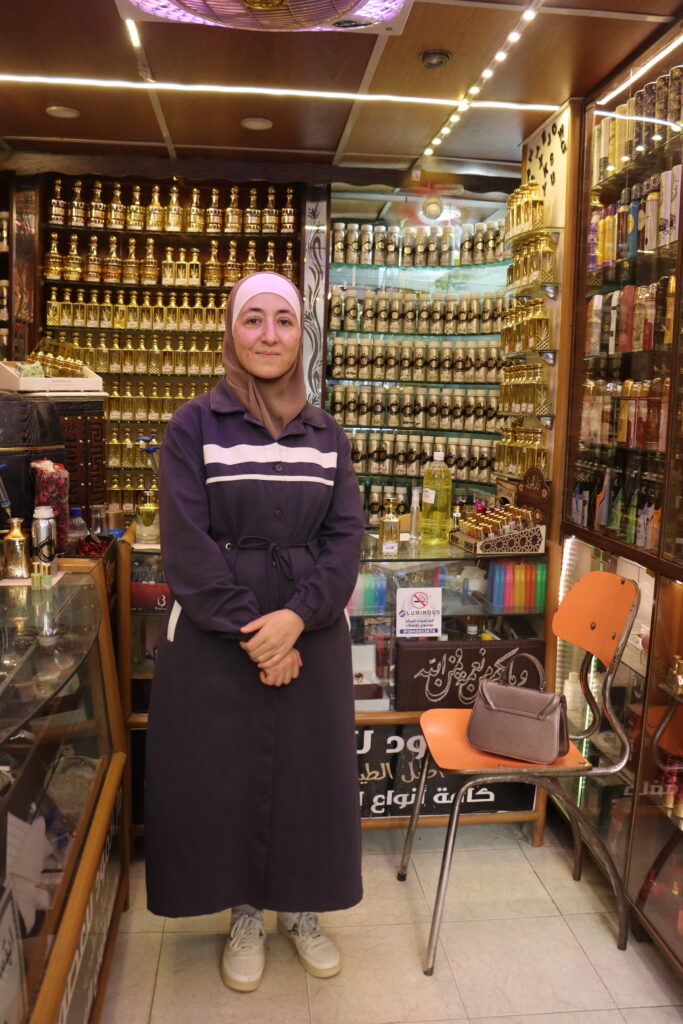
During the war, inspired by her family’s struggles caring for her younger brother with Down syndrome, Hiba began working with children with special needs—a profession she continues to this day, despite her own personal battles.
“People were disconnected from the world,” she says, pointing to what once was her house—a collapsed building lying under the weight of repeated barrel bombs and artillery strikes. “Our country is destroyed, but we mustn’t forget what happened to us. Our children must remember everything—so it doesn’t happen again.”
Both Zabadani and the Eastern Ghouta regions stand as stark evidence of how siege warfare and chemical weapons became tools of collective punishment—obliterating not just lives, but the ecosystems and livelihoods that sustained millions of ordinary civilians, including mothers, who are now searching for hope amidst rubble.
Back in Zabadani, 35-year-old Lana—a mother of two toddler boys—walks the grounds of her grandfather’s house and what was once her safe haven as a child.. She is a psychologist who has recently returned to her flattened town after years of life as a refugee in Lebanon. Today, along with her husband, she’s back “home,” doing what she once dreamed of doing for her own people and community.
“This is my grandfather’s home. My daddy grew up here,” she says. “We used to play here as children.”
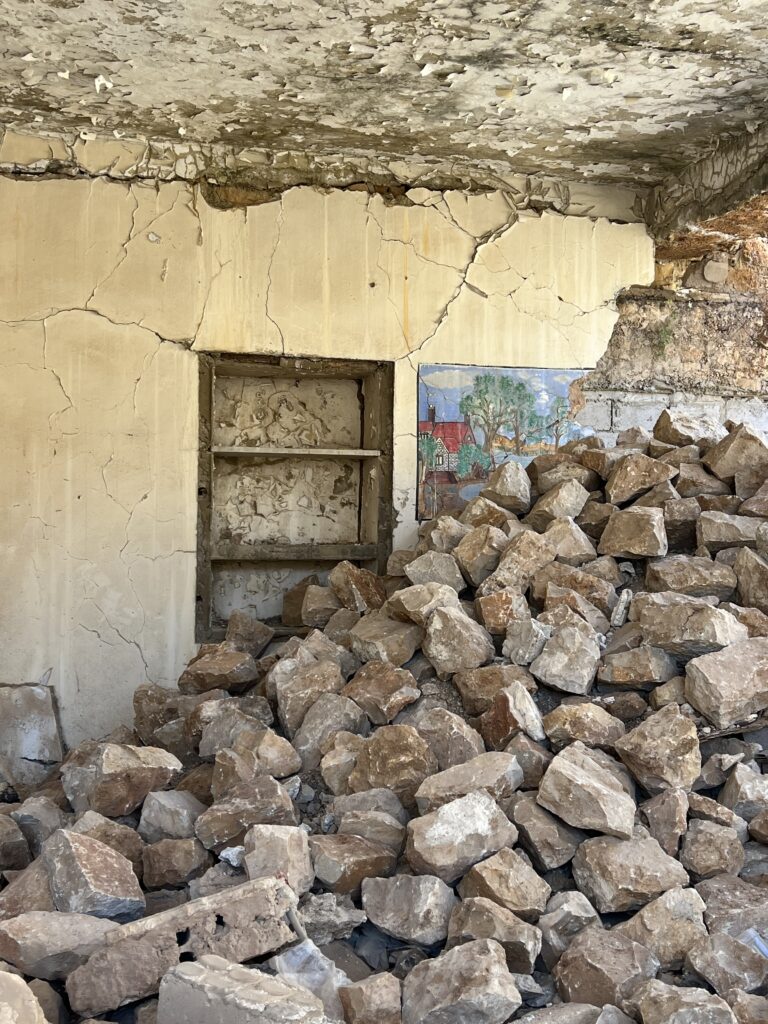
The building’s walls are pocked with shrapnel holes and its ceilings blown down into rubble, but as we climb up and walk into the remnants of the house, she suddenly turns around, tearing up. On a half-collapsed wall, a faint drawing survives—painted decades ago by Lana’s father as a child, and depicting a red house surrounded by trees and a bright blue lake—the last fragile trace of a family’s life before war.
“My daddy was an artist. I have to tell him this is still here.” She looks at the flowers growing from underneath a pile of stones and smiles: “See, even in the middle of this destruction, we still have flowers bloom. There is hope, Tara. We are here.”

Tara Kangarlou is an award-winning Iranian-American global affairs journalist who has produced, written, and reported for NBC-LA, CNN, CNN International, and Al Jazeera America. She is the author of The Heartbeat of Iran, an Adjunct Professor at Georgetown University, and founder of the NGO Art of Hope.

"A revolution has begun. There is no going back."
On the anniversary of the Beijing women’s conference, a blueprint for a brighter future
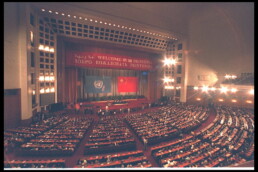
Thirty years ago this month, women from around the world gathered for a conference that made history and, as it turned out, would not happen again. The 1995 UN Fourth World Conference on Women in Beijing was a monumental moment for activists and world leaders who came together to “answer the call of billions of women who have lived, and of billions of women who will live,” as the first female Prime Minister of Norway, Gro Harlem Brundtland, put it at the time. It’s the meeting at which then-First Lady Hillary Rodham Clinton, building on years of women’s organizing, famously said, “Women’s rights are human rights,” which made global news because it was (and apparently remains) a radical perspective.
The journey to the conference—which is documented in a new multimedia project from the United Nations Foundation and co-produced by The Meteor—was two decades long, with previous meetings held in Mexico City, Copenhagen, and Nairobi. Beijing itself was the largest women’s rights gathering at that point in history, with a massive audience of 45,000 people invested in building a better future. Pulling it off was no small task, but the leaders charged with doing so were more than up to it. Among them was the inimitable Gertrude Mongella of Tanzania, the Secretary-General of the conference, who later became known as Mama Beijing. “A revolution has begun,” she said during a closing speech at the Conference, “there is no going back.”
Mongella was a key player in producing the Beijing conference’s most significant document: The Beijing Declaration and Platform for Action—which remains the most comprehensive blueprint for gender equality and women’s rights ever created. It wasn’t just a wish list; 189 countries committed to it in Beijing. It demanded women’s inclusion in government and policymaking; economic policies built with gender in mind; the understanding that violence against women is a human rights violation; and was also one of the first international agreements to demand that governments complete a thorough analysis of how climate change and industrialization had affected women. From the Platform: “The continuing environmental degradation that affects all human lives has often a more direct impact on women…Those most affected are rural and Indigenous women, whose livelihood and daily subsistence depends directly on sustainable ecosystems.”
You probably know how this ends: While some of the Platform’s key goals have been achieved—women’s representation in government, for instance, has risen—many have yet to be fulfilled, 30 years later, not because of an absence of activism, but because of global backlash and competing priorities. But the women at the forefront of global change remain motivated. When asked what the next global feminist conference should focus on, Nyasha Musandu of the Alliance for Feminist Movements put it this way: “We must dare to dream bigger, disrupt deeper, and build bridges across movements. The fight for justice is not just about breaking barriers—it’s about reimagining the world itself.”

Four years of the Taliban
  August 14, 2025 Hi Meteor readers, Popping in for the second time this week with a recommendation so fervent, I had to commandeer the newsletter to make it. Last night, I finally saw the Tony-nominated play John Proctor Is the Villain, and I’m still levitating. I cackled with laughter. I cried! The show is set in a high school in rural Georgia, and it unfurls as a class of students reads Arthur Miller’s The Crucible while the #MeToo movement swirls. There are meditations on trust and friendship, jokes about Glee, an epic interpretive dance, feminism club, and such biting, clever dialogue that of course Tina Fey has signed on to produce the movie adaptation. It’s pitch-perfect and brilliant, and here I was thinking 2018 was not a period of time I wanted to revisit at all. If you are anywhere near New York, you must, must, must see it before it closes on September 7. That concludes The Meteor’s Theater Corner. Meanwhile, a special edition of the newsletter below: Today we have a beautiful and moving reflection from Lima Halima-Khalil, Ph.D., who writes to us on the eve of the fourth anniversary of the U.S. withdrawal from Afghanistan, recalling the tumult and horror of that day and sharing her own perspective as a millennial, mom, and researcher in 2020. But first, the news. Stage whispering, Mattie Kahn  WHAT'S GOING ONTaylor Swift, Taylor Swift, and Taylor Swift, for starters. Also, Trump is headed to his much-heralded summit in Alaska, where he’ll meet with Russian President Vladimir Putin. (There will be no showgirls.) Back at home, historians are rightfully freaked out that the White House has expressed a desire to “review” exhibits at the Smithsonian’s museums and galleries, which is the kind of thing that isn’t supposed to happen in democracies. To be clear:  AND:
 “Life is Still An Open Wound”Four years after the Taliban seized her country, Lima Halima-Khalil, Ph.D., reflects on the losses, joys, and complexity of life for young Afghans.On August 15, 2021, time did not just stop; it dissolved. One moment, I was at my desk in Virginia, an Afghan researcher piecing together the life stories of Afghan youth for my doctoral research; the next, I was holding my breath between phone calls I could not miss. My computer screen became my only window to my country slipping away: convoys of cars carrying loved ones I could only follow on Google Maps, the low, frantic hum of evacuation messages on WhatsApp, and the heavy silence between each update. That day marked the beginning of the final withdrawal of American troops from Afghanistan, following a deal signed with the Taliban that effectively handed the country over to them. The elected president fled, and fear settled like smoke across the nation. Thousands rushed to the airport in blind panic, terrified of what the return of Taliban rule would mean. Many of the young people I had interviewed joined the crowds at the gates along with their families (and mine too), desperate for a flight to anywhere. Between August 15 and the final U.S. military departure on the night of August 30, over 200 people died at or near the airport: some trampled in stampedes, some shot, some who fell from planes, and 182 of them killed in a suicide bombing on August 26.  THE AUTHOR, LEFT, DEFENDING HER PH.D. ON AFGHAN YOUTH EARLIER THIS SUMMER. It is hard to explain how, in an instant, everything that anchors your life, your home, family, career, the freedoms you’ve built over a lifetime, can be stripped away. You are left with two choices: walk through the valley of death into a new world naked without any resources, or stay in darkness, losing every human freedom and shred of dignity under the Taliban barbarism. Every year on this day, I try to tell my story and the stories of hundreds of my countrymen and women. I have never quite managed to capture the full weight of what we lived through, or what we are still enduring. But I know who I am: I am Lima Halima-Khalil, and I know that if we do not tell these stories, we risk losing more than a country; we risk losing the truth of who we were and who we still are. Watching My Country DisappearThat day, as haunting footage of young men clinging to U.S. military planes, their bodies falling through the sky, was shown over and over on TV, my inbox was flooded in real time: “Lima, they’ve reached the city gates.” “My office is closed, they told us not to come.” “Can you help me get my sister out?” I typed until my fingers ached—evacuation forms, frantic emails, open tabs of flight lists—while my mind kept circling back to my sister Natasha. She was 24 when the Taliban killed her with an IED in 2020 on her way to work. Every young woman who called me that August day and over the last four years sounded like her: “Please, Lima, don’t leave me here. Save me.” Somewhere in that blur of urgency and grief, I knew I was watching my country disappear in real time. The words of one young woman—an accomplished artist—still echo: “I wasn’t mourning just a country. I was mourning the version of myself that could only exist in that Afghanistan.” In the months and years that followed, I carried my interviewees’ stories inside me. I felt the humiliation of the young woman who had to pretend to be the wife of a stranger just to cross a border. I felt the fear of the female journalist who hid in the bathroom each time the Taliban raided her office. I felt the silent cry of the father who arrived in a foreign land with his toddler son and wife and wandered the streets in winter, looking for shelter. I had nightmares over a young man’s account of seven months in a Taliban prison, tortured for the “crime” of encouraging villagers to send girls to school. Four years later, August 15 is still an open wound. Afghanistan is now the only country in the world where girls are banned from secondary school and university. Women are barred from most jobs, from traveling alone, from their own public spaces. Half the nation is imprisoned; the rest live under constant surveillance. Believing in ChangeHowever, the past four years have not been made up of grief alone. Even in exile, even under occupation, life has found a way in. I have witnessed many Afghan women earning their master’s degrees in exile. I have seen my young participants inside the country opening secret schools for Afghan girls in their homes and enrolling in online degree courses, while those in exile run online book clubs and classes for girls, refusing to let hope die. I have seen families reunited after being separated for four years. I see Afghan identity and tradition celebrated more than ever. In my own life, some moments reminded me why I still fight: celebrating the birth of my daughter, Hasti; dancing with friends after completing 140 hours of interviews for my PhD; standing on international stages to speak against gender apartheid, carrying my participants’ words across borders; watching my research shape conversations that challenge the erasure of my people. Like the two sides of yin and yang, these years have been both destructive and generative. One hopeless day, I called a participant still in Jalalabad. Halfway through, I asked, “What is giving you hope today?” She didn’t pause: “The belief in change. I don’t believe things will remain like this, where women are not allowed to live with full potential in our country. I will not stop my part, which is to keep studying and to believe that I will be the first female president of Afghanistan.” Hope resides in me, too. This year, on this painful anniversary, I ask the world: the war that began in 2001 was never Afghanistan’s war, and today, it is still not the burden of Afghan women and girls to carry alone. So please, don’t turn your face away. Do not accept the narrative that this is simply Afghan tradition, that women are meant to live like this. That lie has been fed to you for too long. The women and girls of Afghanistan are humans. Until we see them and treat them that way, this gender apartheid will not end.  Lima Halima-Khalil, Ph.D., is the program director of the “I Stand With You” campaign at ArtLords, a collective she co-founded, where she mobilizes global awareness against gender apartheid in Afghanistan. Her research explores youth resilience amid violence and displacement. Her writing has appeared in Foreign Policy, TRT World, and academic publications.  WEEKEND READING 📚
 FOLLOW THE METEOR     Thank you for reading The Meteor! Got this from a friend? |

They Were Told “Don’t Write, Don’t Post, Don’t Report”
For Iran’s fearless women journalists, every byline is a form of rebellion
By Tara Kangarlou
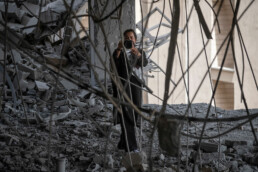
“To be a war correspondent is like a wounded dove flying through a pitch-black tunnel. It crashes into the walls over and over, but keeps going, for a chance to send the message, to save others,” says Arameh, a 40-year-old Iranian journalist. She and her two colleagues, Samira, 39, and Parvaneh, 27 (all have been given pseudonyms for their safety), are among the many brave Iranian journalists who remained on the ground in Tehran to report on the 12-day Israel-Iran war earlier this summer.
The women work for one of Iran’s prominent news sites, covering social, local, and political issues. Although the outlet is independently owned, it still falls under the heavy scrutiny of the Islamic regime’s watchful eyes. (Out of the utmost caution, we’ve withheld the name of the website.) “Despite slow internet and censorship, we wrote, posted, and published” throughout the war, recalls Arameh. “With images of blood and death flooding in, we kept reporting.”
Ultimately, Iran’s missile attacks on Israel killed 28 people and wounded more than 3,000, some of them civilians. Israeli airstrikes on Iran killed more than 1,190 people and injured 4,475, according to the human rights group HRANA. As in many conflicts, Western coverage of the war zeroed in on geopolitics: the Islamic Republic’s hardline rhetoric, the regime’s nuclear ambitions, and the fate of a theocracy teetering on the edge. Yet beneath those soundbites, a generation of fearless, tenacious young journalists—many of them women—tirelessly documented life under foreign bombardment and domestic censorship in the world’s third-largest jailer of journalists.
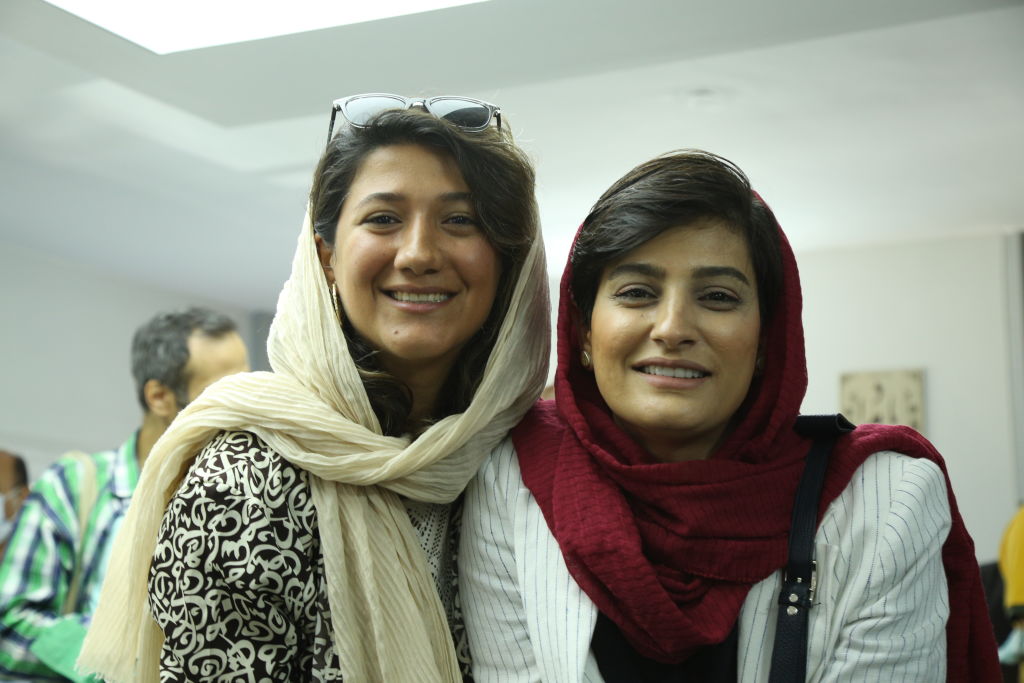
According to Reporters Without Borders (RSF), more than 860 journalists have been arrested, interrogated, or executed in Iran since the 1979 revolution, which brought the Islamic Republic to power. RSF also reports that since Mahsa Amini’s killing in September 2022, at least 79 journalists, including 31 women, have been detained—with some still behind bars. The International Federation of Journalists and Iran’s own Union of Journalists report even higher figures, estimating that over 100 journalists have been detained during this period, most in Tehran’s notorious Evin Prison. Among those held were 38-year-old Elaheh Mohammadi, her twin sister Elnaz, and Niloofar Hamedi, who first broke the news of Mahsa Amini’s killing for Shargh Daily in September 2022.
My connection to these women goes beyond our shared profession—I was born and raised in Iran and immersed in all the complexities of its everyday life; but today, as an American journalist with dual nationality, I can no longer return freely to my country of birth—simply because my profession is deemed threatening to the forces at home. I often have nightmares of being arrested in Iran or of never again seeing my childhood home; but what gives me hope is the strength of women like Arameh, Parvaneh, and Samira, who stayed. They do so knowing their government is always watching, listening, and ready to punish them for telling the truth.
These women were not just covering a war; they were surviving it.
On the war’s second night, 27-year-old Parvaneh tried sleeping in the newsroom as her home was in an evacuation zone. It was just her and the office janitor, whose pregnant wife and daughter had already left the city after their neighborhood was hit. That night, Parveneh recalled, “the sirens were so loud that neither one of us could sleep, so I stayed up all night and covered the strikes.”
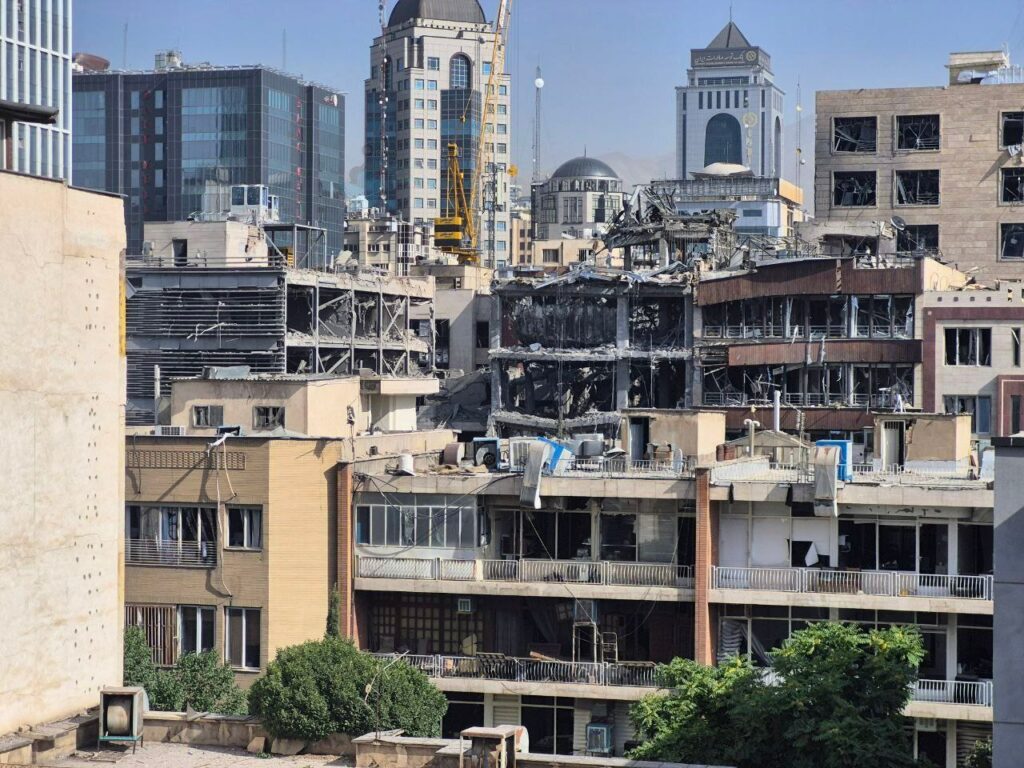
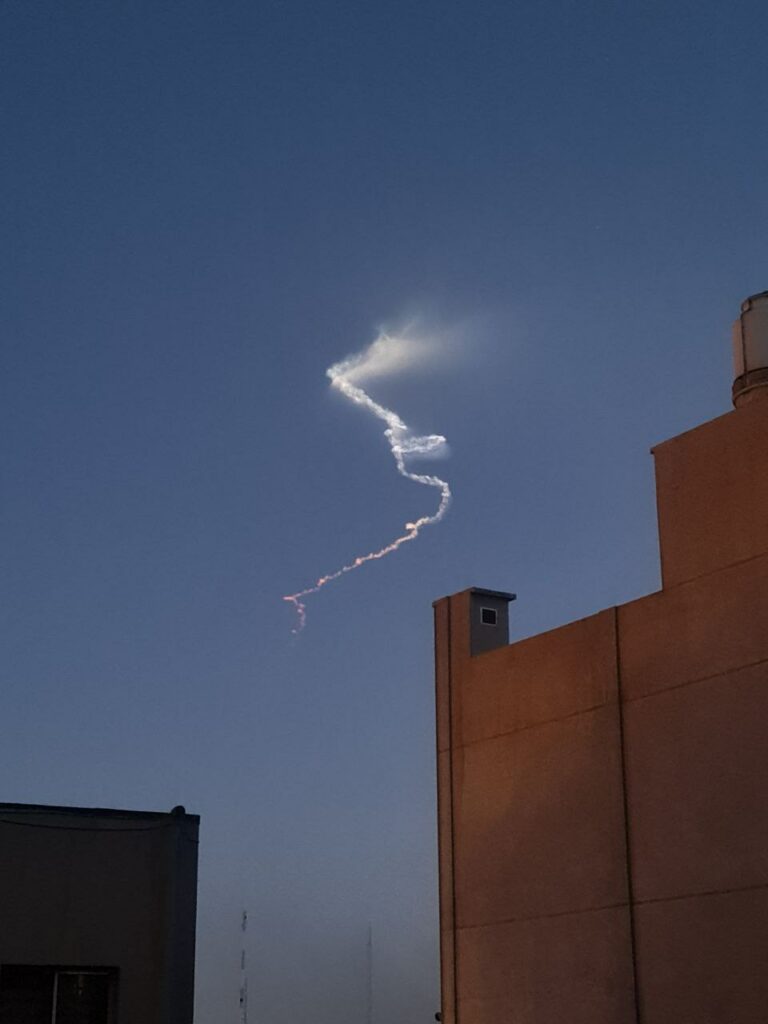
On day three, Arameh convinced her aging parents, brother, sister, and five-year-old niece to leave Tehran without her. “With each strike, I’d tell my niece it was a celebration or fireworks,” she recalls, heartbroken that the little girl believed her each time.
Similar to many other journalists and photographers in the country, Arameh and her colleagues received anonymous calls from intelligence agents and government officials warning, “Don’t write. Don’t post. Don’t report.” But as always, they did. Samira reassured her mother, whose brother was killed in the Iran/Iraq war in the 1980s, that she would not leave Tehran. “I’m a journalist,” she explains. “If I’m not here in these days, it would be like a soldier abandoning the battlefield.”
“We adapted; we always do,” Arameh says. “We stopped giving exact locations or numbers. Instead, we reported where sirens were heard. We told people how to protect their children. In times of war, a journalist must also be a source of empathy.”
For journalists in Iran, adaptability is a necessary skill as they navigate censorship, surveillance, and threats from a regime that has long waged war on its own press. These women documented both the human devastation of the war—including the Tajrish Square bombing that left 50 dead—but also the ongoing intimidation from the state toward members of the press. That intimidation extends to those who defend journalists as well. Human rights lawyers such as Nasrin Sotoudeh, Taher Naghavi, and Mohammad Najafi have been imprisoned for the “crime” of representing journalists and activists.
“My beautiful Tehran felt like a woman who had been brutally violated; battered, broken, bleeding,” says Samira, recalling the last night of the war. “It was the worst bombardment; something inside us died, even as the ceasefire began.”
On June 23, just one day before the ceasefire that would end the war, Israeli airstrikes hit Evin, killing at least 71 people—among them civilians, a five-year-old child, and political prisoners, including journalists. Nearly 100 transgender inmates are presumed dead—all people who should never have been there from the start.
The world often celebrates Iranian women in hashtags and headlines, but falls silent when it comes to tangible support. Heads of state, renowned public figures, and human rights organizations call for freedom and justice, but political inaction persists.
“If such strikes happened elsewhere—especially Europe or the U.S.—the world would’ve cried out,” Arameh says. “But in Iran, the Iranian people are always defenseless. People around the world talk about loving Iranians, but…we are once again left alone in our pain.”
Iranian journalists are not asking to be saved. They are asking to be heard, to be respected as the only eyes and ears of millions whose voices have been stolen by a regime that does not represent them. More than anything, these independent journalists, who are not funded by the regime and continue to report under severe censorship and surveillance, are emblematic of a deeper reality: that Iranians—especially women, and especially young people—stand firm in their pursuit of truth, change, and growth, no matter the cost.
Tara Kangarlou is an award-winning Iranian-American global affairs journalist who has produced, written and reported for NBC-LA, CNN, CNN International, and Al Jazeera America. She is the author of The Heartbeat of Iran, an Adjunct Professor at Georgetown University and founder of the NGO Art of Hope.
A Global Backlash Against Women
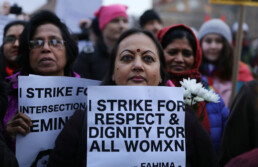
  March 6, 2025 Hello, sweet Meteor readers, I live in the tundra, a.k.a. upstate New York, and to us, 50-degree days like the one we’re having today pass as signs of spring. That, and when my kid starts to come home from preschool covered in mud. It’s happening, y’all. Bring on the dirt.  Today, on the occasion of International Women’s Day, we take the temperature of women’s rights around the world. Plus, some good news for abortion, gender-affirming care…and your brain. Thawing out, Nona Willis Aronowitz  WHAT'S GOING ONA global backlash: International Women’s Day, celebrated every year on March 8, is always a good excuse to take stock of how women and girls are doing around the world. Two new reports confirm that there’s data behind what we can clearly see: There’s been a palpable backslide. A new poll conducted by Gallup in 144 countries asked participants, “Do you believe women in this country are treated with respect and dignity, or not?” and found that in 93 countries, women are much less likely than men to say yes. Echoing this data, a new report from UN Women has found that, precipitated by factors like COVID and political polarization, one in four nations reported that backlash impeded progress on women’s rights in 2024.  INTERNATIONAL WOMEN'S DAY RALLY IN NEW YORK CITY, 2018 (VIA GETTY IMAGES) Looking closer at Gallup’s results for the United States in particular, tells us a lot about how gender dynamics have changed here in the last decade or so. In 2012, a full three-quarters of women and 80% of men agreed that women in this country are treated with dignity and respect. Now, those numbers have plunged to 49% and 67%, respectively. That not only points to a huge gender gap in how respondents think women are treated (implying, perhaps, that men are not paying attention?) but a sharp decline overall. In fact, these percentages are the lowest in the United States since Gallup started these polls 20 years ago. So: Are they a bleak reflection of ways life has actually gotten worse for women since the fall of Roe v. Wade, the rise of far-right misogyny, and more? Or do they also show the rise in awareness of sexism and misogyny (a good thing)? For many women and some men, wake-up calls—like #MeToo and Trump’s two wins over two women—may have smashed any illusions of gender equality. Sexual harassment in the workplace was just as bad in 2012, for instance, but maybe now we’re more likely to notice it. Still, the data does make clear that when respondents say women are more likely to live without respect and dignity, they’re often right. The UN Women report found that in the last few years, discrimination against women and girls has risen, legal protections have lessened, the number of women and girls living in conflict has spiked by 50 percent, and funding for programs that support women has withered. If you’re looking for signs of progress, there are some: The report found some improvements over the last 30 years, like greater parity in education, one-third fewer maternal deaths, higher representation of women in parliaments, and more than 1,500 legal reforms striking down discrimination in 189 countries and territories. In a sliver of good domestic news, Pew Research Center also found in a recent survey that the pay gap has narrowed slightly in the United States. So the news isn’t all bad—but it’s a clear indication that progress isn’t linear and that we have a long way to go. The Gallup poll’s gender gap is most pronounced in young people; only 41% of young women think they’re treated with dignity and respect, as opposed to 63% of young men. This is depressing on one level but heartening on another: At least young women’s eyes are wide open to the work they still have to do. It’s an open question when and whether their male peers will get on board. AND:
 REPRESENTATIVE AL GREEN DOING WHAT MANY OF US WISH WE COULD DO: YELL AT DONALD TRUMP. (VIA GETTY IMAGES)
  WEEKEND READING 📚On hypocrisy: A pediatrician who left her seven-year-old daughter behind in the States to care for war-wounded children in Gaza confronts the monstrous lopsidedness of Western media covering the conflict. (LitHub) On loss: A mother writes a eulogy for her beloved Altadena house, which burned in the L.A. fires—and for a world in which the consequences of climate change seem remote (Romper) On reparations: Mina Watanabe explains the history of “comfort women”—a euphemism for women who were sex slaves for Japanese troops in the ‘30s and ‘40s—and what justice would mean for them. (New York Times)  FOLLOW THE METEOR     Thank you for reading The Meteor! Got this from a friend? |

Three Years of Taliban Rule
  August 15, 2024 Howdy, Meteor readers, We’re going on a road trip and we’d love it if y'all joined us—specifically, in Chicago at the Democratic National Convention next week! We’ll be hosting the Power Lounge at McCormick Place, in partnership with Emerge—an organization that trains women to run for office— on August 21st-22nd. We’ll be hosting conversations with trailblazers like Rep. Jasmine Crockett, State Rep. Gloria Johnson (of the Tennessee Three), Brittany Packnett Cunningham, Connie Britton and lots more. You can register for this event by clicking the image below. See you in Chicago!  But before we hit the road, let’s hit this newsletter. Today marked the three-year anniversary of the Taliban’s return to power in Afghanistan. We spoke with Sahar Halaimzai, the director for the Afghanistan Initiative at the Malala Fund, about what life has been like for Afghan women ever since. Plus, your weekend reading list. DNCya later, Shannon Melero  WHAT'S GOING ON
 Three Questions About...Gender ApartheidOn the anniversary of the Taliban’s return to power, an advocate explains what life has been like for women in Afghanistan OLYMPIC RUNNER KIMIA YOUSOFI OF TEAM AFGHANISTAN HOLDS A SIGN THAT READS, "EDUCATION" AND "OUR RIGHTS" AFTER RUNNING THE WOMEN'S 100 METER. POLITICAL AND PROTEST SIGNAGE WAS BANNED DURING THE 2024 OLYMPICS IN PARIS. (VIA GETTY IMAGES) Three years ago today, Taliban forces seized Kabul and restored an oppressive theocratic regime to power. You probably remember the images: people attempting to flee, clinging to airplanes, parents handing babies over fences to strangers. And yet, as quickly as those images came across our screens, they vanished. Over the last three years, women in Afghanistan have lost their ability to work, and girls have been barred from higher education, but in the West, their plight has largely been pushed from the front pages. The Malala Fund, founded by Nobel laureate Malala Yousafzi and her father, Ziauddin, is working to change that. We asked the Fund’s Afghanistan director, Sahar Halaimzai, three questions. What has been the most significant change in the everyday lives of Afghan women since 2021? Women and girls have experienced a total rollback of their basic rights. The Taliban have banned girls from attending school beyond the sixth grade and women from most forms of employment. There are also severe restrictions on women’s freedom of movement and access to public spaces. They cannot enjoy a stroll in a park or go to the salon to get a haircut. This oppression is systemic, institutionalized, and a core part of the Taliban’s governance model; it’s a system of gender apartheid. But as of now, the international community does not legally recognize gender apartheid as a crime despite support from Afghan activists and many global experts, including prominent feminists and legal scholars. Daily life is fraught with danger. [But] there are many brave women and girls who continue to protest, run or attend underground schools, and organize advocacy efforts to fight for their rights. If caught, these women have been subjected to violence and harassment, arbitrary detention, torture, and enforced disappearances. The Taliban have also targeted their families, using coercion and violence to suppress any form of resistance. Despite these risks, Afghan women remain resilient. Has the lack of Western media focus on the plight of Afghan women impacted the movement? Absolutely. Without sustained media attention, it is difficult to maintain the pressure needed to hold the Taliban accountable or support Afghan women and girls. Instead, what we are seeing is a creeping normalization of the Taliban’s atrocities, making it easier to sideline women’s and girls’ rights in favor of other interests. If we could get more media outlets to cover what’s happening in Afghanistan as gender apartheid, it could reignite global solidarity for Afghan women and pressure leaders to take action. What needs to happen to protect the rights of women and girls in Afghanistan—and is there anything the average person can do to help? The international community must recognize gender apartheid as a crime under international law. This recognition would open legal avenues to hold the Taliban accountable for their atrocities. There's a real opportunity to do this: the United Nations General Assembly's Sixth Committee is currently debating the draft language of the Crimes against Humanity treaty. In October 2024, the Committee will resume discussions and vote on whether to advance the treaty to the next stage—a pivotal moment that could solidify international legal frameworks to address and prevent such egregious human rights violations. Everyone can contribute to this push by supporting organizations like [ours] that advocate for Afghan women’s rights, amplifying their stories, and by pressuring their governments to take decisive action during this critical period, first by naming what is happening in Afghanistan as gender apartheid. The situation in Afghanistan is not just a localized issue but a global human rights crisis. The Taliban’s gender apartheid…sets a dangerous precedent. If our elected representatives are happy to engage with a governance system that, at its core, is about enforcing gender apartheid, it signals that women’s rights are negotiable and can be easily sacrificed.  WEEKEND READING 📚On boy things: Are big loud podcast voices like Joe Rogan moving more young men to the right? (The Guardian) On lingering questions: Who is this woman and how did she make it to the Olympics? (The Root) On health: Routine pap smears have been unpleasant and uncomfortable since the dawn of time, but a less intrusive new alternative is right on the horizon. (New York Times)  FOLLOW THE METEOR  Thank you for reading The Meteor! Got this from a friend? Subscribe using their share code or sign up for your own copy, sent Tuesdays and Thursdays. |


The deadly act of telling the truth
|
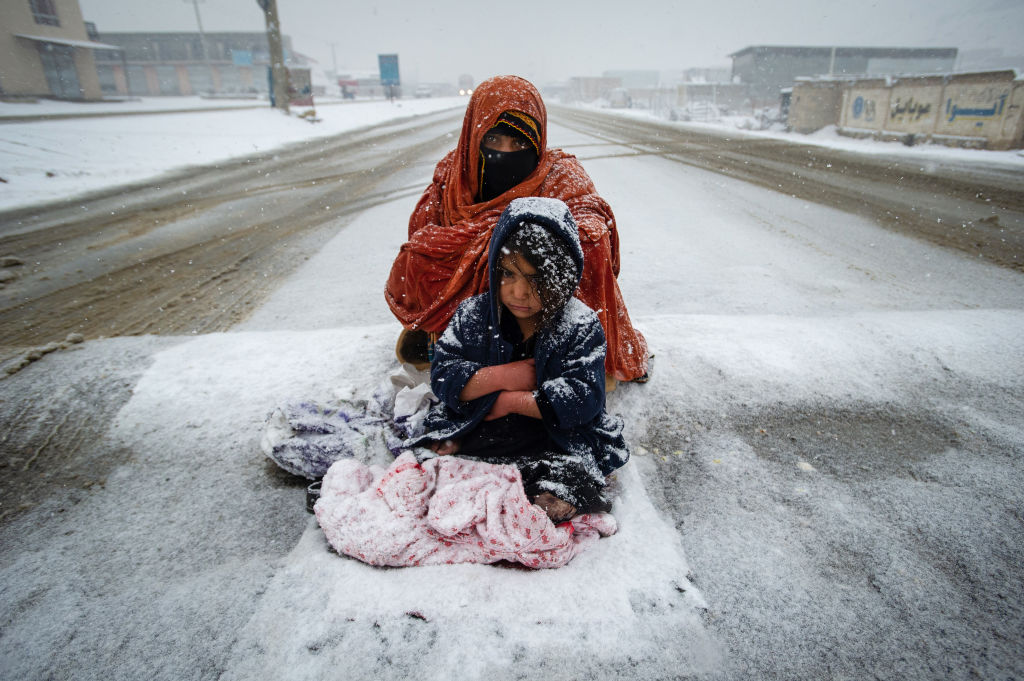
No images? Click here  February 11, 2022 This week, it was reported that the Taliban is currently detaining at least nine foreigners in Afghanistan, including two UK journalists who were in Kabul to report for the UN. But we’ve long known about the Taliban’s hostilities toward journalists, especially women journalists—and of course toward women in general. That’s why today’s newsletter feels so urgent. First, Mariane Pearl sits down with the incredible Afghan women behind Rukhshana Media, a news organization that reports on women in Afghanistan and the Taliban government from the ground, at great personal risk. After that, Shannon Melero writes about France’s shameful new ban on hijab in sport and her own experiences as a hijabi athlete. In a week of headlines questioning whether foreign policy can truly be feminist, this edition will convince you that it’s more important than ever. As ever, if you’ve got thoughts—on what you’re reading, or what you’d like to read—we’re all ears: [email protected]. —Julianne Escobedo Shepherd  THE COST OF AN UNTOLD STORYSix Months of the TalibanWhat life is like for women in Afghanistan now—from two journalists fighting to get their stories out BY MARIANE PEARL  A WOMAN AND HER CHILD ON THE ROAD IN KABUL, JANUARY 2022. (PHOTO BY SCOTT PETERSON VIA GETTY IMAGES) Six months ago next Tuesday, Kabul fell to the Taliban, plunging Afghanistan’s citizens, but especially girls and women, into panic and despair. Rukhshana Media is one of the very few woman-run media outlets in the country; its two founders, Zahra Joya and Zahra Nader, now live in exile, working 18 hours a day to ensure coverage of the systematic oppression of women at the hands of the Taliban. I spoke with these extraordinary journalists in late January over Zoom. MP: Rukhshana Media, the news agency you created, is named after a victim of Taliban oppression. Can you tell us about her, and why you started the agency? Zahra Joya: For nine years, prior to creating Rukhshana, I sat in newsrooms, most often the only female to be seen, and saw how much women and girls’ lives were ignored by the media. We had no space, no opportunities to show our worth. Men genuinely believed we couldn’t do the job. So, I founded Rukhshana in 2020 with my own savings to tell our stories, drive change and foster a national dialogue about and with all women in Afghanistan, regardless of ethnicity or religious beliefs. Rukhshana herself was a 19-year-old girl from central Afghanistan who, in 2015, tried to flee an arranged marriage to be with the boy she loved. The Taliban accused her of adultery, dug a hole in the ground, leaving her upper body out, and stoned her to death. I chose her name so that each time we pronounce it we honor her—and fight against the risk of oblivion. Zahra Nader: My biggest fear is that young women who are taught history in the future will say, “I can’t believe there were once female journalists in our country.” There are only 100 female journalists left in Afghanistan (out of 700 before last August). You have reporters working inside Afghanistan and rely on volunteers. Can you explain how people bring stories to you? And are they in danger? ZN: They are not quite volunteers because we insist on paying our collaborators. Women have lost their jobs [since the Taliban took over], so this is also a way of encouraging them to join us and speak out. Some of the women now working with us are not journalists; they were students or teachers, so we train them on the job. ZJ: Right now, we have four female journalists and two men inside Afghanistan. We are looking for someone to cover the Eastern region, but the situation there is beyond control. Despite the danger, our reporters are doing remarkable work. In February alone, they wrote about two abducted women’s rights activists, the ban on women’s voices and music, and how former security forces fear being hunted down when applying for passports, among other critical reporting. We are constantly tracking our collaborators, making sure they are okay, but we don’t want them to take risks. Journalists themselves need to decide. No story is worth a human life, but the cost of an untold story is also very high. ZN: If we need to contact Taliban officials for comment, we do it exclusively from abroad. One time, I made such a call, and the next day, two women contacted me, pretending they needed help; these calls came from the Taliban trying to measure my vulnerabilities.
Afghanistan has one of the youngest populations on earth, with 63% of its people under the age of 25, meaning most Afghans don’t remember what life was like under the Taliban, which held power over roughly three-quarters of the country from 1996 to 2001. Do you have any memories of life under Taliban rule? ZJ: I was nine when the Taliban left. In order to go to school, I had been dressing up as a boy and called myself Mohammad. The ’90s were particularly harrowing for women. Now at least we have platforms, social media, and networks. They didn’t have any of that then. My mother told me there was no bread on the table. They didn’t even know that there were doctors and clinics that could save their lives. ZN: When the Taliban came the first time around, I moved to Iran, where I wasn’t allowed to go to school [because I was a refugee]. The concept of home became a very big deal. The day my parents told me we were going back was the best of my life. I went to school and held my head high. To me, school meant change—the Taliban were in history books, a mere nightmare from the past. We were a generation that was going to change this country for the best. Where were you last August, when the Taliban took Kabul? ZJ: That first day, I went to the office as usual, but my colleagues told me to leave immediately, so I went back home. The only thing I was able to grab was my diary. I was evacuated to London three days after the takeover. I lost everything. ZN: I was working on a story about women’s reactions to the Taliban. Suddenly on television, I saw one entering the presidential palace in Kabul. I knew they were coming, but that image brought it home. I didn’t think it would happen so fast. I sat there just crying. It wasn’t only the fall of a country I was witnessing; it was the death of the hopes of my generation. The Hazara community to which you both belong is being specifically persecuted by the Taliban. What do we know about Hazara women and what is happening to them? ZJ: We have always been discriminated against. Many Afghans believe that we don’t belong there as we are mostly Shia Muslims, and the majority [of Afghans are] from the Sunni sect of Islam. And if you are a Hazara woman, you are buried under several more layers of discrimination between your ethnicity and your gender. Yet, as journalists, we are very conscious about not letting labels and nationalism prevent us from representing all women.  RUKHSHANA CO-FOUNDER ZAHRA JOYA. (PHOTO COURTESY OF ZAHRA JOYA) The Taliban promised to respect women’s rights “according to Islam.” But “according to Islam” is a vague, and in this case threatening, formulation, as the interpretation of the Quran is complex and varies widely depending on the individual. ZN: In May 2021, I asked the Taliban to define what they considered women’s rights. Every Muslim country has its own interpretation of how women should live. Pakistan, Saudi Arabia, Iran—they are all different. The Taliban never answered the question or defined anything. But they are slowly pursuing their agenda and imposing a very narrow interpretation of Islam. The word “misogyny” lacks the power to represent their ideology towards women. One of the first Taliban decrees stated that “women are human beings.” They actually had to wonder about that. How at-risk are the women who were most visible during the last 20 years? Journalists, of course, but also women working in the armed forces, as lawyers or activists? ZN: Rukhshana is doing everything we can to answer that question. We hear about so many stories of women being killed but often we can’t run them because we can’t reach anybody to confirm the facts. When we can talk to the family, friends or relatives, we reach out to the Taliban and they simply deny responsibility: They say these women have died because of family feuds. How is it possible that so many public, visible women are suddenly all dying from family feuds? It’s so easy for Talibans to find and execute these targeted women. All the public data, fingerprints, census and personal information are in their hands now.
In January 2022, a delegation of Taliban was hosted in Oslo to speak with world representatives. Officially, the meeting was to address the economic crisis, but activists see that meeting as a first step towards legitimizing the Taliban government. What do you think? ZN: When we challenge the fact that the Taliban should not be invited to the world table, we are told that Afghanistan has too many problems. That we should resolve the economic crisis first, then we can talk about women. But how do you resolve starvation if half of the country is under house arrest? I was saddened by the lack of protests from the Norwegian people, who ultimately paid for the expenses of that meeting. How can the international community help Afghan women? ZJ: The best way is to put pressure on your governments, to tell the world that you disagree with what is happening. Ultimately, this is about all women and the way we can be treated when men are at their worst. Show what you stand for, challenge inertia. Another way is to support Afghan women who are now outside the country. You can help them help us.  PHOTO BY JUAN LEMUS Mariane Pearl is an award-winning journalist and writer who works in English, French, and Spanish. She is the author of the books A Mighty Heart and In Search of Hope.  WHAT ELSE IS GOING ON
AND:
—JES  HATERS GONNA HATEThe French government makes another move in its battle against hijab BY SHANNON MELERO  FRENCH WOMEN'S SOCCER TEAM, LES HIJABEUSES, PROTESTING THE HIJAB BAN AT JARDIN DU LUXEMBOURG (SCREEN GRAB VIA LE PARISIEN) “How are you going to do all of that with that,” a doctor once asked me during a visit. The that she was referring to was my hijab, and the all of that was a Spartan race I was participating in that fall. In my short life as a hijabi, it was the first time I had considered whether my choice would hinder my athletic pursuits. I shrugged and said, “I think they have sports hijabs online.” It seemed like a simple enough solution, and my appointment carried on as usual, with my doctor telling me to bring my medal to our next visit. As I soon discovered, the intersection of hijab and activewear was a hotbed of debate—not just from consumers who found fault in nearly every product but from entire governments who sought to legislate against hijab in sport, all in the name of women’s liberation. It turned out that it wouldn’t be my hijab hindering me, but global ignorance, manifesting itself in an obsession with a small piece of fabric that some women choose to place or not place over their hair. That ignorance has steadily grown since my days of obstacle course racing. Just three weeks ago, the French government voted to ban hijab wearing in sports competitions to assert “neutrality” on the field. Technically, “all conspicuous religious symbols” like yarmulkes or turbans would fall under this ban, but given France’s history of hostility toward Muslims, the rule was clearly targeted. Just last year, the government limited the religious freedoms of over 5 million Muslim and immigrant citizens by placing strict regulations on homeschooling, the finances of religious organizations, and strengthening France’s “neutrality principle,” which “prohibits civil servants from wearing religious symbols like the Muslim hijab and voicing political views.”  THE AUTHOR, IN HER PRIME, TWO SECONDS BEFORE SHE FELL INTO A MUD PUDDLE. (IMAGE COURTESY OF SHANNON MELERO) This latest affront to hijab in sport is particularly unsettling considering the political climate of the Olympics. This year, an Uyghur athlete, Dinigeer Yilamujiang, lit the Olympic flame in Beijing, despite the Chinese government being accused of carrying out human rights violations against the Uyghur Muslim population, equivalent to “a campaign of genocide.” The 2024 Summer Olympics, to be held in Paris, will have its own issues, as sporting authorities decide how the country’s ban will affect international competitors. But even without an Olympics looming, the ban is symptomatic of the lingering mistrust of Islam in predominantly Judeo-Christian nations that believe themselves too superior to fall into the trap of theocracy. It’s all infuriating. The choice to do anything in hijab–go to work, play a sport, draw breath–opens the wearer up to an endless stream of vitriol. Hardened athletes like English boxer Safiyyah Syeed and Olympic bronze medalist Ibtihaj Muhammad manage to soldier on with fearlessness and hijabs that don’t slip. (How!?) But when I think of these laws, I think of the millions of women who will have to consider leaving their club or school teams—women who just want to play the game. I never bought that sport hijab. Partly for personal reasons pertaining to where I was with my faith at the time and because I was experiencing some hearing loss. The sport hijabs available at the time would have covered my ears, making it harder to be aware of any fellow racers trying to pass me on uneven terrain. I finished that Spartan race in what my friends jokingly called hijab-lite–everything covered but my hair. By the end of it, I felt like I had climbed a mountain (I had) and didn’t give a second thought to what wasn’t on my head. As for the hijabis I met up with later in the week, they didn’t care either; they wanted to see the medal.  A previous version of this newsletter stated the Taliban held power in Afghanistan from 1986-2001. In fact, it was 1996-2001. We regret the error.
FOLLOW THE METEOR    Thank you for reading The Meteor! Got this from a friend? Sign up for your own copy, sent Wednesdays and Saturdays. |


Six months of the Taliban
Two Afghan journalists on what life is like for women there now, as told to Mariane Pearl
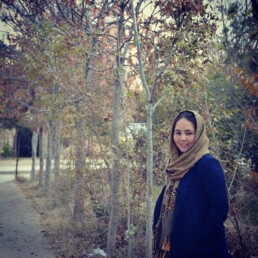
Six months ago next Tuesday, Kabul fell to the Taliban, plunging Afghanistan’s citizens, but especially girls and women, into panic and despair. Rukhshana Media is one of the very few woman-run media outlets in the country; its two founders, Zahra Joya (shown above) and Zahra Nader, now live in exile, working 18 hours a day to ensure coverage of the systematic oppression of women at the hands of the Taliban. I spoke with these extraordinary journalists in late January over Zoom.
MP: Rukhshana Media, the news agency you created, is named after a victim of Taliban oppression. Can you tell us about her, and why you started the agency?
Zahra Joya: For nine years, prior to creating Rukhshana, I sat in newsrooms, most often the only female to be seen, and saw how much women and girls’ lives were ignored by the media. We had no space, no opportunities to show our worth. Men genuinely believed we couldn’t do the job. So, I founded Rukhshana in 2020 with my own savings to tell our stories, drive change and foster a national dialogue about and with all women in Afghanistan, regardless of ethnicity or religious beliefs. Rukhshana herself was a 19-year-old girl from central Afghanistan who, in 2015, tried to flee an arranged marriage to be with the boy she loved. The Taliban accused her of adultery, dug a hole in the ground, leaving her upper body out, and stoned her to death. I chose her name so that each time we pronounce it we honor her—and fight against the risk of oblivion.
Zahra Nader: My biggest fear is that young women who are taught history in the future will say, “I can’t believe there were once female journalists in our country.”
There are only 100 female journalists left in Afghanistan (out of 700 before last August). You have reporters working inside Afghanistan and rely on volunteers. Can you explain how people bring stories to you? And are they in danger?
ZN: They are not quite volunteers because we insist on paying our collaborators. Women have lost their jobs [since the Taliban took over], so this is also a way of encouraging them to join us and speak out. Some of the women now working with us are not journalists; they were students or teachers, so we train them on the job.
ZJ: Right now, we have four female journalists and two men inside Afghanistan. We are looking for someone to cover the Eastern region, but the situation there is beyond control. Despite the danger, our reporters are doing remarkable work. In February alone, they wrote about two abducted women’s rights activists, the ban on women’s voices and music, and how former security forces fear being hunted down when applying for passports, among other critical reporting. We are constantly tracking our collaborators, making sure they are okay, but we don’t want them to take risks. Journalists themselves need to decide. No story is worth a human life, but the cost of an untold story is also very high.
ZN: If we need to contact Taliban officials for comment, we do it exclusively from abroad. One time, I made such a call, and the next day, two women contacted me, pretending they needed help; these calls came from the Taliban trying to measure my vulnerabilities.
“No story is worth a human life, but the cost of an untold story is also very high.”
Afghanistan has one of the youngest populations on earth, with 63% of its people under the age of 25, meaning most Afghans don’t remember what life was like under the Taliban, which held power over roughly three-quarters of the country from 1986 to 2001. Do you have any memories of life under Taliban rule?
ZJ: I was nine when the Taliban left. In order to go to school, I had been dressing up as a boy and called myself Mohammad. The ’90s were particularly harrowing for women. Now at least we have platforms, social media, and networks. They didn’t have any of that then. My mother told me there was no bread on the table. They didn’t even know that there were doctors and clinics that could save their lives.
ZN: When the Taliban came the first time around, I moved to Iran, where I wasn’t allowed to go to school [because I was a refugee]. The concept of home became a very big deal. The day my parents told me we were going back was the best of my life. I went to school and held my head high. To me, school meant change—the Taliban were in history books, a mere nightmare from the past. We were a generation that was going to change this country for the best.
Where were you last August, when the Taliban took Kabul?
ZJ: That first day, I went to the office as usual, but my colleagues told me to leave immediately, so I went back home. The only thing I was able to grab was my diary. I was evacuated to London three days after the takeover. I lost everything.
ZN: I was working on a story about women’s reactions to the Taliban. Suddenly on television, I saw one entering the presidential palace in Kabul. I knew they were coming, but that image brought it home. I didn’t think it would happen so fast. I sat there just crying. It wasn’t only the fall of a country I was witnessing; it was the death of the hopes of my generation.
The Hazara community to which you both belong is being specifically persecuted by the Taliban. What do we know about Hazara women and what is happening to them?
ZJ: We have always been discriminated against. Many Afghans believe that we don’t belong there as we are mostly Shia Muslims, and the majority [of Afghans are] from the Sunni sect of Islam. And if you are a Hazara woman, you are buried under several more layers of discrimination between your ethnicity and your gender.
Yet, as journalists, we are very conscious about not letting labels and nationalism prevent us from representing all women.
The Taliban promised to respect women’s rights “according to Islam.” But “according to Islam” is a vague, and in this case threatening, formulation, as the interpretation of the Quran is complex and varies widely depending on the individual.
ZN: In May 2021, I asked the Taliban to define what they considered women’s rights. Every Muslim country has its own interpretation of how women should live. Pakistan, Saudi Arabia, Iran—they are all different. The Taliban never answered the question or defined anything. But they are slowly pursuing their agenda and imposing a very narrow interpretation of Islam.
The word “misogyny” lacks the power to represent their ideology towards women. One of the first Taliban decrees stated that “women are human beings.” They actually had to wonder about that.
How at-risk are the women who were most visible during the last 20 years? Journalists, of course, but also women working in the armed forces, as lawyers or activists?
ZN: Rukhshana is doing everything we can to answer that question. We hear about so many stories of women being killed but often we can’t run them because we can’t reach anybody to confirm the facts. When we can talk to the family, friends or relatives, we reach out to the Taliban and they simply deny responsibility: They say these women have died because of family feuds. How is it possible that so many public, visible women are suddenly all dying from family feuds? It’s so easy for Talibans to find and execute these targeted women. All the public data, fingerprints, census and personal information are in their hands now.
“The word 'misogyny' lacks the power to represent [the Taliban's] ideology towards women.”
In January 2022, a delegation of Taliban was hosted in Oslo to speak with world representatives. Officially, the meeting was to address the economic crisis, but activists see that meeting as a first step towards legitimizing the Taliban government. What do you think?
ZN: When we challenge the fact that the Taliban should not be invited to the world table, we are told that Afghanistan has too many problems. That we should resolve the economic crisis first, then we can talk about women. But how do you resolve starvation if half of the country is under house arrest? I was saddened by the lack of protests from the Norwegian people, who ultimately paid for the expenses of that meeting.
How can the international community help Afghan women?
ZJ: The best way is to put pressure on your governments, to tell the world that you disagree with what is happening. Ultimately, this is about all women and the way we can be treated when men are at their worst. Show what you stand for, challenge inertia. Another way is to support Afghan women who are now outside the country. You can help them help us.
Read Rukhshana Media here, and follow them on Twitter here.
Mariane Pearl is an award-winning journalist and writer who works in English, French, and Spanish. She is the author of the books A Mighty Heart and In Search of Hope.
