
In Peru, a High-Stakes Election for Women
BY LORENA PROCHAZKA
Women’s rights under attack. Hard-won gains rolled back. A political agenda moving steadily backward. Sounds familiar? As Donald Trump’s administration chips away at women’s freedoms in the United States, women inhabit a similar battlefield a few thousand miles to the south in Peru, where I am based as a journalist. Heading into the final stretch of a deeply polarizing presidential election, we find ourselves stuck between a rock and a hard place.
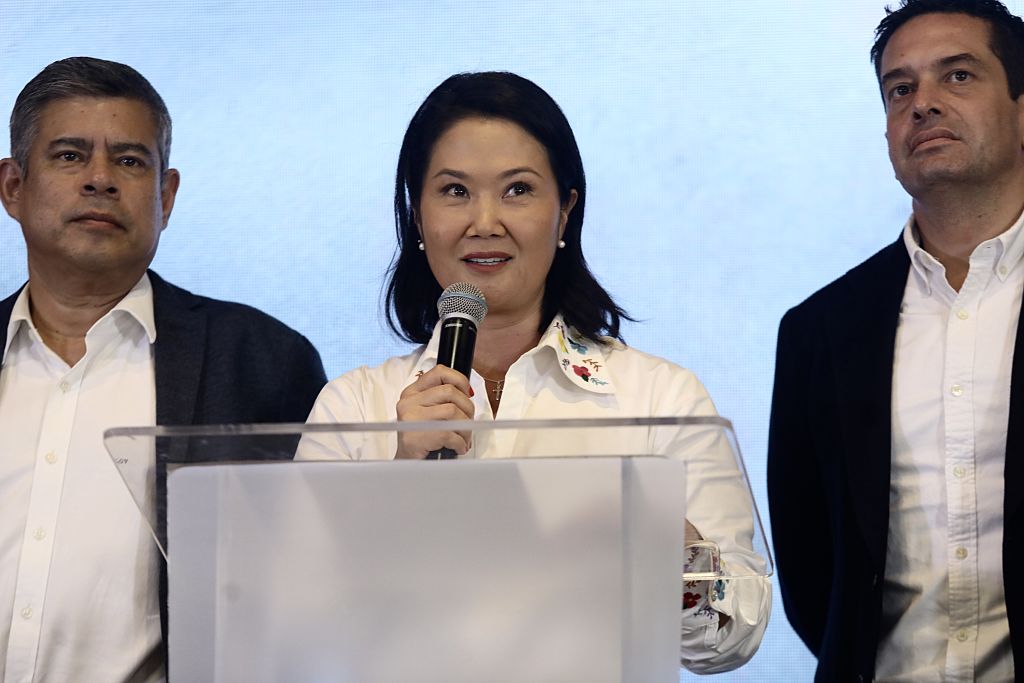
After a chaotic first round, the runoff has come down to an unexpected contender and an infamous veteran, respectively: leftist Roberto Sánchez and right-wing Keiko Fujimori. After initially trailing Sánchez, Fujimori—a woman—has clawed back to a lead of around 30,000 votes. Though the race remains open, with 99% of ballots counted, each update makes it more likely that Fujimori, who has run four times, will finally win.
At first glance, the candidates couldn’t seem more different: Fujimori’s Fuerza Popular (FP) carries a legacy of human rights violations linked to her father, president-turned-dictator Alberto Fujimori. Sánchez’s Juntos por el Perú (JP) promises to defend human rights while positioning the candidate as heir of socialist ex-president Pedro Castillo.
But here’s the rub: Neither party appears to have women’s interests at heart. Peru is following a global trend of setbacks in women’s rights amid rising conservative pressures, but in our case the trend pops up across the political spectrum. As former Minister for Women and Vulnerable Populations Marcela Huaita tells The Meteor, those advocating for human rights are “no longer pursuing a progressive agenda, but one of resistance.”
Peru is already at a point where reports of femicide have increased, and thousands of sexual abuse cases have gone unpunished. To make matters worse, current president José María Balcázar has defended child marriage and normalized sexual relationships between teachers and students.
Huaita sees “no ground for optimism.” We already know what FP stands for, she points out: It opposes same-sex marriage, abortion even in the case of rape, and comprehensive sex education, which FP charges will “homosexualize” children. FP has a natural ally in ultra-conservative Renovación Popular (RP). Together, they’re just one vote away from a Senate majority. And RP passed a law that eliminates “gender perspective”—a framework used to address gender inequality, gender-based violence, and sexual and gender diversity.
It’s not just a matter of rhetoric: This law removes the concept of gender from all legislation, obscuring how gender-based power dynamics drive violence and discrimination, Huaita explains. It limits access to comprehensive sexual education, health and reproductive rights; it means even more impunity for abusers and less support for survivors. It also sends an important institutional message: Women are not a priority.
The new administration will decide whether to preserve or dismantle the “gender perspective” framework. But it’s not as if a Sánchez presidency would have necessarily saved the project: Both Fujimori’s and leftist Castillo’s party supported the law eliminating it.
And Peru’s left has not always aligned with progressive positions on gender issues. For instance, Pedro Castillo opposed the gender-equality approach in education. Sánchez, who claims to be his political heir, has sent mixed signals on women’s rights. After criticism over the absence of gender-focused policies during his first campaign, he presented a revised government plan expanding on them. But just a day earlier, he had signed a commitment to an evangelical church emphasizing “family, life, and religious freedom.” His political friendships also raise some questions. Ricardo Belmont, president of the OBRAS party, which backed Sánchez ahead of the runoff, stated that “legalizing abortion will allow me to shoot anyone who accesses it.” Meanwhile, Antauro Humala, leader of a radical nationalist-socialist movement—once a close ally whom Sánchez has since distanced himself from—is openly homophobic.
Peru’s women had a bad candidate and a worse candidate to choose for president—and it looks like the worse candidate has won. But no matter what comes next, it’s clear they’ll have to wage a battle for women’s rights on their own terms, regardless of political party.

Lorena Prochazka is a journalist and documentary producer at Pacha Films. She specializes in documentary research, development and production of human-centered stories across Latin America.