

The Dangers Rise for Clinic Staffers
  May 21, 2026 Greetings, Meteor readers, I’ve been informed by my husband that everyone loves Landry Shamet right now (Knicks player, don’t worry if you’ve never heard of him). And I would just like to say that I was loving on Shamet in December!! I’m finally a trendsetter. Anyway, congratulations to the entire city of New York for how well we’re all doing in the playoffs. In today’s newsletter, violence against abortion providers is on a steady rise. Plus, farewell to Stephen Colbert and hello to E. Jean Carroll. Shamtastic, Shannon Melero  WHAT'S GOING ONAn emboldened wave of zealots: Imagine checking in several patients for their appointments at your job at an abortion clinic, only to have them begin throwing unknown liquids and powders throughout your facility—at which point you realize they are not patients at all, but undercover extremists. That’s what went down in July 2025 at the Women’s Center of Delaware County, Pennsylvania. Given that the incident “happened in the space [where staffers] spend countless hours providing compassionate care,” says Amanda Kifferly, Vice President for Abortion Access, “clinic staff felt uneasy and violated.” Kifferly’s recounting of this story, along with so many others, was gathered in a new report from the National Abortion Federation (NAF), which found that since Donald Trump’s return to the White House, violence against abortion providers and disruptions at clinics have increased across the country; instances of death threats, clinic theft, and stalking doubled over just the first year of Trump’s second term. And anti-abortionists aren’t satisfied with targeting providers; they’re also going after patients more often. Incidents of obstruction—anti-abortionists physically blocking a patient’s entrance to a clinic—have quadrupled. Tracii Wesley, the head of security at Feminist Center for Reproductive Liberation in Atlanta (and the star of the Oscar-nominated short “The Devil Is Busy”) told NAF that she sees protesters block patients’ path multiple times a week, sometimes shouting “explicitly racist” rhetoric to the clinic’s mostly Black and brown patients. (The white patients, she said, receive a less hostile “We’ll pray for you.”)  A YOUNG WOMAN, WHO TRIED TO POSE AS A CLINIC ESCORT, REMAINS STATIONED OUTSIDE OF A CLINIC READING THE BIBLE ALOUD FOR THOSE TRYING TO ENTER. (VIA GETTY IMAGES) Violence against providers is certainly not new, but it’s thriving under an administration that has stopped enforcing the 1994 Freedom to Access Clinic Entrances (FACE) Act, a law meant to criminalize obstruction, property damage, or threats of harm to employees of clinics and religious establishments. Rather than maintain the law, Trump claimed that the Biden administration had been overzealous in prosecuting anti-abortionists. Shortly after taking office, he pardoned known perpetrators, among them Lauren Handy (the infamous activist who stole aborted fetuses) and those same extremists who would go on to invade and vandalize the Women’s Center in Pennsylvania. NAF also notes that the newly aggressive administration brought with it “the fear of ICE raids and violence against immigrant communities, alongside a surge in hate speech and racist rhetoric”—all of which may deter patients from seeking reproductive healthcare, the report states. NAF’s numbers only cover reported instances, which means there are likely untold numbers of stories out there. As Abortion, Every Day writer Jessica Valenti points out, “We know why anti-abortion extremists are feeling so fearless.” They’ve got the president and the entire right-wing machine on their side. But providers and patients have us on their side. The Women’s Center, which has multiple locations, has a reproductive freedom ambassador program that allows volunteers to get active in supporting patients and centers. Planned Parenthood offers a patient escort program. And if neither of those are your jam, the Center for Reproductive Rights has a plethora of options on how to get involved at all levels. Anti-abortionists are working together to fulfill their mission; it’s on those of us who care to match that energy. AND:

 FOLLOW THE METEOR     Thank you for reading The Meteor! Got this from a friend? |



When your parents get detained by DHS
 May 19, 2026 Greetings, Meteor readers, You know how you think in your mind something is a great idea, and then the longer you ponder, the less great it sounds? Anyways, I signed up for a 36-mile group hike. It’s giving mid-life crisis, but at least I get to see some trees.  In today’s newsletter, we look at the staggering number of children who have been abandoned after their parents were detained by ICE. Plus, the woman who was forced to give birth in a New York courthouse. Training mode, Shannon Melero  WHAT'S GOING ONThe forgotten children: In February, ProPublica spoke to a group of children who had been detained in Dilley Immigration Processing Center in Texas. Those children, some as young as two years old, were detained with their parents. Many of them pleaded to be rescued. The response was sizable: Protests were held outside of Dilley with demands from locals, mom groups, and even Ms. Rachel to release the children from detention. Some have been released while others face an uphill legal battle. Because of the publicity surrounding Dilley, we know some of these children’s names. They are real to the public; their faces give the average person something to fight for. But what about the children we don’t see? The ones who are left at home, but without their caregivers? “We know surprisingly little about what happens to children of detainees,” a new report from the Brookings Institute states. Relying on “demographic characteristics of detainees matched with likely unauthorized immigrants in the American Community Survey,” the organization estimates that since the beginning of the second Trump administration, 205,000 children have been impacted by parental detention, meaning one or both parents living in the household with them have been detained. Roughly 145,000 of those children are U.S. citizens, and nearly a third are under the age of six. In the most extreme cases, 22,000 children who are citizens of this country have been left with no parents because both parents have been detained. (Brookings notes that these numbers are not exact due to limits on available data from the Department of Homeland Security, but says they are a very close estimate.)  PROTESTORS ON THEIR WAY TO THE SOUTH TEXAS FAMILY RESIDENTIAL CENTER IN JANUARY AFTER THE ATTEMPTED DEPORTATION OF LIAM CONEJO RAMOS AND HIS FAMILY. (VIA GETTY IMAGES) What’s more, little is being done—at least by the federal government—to help. “No government entity is responsible for [the children’s] well-being,” Brookings states. And there is “no systematic approach to protecting the children of those detained by ICE.” All in all, we’re talking about more than 200,000 children left without one or both of their parents. That’s equivalent to the entire population of cities like Little Rock, Arkansas or Grand Rapids, Michigan. It’s more than 60 times the population of the entire city of Dilley, Texas. Imagine an entire city, traumatized. That is how many kids we’re talking about. And the government, it seems, wants more. Brookings estimates that if the administration continues moving towards its goal of removing every unauthorized immigrant from the U.S., 2.5 million children will be affected. The report calls for, at the bare minimum, DHS to collect and report accurate data on these children. But what is needed more than that is an end to the unjust immigration policies that leave them parentless to begin with. The midterms are 24 weeks away. The people we vote in will control how much funding DHS gets. Every candidate should be asked about what they are doing about the tens of thousands of kids whom our government has abandoned, and about the 2.5 million more who are at risk. AND:
 AN ICONIC STOLE FOR AN ICONIC GRADUATE. (VIA GETTY IMAGES)
 FOLLOW THE METEOR Thank you for reading The Meteor! Got this from a friend? |


A world where only husbands vote
  May 14, 2026 Greetings, Meteor readers, We are excited to officially invite you all to a virtual book club discussion of Yesteryear, the book we quite literally cannot stop talking about. Your favorite newsletter pals will be in attendance, and we’d love it if you could join. Just hit the button below to sign up for our inaugural meeting. You’ll receive a link to join and a few discussion questions to noodle on ahead of our chat. It will be a lunch-and-laugh, so feel free to come with a snack or your favorite emotional support beverage (mine is a twice-reheated cup of coffee that I forgot I reheated). In today’s newsletter, we are exploring the wonderful world of submission. No, not that world, the other one. Plus, Erin Brockovich has a new mission, and your weekend reading list. See you at book club, Shannon Melero  WHAT'S GOING ONCreeping conservatism: An outlandish suggestion has been cropping up on the right-wing internet. One so silly, so out of pocket that you would think it hardly merits discussion…and yet! Apparently, there are women out there who believe, quite firmly, that women should not have the right to vote as individuals—a position euphemistically known as “household voting.” Far be it from me to yuck anyone’s yum, but when your yum is coming for my rights, I will yuck if you buck. This thought isn’t new amongst conservatives, but it is gaining enough ground that at next month’s Turning Point USA Women’s Leadership Summit, one of the invited speakers is an influencer named Savanna Faith Stone who doesn’t believe women should vote. As far as we know, the 19th Amendment is not in immediate danger (even if our own Secretary of Defense’s pastor is a fan of it and the SAVE Act is setting the stage). But we bring it up today because, in the age of algorithms rewarding extreme rhetoric, fringe ideas are increasingly becoming mainstream. Look at the president. Remember when that was just a national joke?  SAVANNA FAITH STONE (SCREENSHOT VIA TURNING POINT USA) Stone, like many of her ilk, believes “husband and wife are one flesh and therefore should make that political decision together.” One family, one vote…it’s an idea that was first proposed in the ‘80s, inspired by pronatalist movements in Europe. Now it’s getting an alluring rebrand courtesy of beautiful 20-year-old influencers yearning to give up their vote in exchange for a man who will make all the decisions, and the money. This current iteration of household voting relies on strict interpretations of Biblical passages establishing the man as the head of the household and the woman as a “helpmate.” Ephesians 5:22, for instance, reads, “Wives submit yourselves to your husbands as you do to the Lord.” This idea of complete submission lies at the heart of the “no votes for women” issue, and that idea isn’t as fringe as we might like it to be. In fact, people who say they prioritize submission in their relationships are everywhere, and they’re talking about their desire for submission loudly and proudly. If you’ve seen the most recent season of Love is Blind, then you’ve heard about submission from Christine and Vic. If you’ve watched more than two minutes of Pop the Balloon or Find Love on YouTube— a speed-dating show with more than 100 episodes and more than a million views per video—you’ve heard it from literally hundreds of contestants on that show, regardless of gender. The rise of Mormon influencers who are talking about their mixed feelings on submission while still submitting? We see so many of them because they’re literally paid by the church to sell a vision of the nuclear Christian family. Submission is in the air—not in the Fifty Shades of Grey way, more the “you and your votes are mine” way—and it’s being renormalized at an alarming rate.  Of course, the promotion of Christian submission gets less strict when applied to men. Conservatives who take Ephesians literally conveniently forget the line that comes right before the submission of women: “Submit to one another for the sake of Christ.” Details, details. At any rate: The worry shouldn’t just be that someone like Savanna Stone is going to Turning Point to talk about this. We should worry more about how easily the same idea has been sliding into television and social media as an aspirational way of living. Women and young girls consume more media than men. Our eyes need to be fully open to what we’re waving off as too small to succeed. You know what they say about mustard seeds. AND:
 SIRI, PLAY IT'S RAINING MEN. (VIA GETTY IMAGES)
 WHY WOULD ANYONE WANT TO LEAVE THESE DELIGHTFUL CHILD FANS? (VIA GETTY IMAGES)  WEEKEND READING 📚On the facts in front of us: Tracie Morrissey painstakingly lists the many details about the young boys that were part of Michael Jackson’s orbit. Seeing it all together is stomach-churning. (Flagged & Reported) On the “ambition penalty”: Apparently, nothing has changed since 1999: Single women are being shunned by potential dates for owning property. (The Guardian) On sisterly love: Lindsey Adler goes long on Amy Wallace, who fiercely protects her brother David Foster Wallace’s legacy and humanity. (The Small Bow)  FOLLOW THE METEOR     Thank you for reading The Meteor! Got this from a friend? |


The devil wears a prairie dress
 May 12, 2026 Greetings, Meteor readers, The WNBA’s 30th season tipped off this weekend with gigantic rings and an iconic performance from the one, the only, the incomparable Ellie the Elephant. You literally love to see it.  ELLIIIEEEEEE (VIA GETTY IMAGES) In today’s newsletter, we’re putting on our cutest boots to dig into the intersections of “The Devil Wears Prada 2” and book-of-the-moment Yesteryear. They’ve got more in common than you think! But first, the news. xoxo, Shannon Melero  WHAT'S GOING ON
 The Devil Wears a Prairie DressYesteryear and “The Devil Wears Prada 2” have the same moral: Let women’s ambition run wild.BY NONA WILLIS ARONOWITZ  ANNE HATHAWAY'S ANDY SACHS IN "THE DEVIL WEARS PRADA 2" AND MODERN DAY TRADWIFE HANNAH NEELEMAN, AKA BALLERINA FARM. (SCREENSHOTS VIA YOUTUBE AND INSTAGRAM)
Everyone is talking about Yesteryear, Caro Claire Burke’s bestselling novel about a deeply venal tradwife influencer who suddenly wakes up in the year 1855. The book (which will soon be a movie) hits many, many notes: Its time-travel element reminds us how little the 19th century deserves rose-colored glasses, but Yesteryear also seeks to expose modern ills like the empty grift of tradwife cosplay, the rise of the manosphere, and social-media brainrot. Maybe it’s because I immediately followed this book with a viewing of "The Devil Wears Prada 2," but to me, Yesteryear is above all a warning about what happens when women are not allowed to be openly ambitious. A little-discussed detail about the main character, Natalie, is that she breaks with her small-town Christian upbringing to attend Harvard on a free ride. She doesn’t mention specific intellectual ambitions, but we know Natalie is gifted and sharp from a young age. She was “practically running” her Sunday school class by the time she was 12. Never one to socialize, she was excited to go to a college “where intellect would matter much more than being likable.” Pretty soon, though, Natalie’s long braid and air of superiority render her an outcast, and we are treated to a succession of fish-out-of-water scenes that reminded me of Tom Wolfe’s anti-hookup-culture novel I Am Charlotte Simmons. Homesick and lonely, Natalie takes refuge in a church group whose members are comfortingly familiar, even if they’re “dumb as rocks.” It’s there where she meets her future husband, Caleb, a wealthy senator’s failson. She never gets her degree. Within a few short years, she’s a wife, mother, and owner of a vast Idaho farm that becomes the stage for her illusory world—and her family’s principal source of income. Without giving away too much, I’ll say that throughout Yesteryear, Natalie is not well. She is selling a life premised on domestic bliss, but she experiences very little genuine happiness throughout the book. She tamps down her anger by pretending she is being watched at all times. She smiles maniacally no matter what. She appears to suffer from severe postpartum depression and psychosis. She has zero respect for her increasingly red-pilled husband, whom she realizes is “an actual, honest-to-God idiot.” (“Please give my husband a spine,” she prays to the Lord at one point. “I’m tired of him needing to borrow mine.”)  (VIA PENGUIN RANDOM HOUSE) One of the only flashes of pleasure we see Natalie have is her rush of ecstasy when two nannies show up to almost fully take over her five children’s care. Eventually, she becomes physically unable to repress her innermost negative thoughts and instincts (which leads to an incident that jeopardizes her influencer career). Other than a desire for control and outward perfection, we don’t know what truly makes her tick—because she doesn’t know. In her 1983 book Right Wing Women, Andrea Dworkin describes how a woman’s intelligence, if left to wither, disfigures her. “Imprisoned, intelligence turns into self-haunting and dread,” she writes. Confining a smart woman into a domestic space for which she is ill-suited will only lead to misery, because intellect by its very nature cannot be perfect and pre-packaged. “Wild intelligence abhors any narrow world” because “intelligence is also ambitious: it always wants…more of a bigger world.” And yet, Dworkin notes, within the traps of a patriarchal society, a woman “cannot be ambitious in her own right without also being damned.” Natalie’s distress and eventual downfall in Yesteryear is a cautionary tale of what happens when a woman’s intellect is imprisoned, or in this case, channeled into the pursuit of creating an avatar of the ideal white Christian American family. Natalie becomes an influencer almost by accident, but her ruthless negotiations with Caleb’s father reveal her skill for playing hardball, her fearlessness in the face of power—leading us to wonder what would have happened if that unflinching quality had been applied elsewhere. Contrast this bleak portrait of an unfulfilled woman with the fizzy romp that is "The Devil Wears Prada 2," the number one movie in America right now. Watching “DWP2” on the heels of reading Yesteryear, it struck me how happy the lead women seem to be when they’re working hard, especially in comparison to the first movie. The first act treads familiar territory—Meryl Streep’s Miranda Priestley is cruel and vindictive as Runway’s editor-in-chief; Anne Hathaway’s Andy Sachs is put upon as her newly minted features editor. But the rest of the movie has a dynamic duo caper feel, allowing the two women’s wild ambition to thrive in a bigger world. Andy’s successes are unvarnished feel-good moments, and we spend absolutely no time mourning the hypothetical family she never built. Instead, we hate the brotastic heir, and later the callous billionaire tech mogul, who pose an existential threat to Runway and the media industry writ large. At one point, Miranda does acknowledge the domestic sacrifices she’s made, the many lost moments with her daughters, but leaves us with an affirmation: “Boy, I love working. I really do. Don’t you?” These lines are delivered with an authentic smile that makes a mockery of Natalie’s Instagram-ready grin in Yesteryear, a smile so relentless that, at one point, it remains frozen upon her face even when tears run down her cheeks. The moral of both stories seems to be: Let women’s ambition run free—free from the manosphere, free from insipid rich dudes, free from stifling expectations. The villains of "The Devil Wears Prada 2" are not powerful women, but unambitious men messing with the careers that powerful women painstakingly built. In the funhouse-mirror world of Yesteryear, the antagonists are men, yes, but also women enforcing the rules. Perhaps the runaway success of both projects shows us that work can make us happy—as long as we’re the ones making the rules. P.S. Our Yesteryear book club is meeting next week, and we’d love to have you! Reply to this email if you want in.  FOLLOW THE METEOR Thank you for reading The Meteor! Got this from a friend? |

The Women Who Exposed the "Rape Academy"
Three journalists tell the inside story of investigating a dark global network of men assaulting their partners
By Nona Willis Aronowitz
On March 26, CNN published a 16-minute documentary and interactive story about “a global rape academy,” a network of websites and Telegram chat where men trade tips on how to drug and sexually assault their wives and girlfriends. The story has since been viewed and read by millions, first across Europe and then in the U.S., where the story went viral a few weeks later. Behind the exposé were nearly 25 CNN journalists and staff who for seven months dug into this vast and tightknit community. The Meteor spoke with investigative reporters Saskya Vandoorne and Niamh Kennedy, and reporter and producer Kara Fox, about how this extraordinary investigation came together.
Saskya Vandoorne: It all started with Gisèle Pelicot. I'm the CNN Paris bureau chief here, and I was at the trial down in the south of France [in the fall of 2024] where 51 defendants were on trial for raping her. And I remember very vividly her lawyer speaking about Coco, the platform that Dominique Pelicot had used to recruit all these men to rape his sedated wife. The lawyer described Coco as the weapon of the crime. He said Pelicot had gone on there to find like-minded people. So even though Coco had been taken down, I was curious to find out: Are there any other spaces where men speak to one another about crimes they wanted to commit against their wives or partners?
Kara Fox: We had been reporting out the Dominique Pelicot case, and we knew that Coco users were talking about where to go next on a forum. As we knew that these spaces didn’t go away after the trial, we investigated some of them—other websites and a large Telegram group. One site in particular became the focus, also reported on through the amazing work of German journalists Isabel Beer and Isabel Ströh: Motherless.com. Throughout the course of our reporting we also reported on similar cases, like “the German Pelicot” or “the UK Pelicot.”
Niamh Kennedy: [In the “sleep” groups on] Motherless, there were over 20,000 videos, some showing unconscious women and their eyelids being lifted up to show that they've been sedated. There were more graphic videos as well, sometimes showing what appeared to be nonconsensual sex acts being carried out on these sedated women. It was from spending a lot of time on Motherless that I found a link to the private Telegram group [called “Zzz”]. It featured 1,000 men from all around the world who were giving each other tips on how to drug and rape their partners. It was quite tough, to be honest with you…I definitely felt chills a lot of the time seeing what was going on there. It was very hard.
An upside-down world
SV: There were many conversations that were had before we went undercover [to log onto the site and join the Telegram group to speak to participants]: What did we want to achieve? What could we say? Where was the line? We wanted to remain journalists, so our role was just to ask questions. At no point did we want to encourage any of this behavior; of course, we weren't going to share any pictures or videos of our fictitious wives. So it was very much, sit in this space, ask questions, find out what are they doing, how long have they been doing it for. And also, what was their motivation?
NK: Saskya and I made a shared fake profile, working late into the evening when a lot of the men were online. We spent a lot of time both on the site and in the private Telegram group. There were tiers: men who were selling content, men who were selling sleep liquids—very powerful drugs that could immobilize women. There were men that were offering livestreams. We're talking about hundreds of messages all day long, ping pong, ping pong. They would turn to each other for advice. One guy would write in and be like, "I'm thinking of drugging and raping my wife. Who's done this before?" And one guy would be like, "Yep, I've been doing this for three years. Use this drug." Others would be like, “What weight is she?” “Oh, I did this and I got away with it. " And then a couple of hours later, the man who'd asked the question would post a video and they'd be encouraging each other. It was like a whole brotherhood, where they were really bonding over this shared interest.
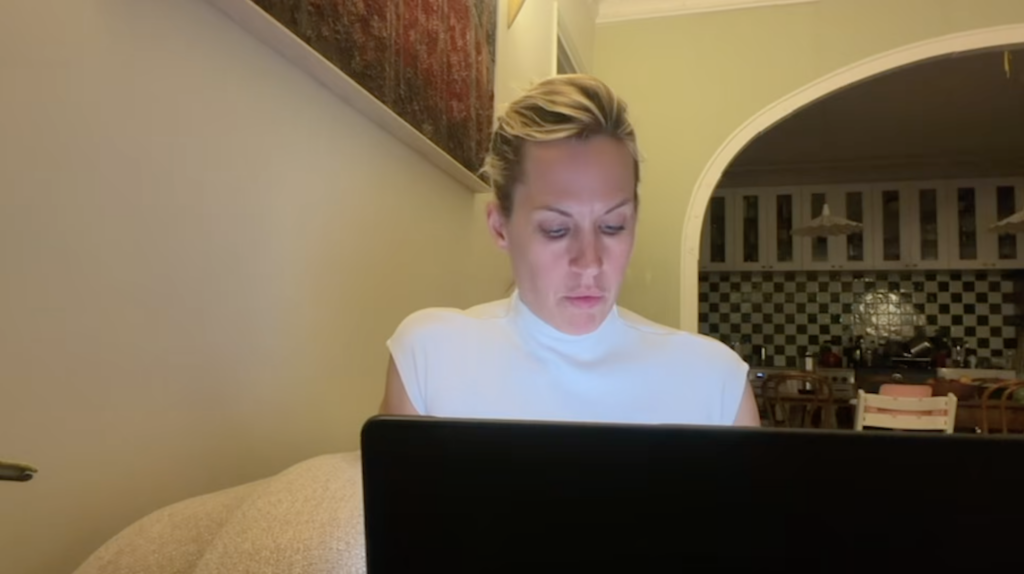
SV: [There, the] world is turned upside down. In our world, you've got Gisèle Pelicot, a feminist idol. On Motherless, it's Dominique Pelicot who is the idol. They see him as some kind of god to revere and to emulate.
KF: These users are very comfortable and callous and boisterous. They're not afraid to say what they're doing. They appear to be living in this place where they think they're immune. The psychologist that evaluated half of the men in the [Pelicot] trial told us that they feed on this collective energy of not just the excitement around the abuse, but also allowing themselves to normalize it.
SV: [In the groups] there's this feeling that your wife, your girlfriend, is yours. She is your object to possess, and therefore, it's not rape because you know her, because you're having sex with her anyway. I remember one man said, "Well, I'm not cheating on her. I'm still having sex with her, so she should feel lucky.”
Another way of understanding their mindset is a pendulum swing: Is it because of the emancipation of women, that women are now independent and they have power? Do these men feel under threat? Do they feel like this is a way of getting back the control of being once again the dominant alpha male? Because there is nothing more dominant than a man performing sex acts on an inanimate woman's body. I felt that was fueling some of this behavior.
“A complete shot in the dark”
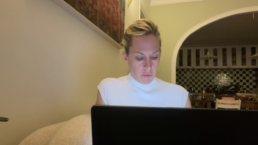
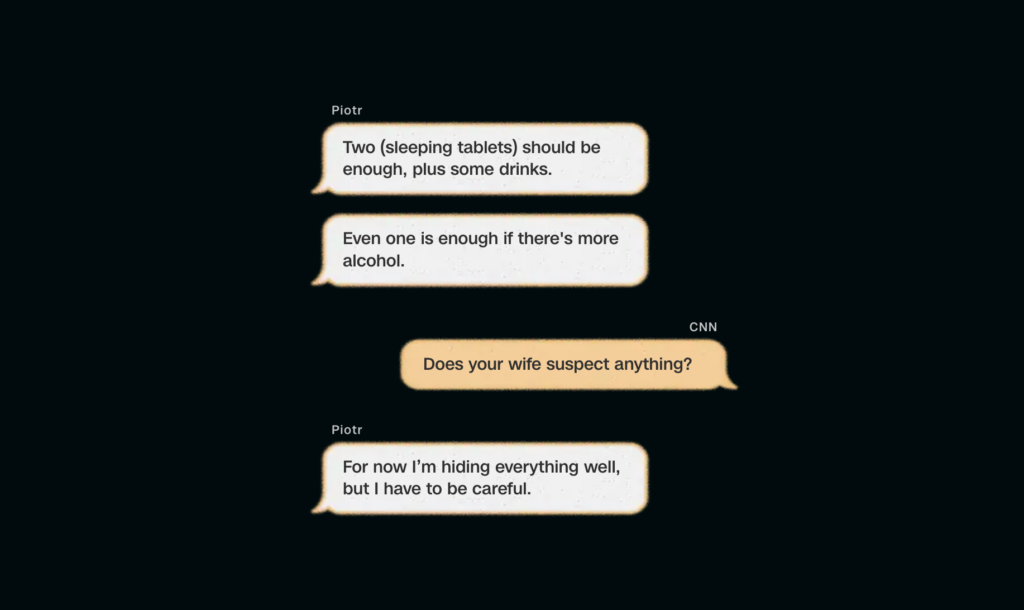
SV: A lot of the men we met in the Telegram group would get very suspicious [of our questions] and the conversations would go cold. But there was this one Polish man, whom we call Piotr in the piece, who was willing to talk and was happy with me being a sounding board, just listening to him and asking questions. I think he was lonely and just really needed to talk. He assumed that I was someone who shared the same fantasies as him, and he was incredibly trusting. And so he would talk about what he was up to that weekend, the holidays he'd go on with his wife and the social activities he would do with his friends. It wasn't all darkness.
One day, Piotr let it slip that he was going to a party at a restaurant.
NK: The thing that made this experience feel more real was when we traveled to Poland to track down Piotr [to confirm that he was real]. He didn’t give us the name of the restaurant, and there was no guarantee that we would find the right place. We were piecing together cryptic clues. We'd figured out based on a photo where he lived, geolocated his house, and then it was just internet research going through all the different restaurants in the area. We found one that had an event which matched the criteria that he'd mentioned. It was a complete shot in the dark.
SV: I remember the party was meant to start at 7:00 and everyone had arrived by 7:05. [Piotr and his wife] still weren't there. I sent a message to Niamh who was standing across the road: "This is the wrong place. They're not going to be here tonight." And then they came out of the car.
NK: When we saw him face-to-face, my heart sank because it's almost like I didn't want it to be true. But everything matched up: the facial identities, the people. He hadn’t been lying.
SV: What was even worse than seeing him was seeing her. Because I'd seen many photos and videos of her. You are a journalist, you're not there to interfere, but I remain a woman. So of course you can't help but think if the shoe was on the other foot, if I were her and she were me, would I want [a journalist] to come and tell me right there and then? And so it was really chilling, unnerving. It was almost a kind of out-of-body experience. I felt like I was watching the scene from up above, and I had to slightly dissociate from my emotions to be able to continue working as a journalist.
Seeing them on the dance floor was also a pretty harrowing moment: She would be dancing with her friends, he would come to join her, and she would leave and sit back down. You just felt that she was kind of fleeing him. Her face had such a vacant expression. This is me projecting, but it was almost as if her body knew what he was doing to it. It was a very strange and cold dynamic.
NK: We're not police officers, but in this case, we felt that we had to do a little bit more [than just observe]. Saskya and I made the call not to approach them because we were very mindful of this woman and her safety, but we did hand our findings in to the police. They were incredibly responsive. [On April 9, Polish authorities confirmed that] they arrested him and he's admitted to all the charges.
SV: We knew the Piotr meeting would be the final stage of the investigation because as soon as we had confirmed who he was, we weren't going to sit on that. So before we got to that stage, we had made sure that we had checked out all the other survivors’ stories that we were going to weave in.
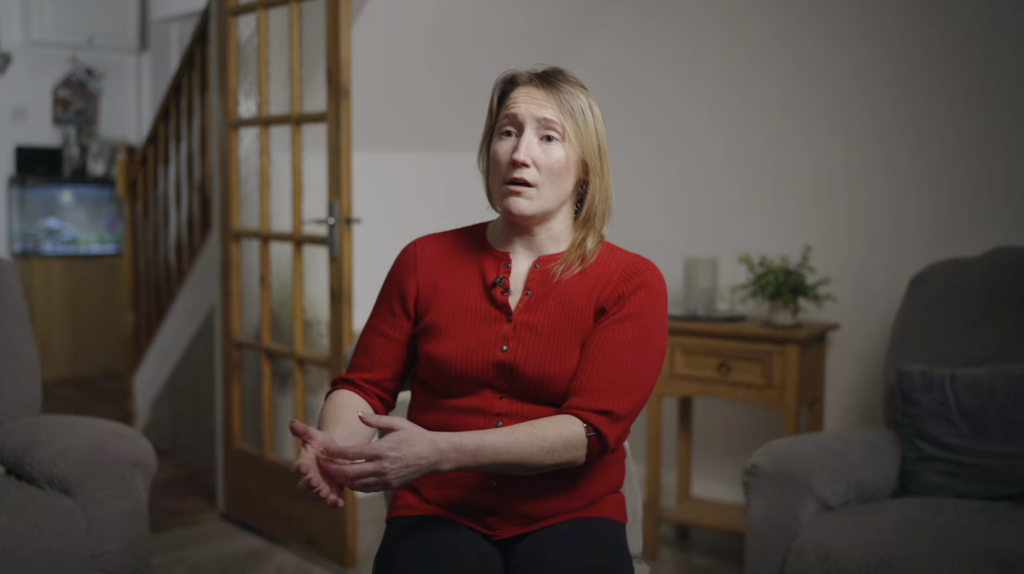
NK: The thing that really brought it all to life was meeting women who, though they weren't directly connected with this group, were survivors of this kind of abuse. The men in this group felt very invisible; they had these shadowy personas. And then when we met people that had been impacted by this kind of harm, that…made it all feel so real. Although I was in awe of their bravery, I was also deeply, in my soul, devastated to see the impact of this.
“A question of whack-a-mole”
KF: The arrival of publication day was a collective exhale. There's been a viral outpouring from survivors; they're flooding our inboxes with stories. Even for us, who know that this sort of abuse has been going on, to see so many survivors coming from the U.S., Australia, Europe, the UK is a lot. And we've seen people talking about their own rape stories and naming their rapists—not necessarily rape that had to do with [drug-facilitated sexual assault], but they felt like this was a moment to reclaim their own narratives.
SV: People began to understand that Dominique Pelicot is not an outlier. He's not unique. This is a phenomenon, and that's why we need to take note of it. The algorithms need greater scrutiny: Some of these guys may be going onto a porn site just watching regular porn, but then they find this slightly darker corner of this website where they're like, "Oh, what is ‘sleep porn’? This is interesting. This is forbidden. Maybe I'll try it out." It is out there, it's not on the dark web, it's easily accessible.
KF: [From a legal standpoint] it looks like there's momentum. In Europe, for example, there's legislation that's being proposed about non-consensual sex and how to define it from a yes-means-yes perspective instead of what exists right now. Several members of the European parliament raised our investigation as proof that more needed to be done. [A majority of the European Parliament approved the “only yes means yes” rape definition on April 28, in order to close any existing loopholes in rape legislation. Irish MEP Maria Walsh said that CNN’s investigation accelerated the debate.]
SV: [We need] more awareness of red flags. We need to ensure that the next time a woman goes to see her doctor and starts complaining about fuzziness or not remembering things she did last week, that if her husband is sitting next to her, the doctor might say, "Hey, can I have a moment alone with you?” So many of these women would go into the doctor's office with their husband, who would then manipulate the conversation like, "Hey, you've been under a lot of pressure, a lot of stress." And police need to recognize that drug-facilitated abuse [happens with] couples in marriages.
Of course, there needs to be better moderation and regulation. In the wake of our investigation, there has been a public outcry here [in France] about Cocoland, [a new site] which has the same interface and is modeled completely on Coco. Just today, prosecutors opened an investigation into this website. But even though the Coco founder has been charged, he's not in custody, and the trial is not set to take place for another year or two. Even today, if you were to go on Motherless, you would still be able to find sleep-content videos on there. So yes, better moderation, but also maybe harsher sentences and real legal repercussions when it comes to these founders. Because let's say tomorrow Motherless is taken down. What's to stop five other websites taking its place? It’s a question of whack-a-mole.
The last thing I’ll say is that if people want these kinds of investigations to see the light of day, you need well-funded news organizations. When [you include] the cameramen, the editors, the people who built the interactive, the lawyers, we were about 25 journalists who worked on this in the end. You need the time, the infrastructure to be able to produce this kind of investigation. The more we can raise awareness, the greater chance we have of survivors feeling like they're not alone and of spurring actual change.
So far, Motherless doesn't appear to have banned the so-called “sleep content,” although some related search terms or tags seem to have disappeared since the publication of CNN’s investigation. Meanwhile, other search terms still lead users to what appears to be drug-facilitated sexual assault content. The Zzz Telegram group has vanished from the Telegram chat list, but Telegram has not responded to CNN's questions about the disappearance.


Has your mom eaten today?
  April 28, 2026 Greetings, Meteor readers, There’s been another audio leak from the much-anticipated "Summer House" reunion, and at this point, Bravo just needs to stream all 12 hours of whatever they filmed, editing schmediting, we will watch it raw. In today’s newsletter, we look at what moms are giving up to feed their children. Plus, the enduring, questionable allure of Michael Jackson. Free the footage, Shannon Melero  WHAT'S GOING ONCook a meal for Mother’s Day: A March survey of more than 1,000 mothers in the United States conducted by the group No Kid Hungry found that moms are struggling to feed their children. According to the findings, one in five moms has skipped a meal or eaten less so that their child could have something to eat. That includes a surprising 20% of middle-income moms, and even a handful of “higher-income” ones—but, as always, lower-income mothers are feeling the squeeze most. “That’s a pattern, and it has a name: maternal sacrifice as a survival strategy,” says Lillian Singh, senior VP of family economic mobility at Share Our Strength, the non-profit that started the No Kid Hungry campaign. The numbers quantify what many parents have already been feeling: It’s hard to be a parent these days—more than any other decade in recent memory, according to more than 60% of the moms surveyed. In fact, nearly a quarter of women surveyed admitted to taking on debt in order to afford food. Even psychologists concur that parenting has become more difficult over the last few years for many reasons, including cost-of-living rises and stagnation in pay. Singh also points to anti-parent policies as a factor: “Proposed SNAP cuts”—like the one happening right now under the Big Beautiful Bill budget—“don't just reduce a benefit,” she says. “They remove the floor that makes those small acts of sacrifice survivable…The moms in our network aren't asking for more. They're asking for less to be taken away.”  The man in the mirror: The biopic Michael, which follows Michael Jackson’s career, is doing record-breaking numbers at the box office despite the fact that its protagonist was the subject of years of molestation allegations (including some published just last week). It’s not because it’s critically acclaimed: The film has a 38% critics rating on Rotten Tomatoes, but a 97% audience score. (Whereas with the 2019 documentary Finding Neverland, which profiled two of his accusers, those ratings are reversed.) Why the disparity? It’s complicated. Critics are struggling with the erasure of all of the complexities that made Michael, Michael—but that erasure seems to appeal to audiences. The film, produced by the Jackson estate and starring one of his nephews, Jaafar Jackson, glosses over nearly all of the difficulties Michael Jackson faced in his life and instead presents a pristine, idealistic version of the King of Pop. Put simply, the Jackson family is giving the people the version of Michael Jackson that fans loved most—the man on the stage—while completely ignoring the literal man in the mirror. Beyond preserving his legacy for profit, the Jackson estate has been working tirelessly for years on restoring the idea of Michael Jackson’s childlike purity, going so far as to have Leaving Neverland pulled from HBO and most streaming platforms four years ago. For the most part, this relentless rehabilitation has worked; given the wild success of the Broadway show MJ, the Cirque de Soleil show that sold millions of tickets, and a social media army ready to defend his legacy, Jackson appears too big to fail. Even the social stigma has faded: You’re more likely to see people happily bopping to “Wanna Be Startin’ Somethin’” than to R. Kelly’s “Ignition (Remix)” —neither of which I will link to because I’m not tossing any extra streaming pennies to these men. And that’s really the question at the heart of the Michael divide. Can art ever truly be separated from the artist, and who exactly are we willing to do that kind of separation for? This film brings that quandary a step further by eliminating the person and focusing solely on the art. What viewers are left with, if Rotten Tomatoes scores are to be believed, is an enjoyable musical experience devoid of any analysis or acknowledgment of the costs of that art. But certainly, there are adult survivors of childhood abuse seeing all of this dialogue and wondering when art will be less important than their lived experiences. AND:
 FOLLOW THE METEOR  Thank you for reading The Meteor! Got this from a friend? |


The High Cost of Workplace Affairs
  April 23, 2026 Greetings, Meteor readers, Absolutely everyone is talking about Yesteryear, the new novel from Caro Claire Burke about a tradwife influencer sent back to the 1800s. My local library has a month-long waiting list for a copy, with 433 people currently in line. So we have decided we will not fall victim to FOMO! Over the next two weeks, the Meteor team will be reading Yesteryear and sharing our takes. Are you reading Yesteryear, too? Reply to this email if you want to be part of our roundtable.  In today’s newsletter, we dig into the alleged affair rocking the sports world and why some of us always face more punishment than others. Plus, a very special assignment for your weekend reading. Support your local libraries, Shannon Melero  WHAT'S GOING ONNone’s fair in love and football: Yesterday, New England Patriots head coach Mike Vrabel announced that he would be missing part of this year’s draft to attend counseling. Why is a man advertising his plans to seek counseling? Step into my office. Earlier this month, Page Six published photos of Vrabel at a resort in Arizona with esteemed NFL journalist Dianna Russini. The photos were not particularly salacious—the two are seen eating, sitting separately in a pool, and exchanging an awkward hug—although a later one, of Vrabel and Russini sharing a kiss in 2020, hit the internet just today. Both parties have denied any wrongdoing, but it was clear as soon as the first photos went live who would be paying the price for an alleged consensual relationship between fully grown adults: Russini. The backlash has been swift and ugly. Russini resigned from her position at The Athletic, where she is currently under a conduct investigation. There have also been calls for the AP to investigate Russini’s NFL Awards voting history. Patriots fans on Reddit have even stooped so low as to start questioning the paternity of Russini's son, Michael, which was picked up by a sports outlet. Before we go any further, here’s my opinion on the journalistic ethics of it all: Russini, affair or not, is a rigorous and damn good journalist who has been doing the hard work of covering the NFL for years. Her work is not limited to Vrabel or the Patriots, and there’s been nothing to suggest that their alleged sexual relationship influenced her coverage. And even if you do agree that Russini made an ethical misstep, there’s no denying that she’s shouldering most of the fallout. As she was resigning, the NFL confirmed that it would not be reviewing whether or not Vrabel’s actions were a violation of conduct guidelines. There have been no calls for his resignation (at least not over this), and apart from his absence (beginning on day three of the draft), Vrabel is not expected to lose his job. This is, statistically, par for the course. Though Vrabel and Russini didn’t share a workplace, research shows that when women get involved with a coworker, they suffer more than men who do the same. “Women get half the [economic] gain of dating men with power, but pay double the costs when that relationship ends,” economist and associate professor of finance at the University of Southern California Emily Nix, who wrote a paper on the financial impacts of workplace relationships, tells The Meteor. (Think Kristin Cabot, aka the woman from the Coldplay kiss-cam.) Conversely, men see almost no change in their economic status after dating a superior or a subordinate—Cabot’s paramour Andy Byron resigned as CEO of the company and sold his house for $5 million, and is still a billionaire. Women also have a harder time bouncing back from these relationships, much like Cabot, who recently admitted that she is still looking for work. “One of the reasons women suffer such a big financial loss is because they’re the ones who end up leaving the workforce,” Nix explains. “A year after the event, they’re over 12 percentage points less likely to be employed…which persists for at least four years afterward.” That is what’s so vexing about this situation: seeing someone with the skill, expertise, and impeccable resume of Dianna Russini having her career stalled for a relationship with one out of the 384 coaching staffers in the NFL. Not to mention the blocks this could create for other women who are looking to grow in the industry. “I would not have advised her to resign,” Nix says. “I would have told her to fight tooth and nail because it’s very hard to regain your position. And we do find that women who leave one job have a harder time getting a better offer.” But hey, at least Mike is getting counseling. 🙄 AND:

 WEEKEND READING/LISTENING/WATCHING: “LEMONADE” EDITION 🍋🎶👯 EVERYONE WAS FINDING A FORMATION TO GET INTO. (SCREENSHOT VIA YOUTUBE) “Lemonade,” Beyonce’s sixth and arguably most iconic album, was surprise-released 10 years ago today. Even if you weren’t a card-carrying member of the Beyhive, it was impossible to ignore the ripple effects of this trailblazing “visual album,” whose lyrical, cinematic, and literary references to Black womanhood, history, and religion abounded. (And oh yeah, it’s a chronicle of Jaÿ-Z’s infidelity, mirroring the Kübler-Ross stages of grief.) The cameos were legion, ranging from Serena Williams to Chimamanda Ngozi Adichie to the mothers of Trayvon Martin, Eric Garner, and Michael Brown. Besides gifting us banger after banger, “Lemonade” spurred a kaleidoscope of thinkpieces, reading lists, roundtables, and entire syllabi that reflected on slavery, on Black feminist theory, on food, on witchcraft, on the supernatural, on Afrofuturism, on vulnerability, on capitalism, on marriage, on Black women’s place in rock ‘n roll, and so much more. The 1991 film Daughters of the Dust—directed by Julie Dash, the first Black woman to direct and produce a full-length, widely distributed feature film—was re-released as a result of the album’s nod to it. You could celebrate “Lemonade” this weekend by listening to it…or you could also read the myriad words of others dissecting it. Choose your own adventure!  FOLLOW THE METEOR Thank you for reading The Meteor! Got this from a friend? |


It’s not just “violence.” It’s femicide.
  April 21, 2026 Greetings, Meteor readers, I am sending hearty applause to all of you finishers out there who hit the streets of Boston and Jersey City this past marathon weekend. I genuinely marvel at your abilities. In today’s newsletter, we try to wrap our minds around the uptick in femicides and the lack of response. Plus, a suspicious lawsuit out of California and a shred of good news for bodily autonomy. Shannon Melero  WHAT'S GOING ONCall it what it is: In 2023, historian and author Kimberly A. Hamlin wrote in the Washington Post that femicide—the killing of a woman because she is a woman—was on the rise, and that said rise is not surprising given our country’s deeply patriarchal and white-supremacist history. Her assessment rings particularly true this month, as the news of Dr. Cerina Fairfax, Celeste Rivas Hernandez, Lindha Zerpa Lara, Nancy Metayer Bowen, Ashlee Jenae, and Shaneiqua Pugh have flooded our screens. These women were murdered (aside from Pugh, who was critically injured), and men they were close or married to were named as perpetrators. Over the decade between 2014 and 2024, the number of women killed by intimate partners increased 22 percent. Men are suspects in more than 98 percent of those incidents. Yet “femicide” is not the term most commonly used to describe these kinds of killings; it appears nowhere on the CDC website. The public instead relies on terms like “intimate partner violence”: killed because of a relationship gone wrong. Or “domestic violence”: killed because of some mysterious, private matter inside the home. Neither of those phrases, though, makes clear who the target and perpetrator of that violence is. You can’t address a problem without first properly naming it. Femicide comes closer. The tradition of American femicide has its roots in our country’s history of patriarchy and violence. In her piece, Hamlin points to the exact legal mechanisms that have helped. The most enduring of these was “coverture,” the idea that women’s “legal identity was covered by that of her husband.” Under the laws of coverture, Hamlin writes, it was “basically inconceivable for a husband to be prosecuted for assaulting his wife or children,” because they were his property.  AN ANTI-VIOLENCE PROTEST IN ARGENTINA, 2019 (VIA GETTY IMAGES) More than a hundred years after coverture stopped being common practice, women are still being killed at an alarming and growing rate—and most often, according to data, by men they know. Some women are especially vulnerable: Researchers find that femicide occurs disproportionately among Indigenous, Latina, and Black women, the last of whom make up 14% of the population but, according to the CDC, a full 30 percent of intimate partner murder victims. Laws may change, but the long-term effects of men being told that all things and people are theirs to do with as they please, do not just go away. They adapt. But our response has not. The CDC lists intimate partner violence as a “significant public health issue.” So why is this administration, which purports to be protecting women from everything, stripping away resources meant to protect women from this very real threat? Why is the administration easing gun regulations when on average more than 70 women are shot and killed by an intimate partner every month? In other countries, women have taken to the streets to demand an end to these murders. We could do the same—or at the very least, begin asking candidates what they plan to do about a crisis impacting nearly half of all voters. Because this problem deserves to live not just in “intimate” and “domestic” corners, not just in lurid headlines or true-crime plotlines, but in the open air of the streets. AND:
 FOLLOW THE METEOR Thank you for reading The Meteor! Got this from a friend? |


When The Guy is Accused of Sex Abuse
  April 14, 2026 Hey there, Meteor readers, It’s taken longer than expected, but I have finally listened to all of ARIRANG in one sitting, and phew 😮💨 if it weren’t for my spinal problems and unreliable knees, I’d be at a rave somewhere right now messing up the choreo to Hooligan.  In today’s newsletter, we’re talking about now-former-Congressman Eric Swalwell and the weight of women’s whispers. Plus, an overwhelming but positive week for the people of Hungary. Shannon Melero  WHAT'S GOING ONThe loudest whispers: Just days after accusations of sexual assault, sexual harassment, and sex with interns went public through a combination of traditional reporting and dedicated influencers, Rep. Eric Swalwell (D-Calif.) has ended his campaign for governor and resigned from Congress. (He maintains that the allegations against him are false and only that he’s “made mistakes in judgement.”) The news of Swalwell’s resignation was quickly followed by that of Rep.Tony Gonzales (R-Tx.) who also stepped down in light of an investigation into his relationship with a former aide. If one didn’t know any better, this would be a moment to celebrate the seemingly swift downfall of men who were the masters of their own destruction. But instead we’re left to assess a larger problem, particularly within the Democratic Party. Over the last few years, Swalwell, who entered Congress at 32 and is now 45, has been positioned by the Democratic Party and the media as a bridge between young voters and an aging party in need of resuscitation. In 2016, as the Dems were feathering their nests for what we all believed would be another four years of their party running the show, Swalwell was crowned the “Snapchat king of Congress” by none other than the internet queen herself, Taylor Lorenz. (Ironically, it would be that same platform he would later use to allegedly send unsolicited dick videos to women.) Swalwell was expertly using the platform to bring in new voters and show the ins and outs of Congress, becoming what Politico called a “something for everyone” kind of candidate. Up until this week, Swalwell had a strong chance of succeeding Gavin Newsom with a healthy bloc of Democratic endorsements, and the backing of at least one billionaire donor. He was, at least in California, The Guy. And yet, he was The Guy despite a years-old whisper network about his alleged behavior, which included sexting his subordinates and at least three allegations of rape. After the allegations were published last week, much of the response from political insiders on both sides was that “everyone” already knew. The same way so many people knew about Harvey Weinstein. And R. Kelly. And Jeffrey Epstein. And Donald Trump. So why didn’t this reckoning happen years ago? Well, according to a Sacramento lobbyist who spoke to Politico, part of the reason is that those in the know were “willing to delude ourselves or not ask the questions that should have been asked.”  SUPPORTERS DURING SWALWELL'S SHORT-LIVED PRESIDENTIAL CAMPAIGN IN 2019. INTERESTING THAT HIS TAG LINE INVOLVED THE PHRASE "DO GOOD." (VIA GETTY IMAGES) Some folks, however, did ask the question. Political consultant Mike Trujillo, who had been collecting stories from women about Swalwell since 2017, told Politico this week that when he tried pitching what he knew to reporters, Swalwell’s camp discredited him. Eventually, Trujillo found that after Swalwell dropped out of the 2019 presidential primary, women had “lost interest” in sharing their experiences. The rumors persisted, but the story went nowhere. That’s partly because, as a society, we’re trained not to immediately believe women. But in this particular situation, there’s another factor: the unspoken quest for the great white hope. Since the racist backlash against the Obama administration became clear, Democrats have been on the hunt for the next person who could be a one-size-fits-all savior with a magical ability to unite people of all walks. It couldn’t be Joe Biden (too old), Bernie Sanders (too left), or Hillary Clinton (too woman-y). So the party has increasingly turned its attentions to younger, maler candidates with the same popcorn quality as Swalwell: white and easily made palatable to as many voters as possible, regardless of their actual politics—as evidenced by the fawning, thirsty, sometimes horny coverage similar candidates get. These men aren’t just politicians who drew national attention by accident; they’re the well-tended, well-protected seeds of the party. Women in politics who speak up about sexual harassment and assault have long been treated like a “political inconvenience,” as journalist Grecia Figueroa writes, rather than victims of a system that protects abusers regardless of party lines. The insiders who already knew about Swalwell’s track record with women could have easily slowed down his rise or stopped it altogether. After all, this secret was so well-known that a sitting member of Congress reportedly admitted to Arielle Fodor (aka Mrs. Frazzled), one of the women who exposed Swalwell, that the rumors about him were true. But instead, legislators waited until the rumors made it onto CNN to withdraw support and virtue-signal that they really do believe women. Just not the first time. AND:Shortly after the 2024 election, writer Megan Carpentier sought advice about how to fight authoritarianism from activists who’d done it around the world. One of those activists, professor and former member of Hungary’s National Assembly Gábor Scheiring, gave his thoughts on Prime Minister Viktor Orbán’s “electoral autocracy”; at the time, Scheiring said that we can’t protect democracy by “just talking about how important it is to have a constitutional court…The overwhelming majority of people don’t really think in these terms. They are concerned about inflation and real wages and unemployment and inequality.” On Sunday, that autocracy came to an end with the landslide election of the center-right Tisza Party’s Péter Magyar and, after 16 years, Orbán’s ouster. Hungarians celebrated in the street, Americans felt a bit envious, and Carpentier emailed Scheiring to get his thoughts. He attributed Orbán’s defeat primarily to those same economic factors he listed in 2024—a relevant data point for those of us raging against Trump. “Orbán tried to reframe the election around geopolitics, parading his friendships with Trump and Putin,” Scheiring said. “But you cannot eat a foreign policy alignment, and Hungarians decided they had had enough.” While the magnitude of change under Magyar is “an open question,” Scheiring said, “at the very least, a door has been opened that many Hungarians had stopped believing would ever open.” May it open wide around the globe.  WOW IMAGINE HAVING A PARTY IN THE STREETS AFTER SUCCESSFULLY VOTING OUT AN AUTHORITARIAN...ONE DAY! (VIA GETTY IMAGES)

 FOLLOW THE METEOR  Thank you for reading The Meteor! Got this from a friend? |


Where Abby Wambach Finds Hope
 April 10, 2026 Greetings, Meteor readers, Yesterday, a historic event took place in the heart of New York City—Nona and I met for the first time in person, even though we have worked together over several years, not just here at The Meteor, but at a previous job as well. The good news is there was no frame-mogging, as the kids say, but the awful news is that our combined beauty overheated the room we were in. We will be kept separated until winter. In today’s newsletter, we celebrate the return of UNDISTRACTED with guests Abby Wambach and Glennon Doyle. Plus, the worst-kept secret in America is revealed, and a new professional sports league crowns its champions. IRLmaxxing, Shannon Melero  WHAT'S GOING ONEyes on the ball: Do you ever wonder why women’s sports feels like such a balm when everything else is…less balm-like? It isn’t just that visibility of women athletes themselves is on the rise. There’s something more to it, and soccer icon Abby Wambach—who, along with her wife, activist Glennon Doyle, was a guest this week on UNDISTRACTED with Brittany Packnett Cunningham—perfectly laid out what that something is. “It’s more than just watching women play,” she says. “It feels like something activism-adjacent.” Back in 2019, the USWNT began demanding pay equity, and Wambach was one of their most vocal advocates. Now, basketball players who were once using public restrooms to change before professional games have successfully negotiated a CBA that increased salary caps by 300 percent. And that didn’t just happen, Wambach points out—women worked together to do it, a strategy female athletes have had to employ for years. In the 1970s, “you’ve got Billie Jean King unifying a group of women to sign $1 contracts to create the Women's Tennis Association,” Wambach explains. Then “you have Title IX happening in the United States…and then you look forward, you see this boom of popularity. But what is never talked about and I think is so important is the reason why that happened was collective unity.” Wambach puts it this way: “It’s a very feminine idea that in order to have the most amount of people get the things they want out of their life, we have to figure out how to unify.” Oh, and you know what Wambach’s not feeling? The price gouging of the World Cup. “The sport competitor side [of me] is like, it's going to be such an exciting time,” she says. “But families…and fans can't go unless they pay like $10,000 for a ticket. It’s commodifying and corporatizing these things that have a beautiful essence. And I think that's why women's sports are having such a moment—because it's not totally commodified and taken over by the corporate landscape. Those people sitting in those seats…actually care.” To hear the full conversation (including Glennon on raising a boy in the manosphere) and get extremely hyped for what’s to come with women’s sports, check out the episode here or wherever you get your podcasts.  AND:
ONE MORE THING...New York friends/theater buffs/feminists lookin’ for weekend plans: These are your last few days to see “Antigone (This Play I Read in High School)” at the Public Theater. Our colleague Cindi Leive and podcast host Regina Mahone (of The A-Files) sat down with the cast and creators after a performance of the play, which reimagines Antigone as a fierce young woman who happens to be pregnant and is defying her uncle Creon’s Thebes-wide abortion ban to do what she wants. In one of the play’s best moments, Antigone (the riveting Susannah Perkins) says to her uncle, Creon (Tony Shalhoub): “These ears, these eyes, this hair, these knees, if there's anything we have in this world, that's it. Your own body is it. The conversation with yourself that never ends.” “For me, that speech really is the heart of the play,” playwright Anna Ziegler told us onstage. “It's the moment when Antigone is claiming the dignity that her body deserves.” She does, and it’s worth seeing.  FOLLOW THE METEOR Thank you for reading The Meteor! Got this from a friend? |
