
The Women Who Exposed the “Rape Academy”
Three journalists tell the inside story of investigating a dark global network of men assaulting their partners
By Nona Willis Aronowitz
On March 26, CNN published a 16-minute documentary and interactive story about “a global rape academy,” a network of websites and Telegram chat where men trade tips on how to drug and sexually assault their wives and girlfriends. The story has since been viewed and read by millions, first across Europe and then in the U.S., where the story went viral a few weeks later. Behind the exposé were nearly 25 CNN journalists and staff who for seven months dug into this vast and tightknit community. The Meteor spoke with investigative reporters Saskya Vandoorne and Niamh Kennedy, and reporter and producer Kara Fox, about how this extraordinary investigation came together.
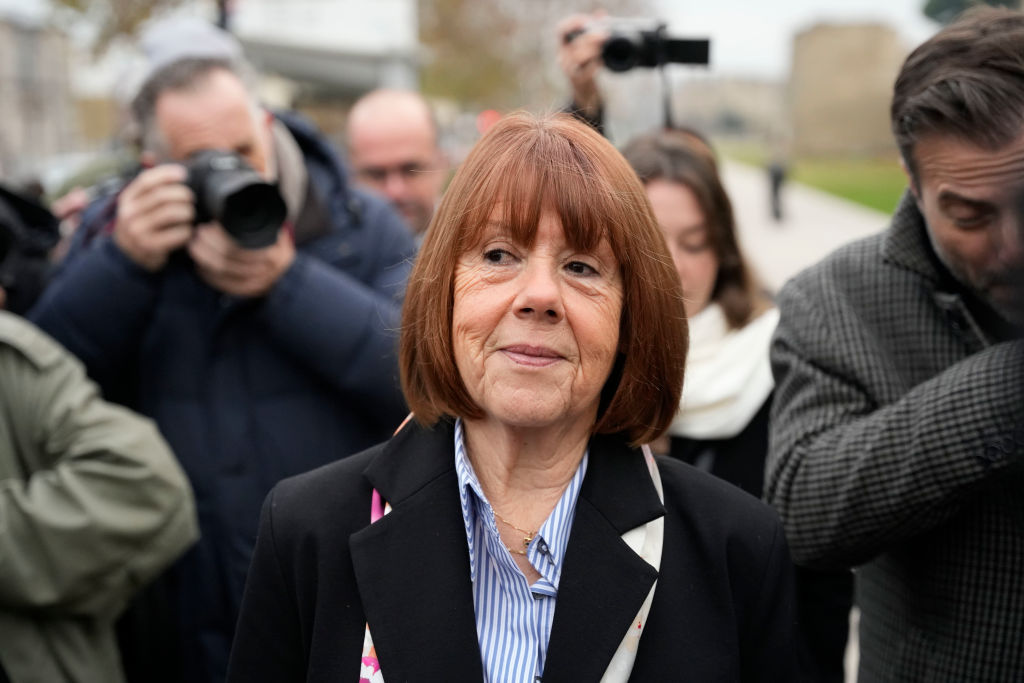
Saskya Vandoorne: It all started with Gisèle Pelicot. I’m the CNN Paris bureau chief here, and I was at the trial down in the south of France [in the fall of 2024] where 51 defendants were on trial for raping her. And I remember very vividly her lawyer speaking about Coco, the platform that Dominique Pelicot had used to recruit all these men to rape his sedated wife. The lawyer described Coco as the weapon of the crime. He said Pelicot had gone on there to find like-minded people. So even though Coco had been taken down, I was curious to find out: Are there any other spaces where men speak to one another about crimes they wanted to commit against their wives or partners?
Kara Fox: We had been reporting out the Dominique Pelicot case, and we knew that Coco users were talking about where to go next on a forum. As we knew that these spaces didn’t go away after the trial, we investigated some of them—other websites and a large Telegram group. One site in particular became the focus, also reported on through the amazing work of German journalists Isabel Beer and Isabel Ströh: Motherless.com. Throughout the course of our reporting we also reported on similar cases, like “the German Pelicot” or “the UK Pelicot.”
Niamh Kennedy: [In the “sleep” groups on] Motherless, there were over 20,000 videos, some showing unconscious women and their eyelids being lifted up to show that they’ve been sedated. There were more graphic videos as well, sometimes showing what appeared to be nonconsensual sex acts being carried out on these sedated women. It was from spending a lot of time on Motherless that I found a link to the private Telegram group [called “Zzz”]. It featured 1,000 men from all around the world who were giving each other tips on how to drug and rape their partners. It was quite tough, to be honest with you…I definitely felt chills a lot of the time seeing what was going on there. It was very hard.
An upside-down world
SV: There were many conversations that were had before we went undercover [to log onto the site and join the Telegram group to speak to participants]: What did we want to achieve? What could we say? Where was the line? We wanted to remain journalists, so our role was just to ask questions. At no point did we want to encourage any of this behavior; of course, we weren’t going to share any pictures or videos of our fictitious wives. So it was very much, sit in this space, ask questions, find out what are they doing, how long have they been doing it for. And also, what was their motivation?
NK: Saskya and I made a shared fake profile, working late into the evening when a lot of the men were online. We spent a lot of time both on the site and in the private Telegram group. There were tiers: men who were selling content, men who were selling sleep liquids—very powerful drugs that could immobilize women. There were men that were offering livestreams. We’re talking about hundreds of messages all day long, ping pong, ping pong. They would turn to each other for advice. One guy would write in and be like, “I’m thinking of drugging and raping my wife. Who’s done this before?” And one guy would be like, “Yep, I’ve been doing this for three years. Use this drug.” Others would be like, “What weight is she?” “Oh, I did this and I got away with it. ” And then a couple of hours later, the man who’d asked the question would post a video and they’d be encouraging each other. It was like a whole brotherhood, where they were really bonding over this shared interest.
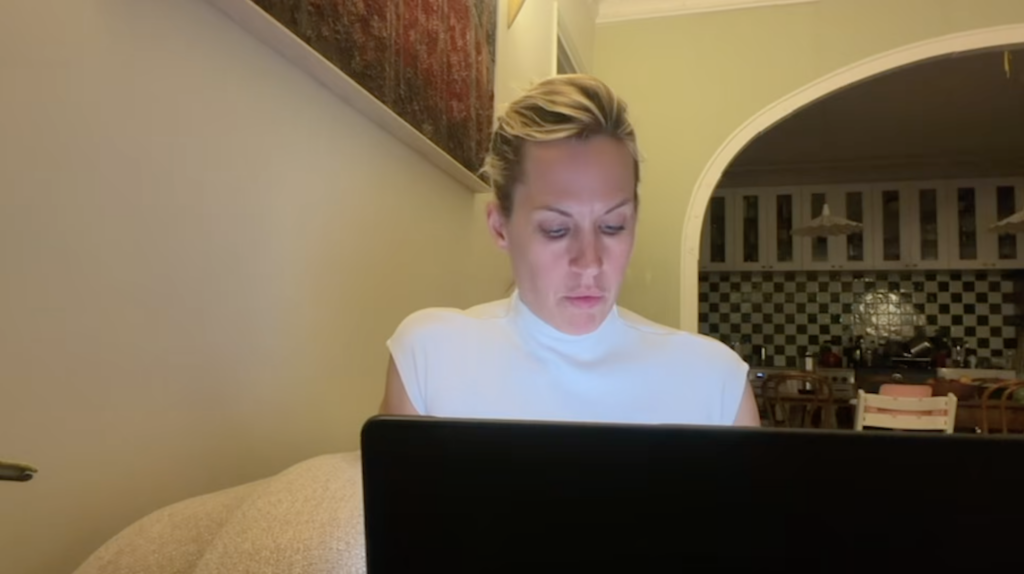
SV: [There, the] world is turned upside down. In our world, you’ve got Gisèle Pelicot, a feminist idol. On Motherless, it’s Dominique Pelicot who is the idol. They see him as some kind of god to revere and to emulate.
KF: These users are very comfortable and callous and boisterous. They’re not afraid to say what they’re doing. They appear to be living in this place where they think they’re immune. The psychologist that evaluated half of the men in the [Pelicot] trial told us that they feed on this collective energy of not just the excitement around the abuse, but also allowing themselves to normalize it.
SV: [In the groups] there’s this feeling that your wife, your girlfriend, is yours. She is your object to possess, and therefore, it’s not rape because you know her, because you’re having sex with her anyway. I remember one man said, “Well, I’m not cheating on her. I’m still having sex with her, so she should feel lucky.”
Another way of understanding their mindset is a pendulum swing: Is it because of the emancipation of women, that women are now independent and they have power? Do these men feel under threat? Do they feel like this is a way of getting back the control of being once again the dominant alpha male? Because there is nothing more dominant than a man performing sex acts on an inanimate woman’s body. I felt that was fueling some of this behavior.
“A complete shot in the dark”
SV: A lot of the men we met in the Telegram group would get very suspicious [of our questions] and the conversations would go cold. But there was this one Polish man, whom we call Piotr in the piece, who was willing to talk and was happy with me being a sounding board, just listening to him and asking questions. I think he was lonely and just really needed to talk. He assumed that I was someone who shared the same fantasies as him, and he was incredibly trusting. And so he would talk about what he was up to that weekend, the holidays he’d go on with his wife and the social activities he would do with his friends. It wasn’t all darkness.
One day, Piotr let it slip that he was going to a party at a restaurant.
NK: The thing that made this experience feel more real was when we traveled to Poland to track down Piotr [to confirm that he was real]. He didn’t give us the name of the restaurant, and there was no guarantee that we would find the right place. We were piecing together cryptic clues. We’d figured out based on a photo where he lived, geolocated his house, and then it was just internet research going through all the different restaurants in the area. We found one that had an event which matched the criteria that he’d mentioned. It was a complete shot in the dark.
SV: I remember the party was meant to start at 7:00 and everyone had arrived by 7:05. [Piotr and his wife] still weren’t there. I sent a message to Niamh who was standing across the road: “This is the wrong place. They’re not going to be here tonight.” And then they came out of the car.
NK: When we saw him face-to-face, my heart sank because it’s almost like I didn’t want it to be true. But everything matched up: the facial identities, the people. He hadn’t been lying.
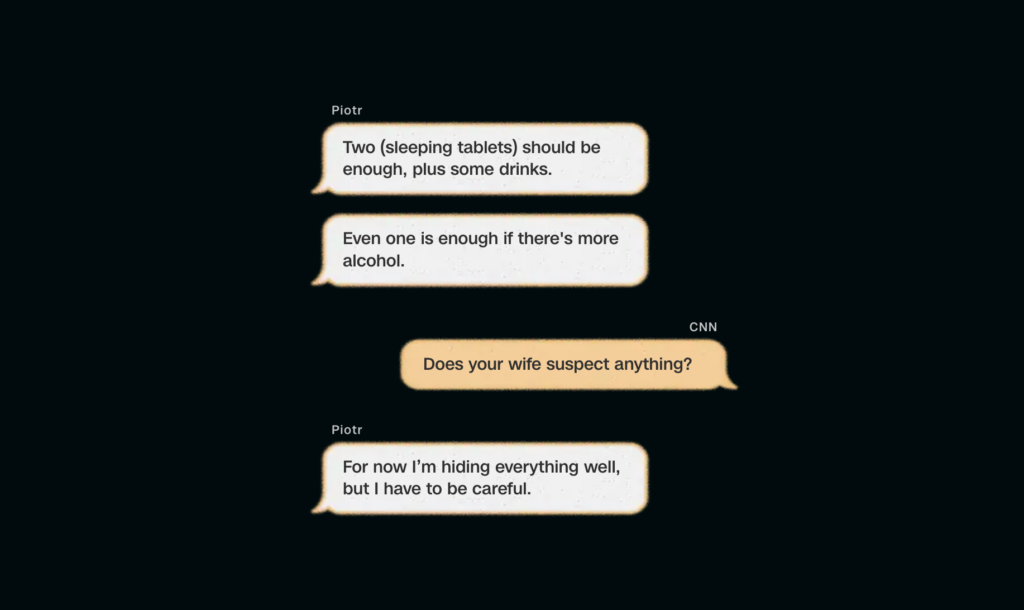
SV: What was even worse than seeing him was seeing her. Because I’d seen many photos and videos of her. You are a journalist, you’re not there to interfere, but I remain a woman. So of course you can’t help but think if the shoe was on the other foot, if I were her and she were me, would I want [a journalist] to come and tell me right there and then? And so it was really chilling, unnerving. It was almost a kind of out-of-body experience. I felt like I was watching the scene from up above, and I had to slightly dissociate from my emotions to be able to continue working as a journalist.
Seeing them on the dance floor was also a pretty harrowing moment: She would be dancing with her friends, he would come to join her, and she would leave and sit back down. You just felt that she was kind of fleeing him. Her face had such a vacant expression. This is me projecting, but it was almost as if her body knew what he was doing to it. It was a very strange and cold dynamic.
NK: We’re not police officers, but in this case, we felt that we had to do a little bit more [than just observe]. Saskya and I made the call not to approach them because we were very mindful of this woman and her safety, but we did hand our findings in to the police. They were incredibly responsive. [On April 9, Polish authorities confirmed that] they arrested him and he’s admitted to all the charges.
SV: We knew the Piotr meeting would be the final stage of the investigation because as soon as we had confirmed who he was, we weren’t going to sit on that. So before we got to that stage, we had made sure that we had checked out all the other survivors’ stories that we were going to weave in.
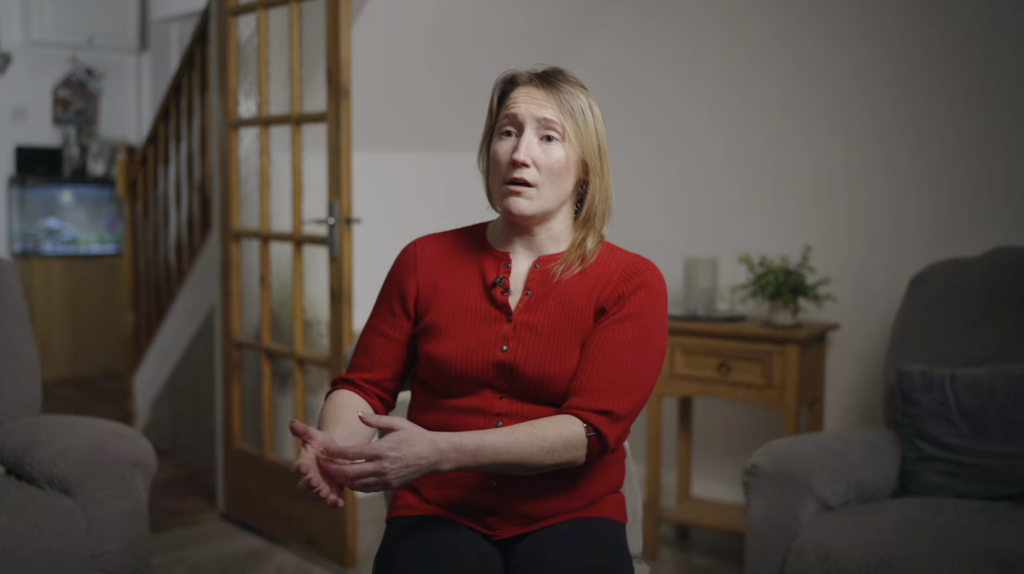
NK: The thing that really brought it all to life was meeting women who, though they weren’t directly connected with this group, were survivors of this kind of abuse. The men in this group felt very invisible; they had these shadowy personas. And then when we met people that had been impacted by this kind of harm, that…made it all feel so real. Although I was in awe of their bravery, I was also deeply, in my soul, devastated to see the impact of this.
“A question of whack-a-mole”
KF: The arrival of publication day was a collective exhale. There’s been a viral outpouring from survivors; they’re flooding our inboxes with stories. Even for us, who know that this sort of abuse has been going on, to see so many survivors coming from the U.S., Australia, Europe, the UK is a lot. And we’ve seen people talking about their own rape stories and naming their rapists—not necessarily rape that had to do with [drug-facilitated sexual assault], but they felt like this was a moment to reclaim their own narratives.
SV: People began to understand that Dominique Pelicot is not an outlier. He’s not unique. This is a phenomenon, and that’s why we need to take note of it. The algorithms need greater scrutiny: Some of these guys may be going onto a porn site just watching regular porn, but then they find this slightly darker corner of this website where they’re like, “Oh, what is ‘sleep porn’? This is interesting. This is forbidden. Maybe I’ll try it out.” It is out there, it’s not on the dark web, it’s easily accessible.
KF: [From a legal standpoint] it looks like there’s momentum. In Europe, for example, there’s legislation that’s being proposed about non-consensual sex and how to define it from a yes-means-yes perspective instead of what exists right now. Several members of the European parliament raised our investigation as proof that more needed to be done. [A majority of the European Parliament approved the “only yes means yes” rape definition on April 28, in order to close any existing loopholes in rape legislation. Irish MEP Maria Walsh said that CNN’s investigation accelerated the debate.]
SV: [We need] more awareness of red flags. We need to ensure that the next time a woman goes to see her doctor and starts complaining about fuzziness or not remembering things she did last week, that if her husband is sitting next to her, the doctor might say, “Hey, can I have a moment alone with you?” So many of these women would go into the doctor’s office with their husband, who would then manipulate the conversation like, “Hey, you’ve been under a lot of pressure, a lot of stress.” And police need to recognize that drug-facilitated abuse [happens with] couples in marriages.
Of course, there needs to be better moderation and regulation. In the wake of our investigation, there has been a public outcry here [in France] about Cocoland, [a new site] which has the same interface and is modeled completely on Coco. Just today, prosecutors opened an investigation into this website. But even though the Coco founder has been charged, he’s not in custody, and the trial is not set to take place for another year or two. Even today, if you were to go on Motherless, you would still be able to find sleep-content videos on there. So yes, better moderation, but also maybe harsher sentences and real legal repercussions when it comes to these founders. Because let’s say tomorrow Motherless is taken down. What’s to stop five other websites taking its place? It’s a question of whack-a-mole.
The last thing I’ll say is that if people want these kinds of investigations to see the light of day, you need well-funded news organizations. When [you include] the cameramen, the editors, the people who built the interactive, the lawyers, we were about 25 journalists who worked on this in the end. You need the time, the infrastructure to be able to produce this kind of investigation. The more we can raise awareness, the greater chance we have of survivors feeling like they’re not alone and of spurring actual change.
So far, Motherless doesn’t appear to have banned the so-called “sleep content,” although some related search terms or tags seem to have disappeared since the publication of CNN’s investigation. Meanwhile, other search terms still lead users to what appears to be drug-facilitated sexual assault content. The Zzz Telegram group has vanished from the Telegram chat list, but Telegram has not responded to CNN’s questions about the disappearance.