
She Fled Fear—and Found It Here
A woman who escaped danger in Afghanistan reflects on what life is like under ICE.
By Lima Halima-Khalil
I drop my three-year-old daughter off at library classes every morning. The library is two minutes from our home in Ashburn, Virginia. Each time, the same thought crosses my mind: Do I have my ID on me? Will my driver’s license be enough if I am stopped?
It is highly unlikely that I will encounter ICE on a two-minute drive to the library. Ashburn isn’t exactly an ICE hub. And yet my fear is constant, embodied, and real. And by the way, I am an American citizen.
I grew up believing America was a mighty country, one so powerful that the rest of the world stood intimidated by its strength. When I first came to the United States in 2006 for an education program from Afghanistan, a country still at war, the vastness of this place revealed itself not only in its size, but in the generosity of the people I met. After that, America became a place I always returned to. I have been part of the American education system since 2010, returning several times for various degrees. I’ve witnessed multiple presidential elections and participated in the most recent one as an American citizen myself.
But after all these years, one lesson about my new home stands out above the rest: This country is led, shaped, and sustained by fear. Outside this country, nations tremble at the military and economic power of the United States, but inside it, people live as though danger is always lurking.
Fear raises money and sustains campaigns. Fear keeps people glued to screens and locked into cycles of outrage. Fear sells guns, justifies surveillance, expands borders and prisons. Much of this fear is not grounded in lived reality but manufactured and amplified by politicians who rely on it to govern. Fear spills into kitchens, sidewalks, classrooms, and moments meant to be ordinary and human.

One of the most brutal tools in this ecosystem right now is ICE. Raids, detentions, and aggressive enforcement practices operate not simply as immigration policy, but as a mechanism of fear, reminding entire communities that their sense of belonging is fragile and conditional. ICE does not need to be everywhere to be effective. The possibility of its presence is enough.
This pervasive fear turns ordinary routines into sites of anxiety. I remember hesitating before offering to share our Thanksgiving meal with our nosy white neighbor, suddenly gripped by thoughts I never imagined I would carry. What if he calls the police on us and claims I was trying to poison him? What if kindness itself is misread as a threat, or hospitality as danger?
Afghans discovered how quickly they could become the “other,” regardless of their sacrifices, their loyalty, and their love for this country.
I recognize these impulses, because fear is not new to me. I lost my school, my home, my loved ones, and eventually my country because I wanted freedom from fear. Millions of Afghans had believed in democracy when America promised it to us for 20 years, until the United States withdrew from Afghanistan in 2021. We voted, we hoped, we worked alongside our American partners for a shared dream, but that freedom never came. In 2020, when my 24-year-old sister was killed by the Taliban in an IED attack in her car, that truth became undeniable. I understood then that Afghanistan was no longer safe, and that realization is what led me to come to the United States permanently.
When the Taliban returned to power in 2021, many Afghans, including members of my own family, were evacuated and brought into this country by our American allies. They arrived in this country under extremely harsh circumstances, believing they would find dignity, safety, and a chance to contribute. Instead, they discovered how quickly they could become the “other,” regardless of their sacrifices, their loyalty, and their love for this country.
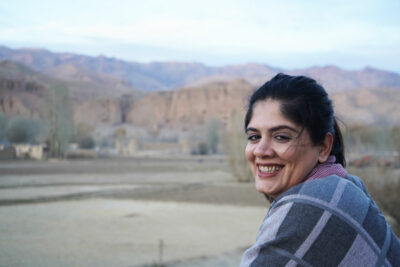
I was reminded of this again in November of last year, after a man from Afghanistan, who had been trained and worked for the CIA in his country, shot two National Guard members in Washington, D.C. Overnight, an entire community began to be seen, once again, as terrorists. Instead of a careful and humane conversation about mental health, trauma, or resettlement failures, the Trump administration halted all immigration from Afghanistan and pledged to re-examine green card holders from 19 countries. Afghans, many of whom fled the very forces America claims to oppose, were once again forced to prove their innocence.
This is how fear functions. It identifies a moment of tragedy, strips it of context, assigns collective guilt, and converts pain into political currency.
For a long time, I believed that fear in this country belonged primarily to people of color, that violence was uneven, predictable, and racialized. Then the killings of Renée Good and later Alex Pretti shattered that belief. They forced a painful realization that in today’s America, no one is safe, not five-year-old Liam Conejo Ramos, not women citizens like Dulce Consuelo Díaz Morales and Nasra Ahmed, not elderly citizens like Scott Thao or longtime residents like Harjit Kaur, not white Americans, either.
Lately, I have felt fear settle into my own body in a way I did not expect. I realized I had been going to sleep holding fear, living with the same quiet dread that so many people here carry without ever naming it. One night, I caught myself thinking, almost with disbelief: Congratulations, Lima, you are an American now.
But it does not have to be this way. Americans deserve more than this constant weight of dread, clinging to them like a second skin. We deserve a country where fear is not the engine that keeps the system running, where safety is not promised to some by threatening others, and where power is not sustained by keeping people afraid.
Lima Halima-Khalil, Ph.D., is the program director of the “I Stand With You” campaign at ArtLords, a collective she co-founded, where she mobilizes global awareness against gender apartheid in Afghanistan. Her research explores youth resilience amid violence and displacement. Her writing has appeared in Foreign Policy, TRT World, and academic publications.


Chrissy Teigen: "This is what care looks like"
Against a landscape of shrinking reproductive freedom, the TV personality and author visits a Tennessee clinic that offers both birth and abortion care
Tomorrow marks the 53rd anniversary of the Roe v. Wade decision. More than half a century later, in a country that no longer grants the freedom that that ruling declared, it’s easy to get mired in the onslaught of harrowing news about our bodies and our lives. But everywhere, there are warriors who keep doing the work of caring for pregnant people, and they are not mired. They are moving forward, every single day.
TV personality and best-selling cookbook author Chrissy Teigen has herself helped to humanize reproductive healthcare. She has spoken about her own experience having a lifesaving late-term abortion; visited the Feminist Center for Reproductive Liberation, a clinic in Georgia, in 2024; and then discussed her experiences with Vice President Kamala Harris during the 2024 presidential campaign. “I started crying once I saw this beautiful mural of butterflies above the operating suite” at the Feminist Center, Teigen told Harris at the time. A doctor there “looked me in the eye and she said, ‘You could have had butterflies.’”
Then, in 2025, The Meteor traveled to Tennessee with Teigen on another visit—one that shows that everyone deserves butterflies, and that you can’t talk about abortion care without talking about maternal care. CHOICES Center for Reproductive Health, a Memphis-based clinic, provides the full spectrum of care for people who can get pregnant. “All pregnancies are different,” says Jennifer Pepper, CEO and president of CHOICES. That’s why the center provides everything from midwife-assisted births to high-risk pregnancy care to prenatal classes—and, since abortion was banned in the state in 2022, abortions in their sister location three hours away in Carbondale, Illinois. (Pepper says CHOICES is the only nonprofit in the country where both birth and abortion take place. And after Dobbs, “we could not stomach the idea that [abortion] patients wouldn’t have anywhere to go,” she says.)
“Every single woman deserves that level of care in America,” Teigen says. “This is what care looks like—people listening to you, and treating your body and your choices with dignity.”
Teigen was moved by how the clinic felt so “open and welcoming and airy and light,” with a “sisterhood” that was far from “the coldness” of her own hospital experience. “It never crossed my mind that I could give birth on all fours, or be in a tub at a birthing center,” she said. She saw a better way to give abortion care, too. When Pepper told Teigen she got her start at CHOICES as an abortion doula, Teigen said, “I can’t tell you how much I would have appreciated an abortion doula,” someone to explain “what was happening with my body.”
Tennessee also has the highest rate of maternal mortality in the country—and so access to supportive birth care can mean the difference between life and death, particularly for Black women. One Black woman in the prenatal class, Jasmine, recalled a conversation with her doula at CHOICES that started with a heartbreaking wish—“First off, I don’t want to die”—and ended with her having a “beautiful experience” delivering her baby.
“Every single woman deserves that level of care in America,” Teigen says. “This is what care looks like—people listening to you, and treating your body and your choices with dignity.”
Producer/director/editor: Emily Murnane
Producer: Rachel Lieberman
Director of photography: Mary Gunning
Audio: Stacia Gulley
Production assistant: Dindie Donelson
Production assistant: Nola Madison
Post producer: Annie Venezia
Graphics: Bianca Alvarez
Produced with support from Pop Culture Collaborative, as part of the United States of Abortion series.
Syria's Mothers are Fighting to Rebuild Their Homes
One year after the end of a long war, they tell journalist Tara Kangarlou what coming home has really been like
By Tara Kangarlou
“There are very few mothers here who haven’t lost a child or a spouse, and very few children who haven’t lost a mother or a wife,” says 62-year-old Khadijah as she sits on the floor of a heavily bombed building—flattened, except for the one room where she now lives with her 75-year-old husband, Khaled. Like most of her neighbors, Khadijah, her husband, and her children—previously displaced across Syria and neighboring Lebanon and Turkey—are now returning to their devastated hometown of Zabadani, wondering how to pick up fragments of a life uprooted.
The nearly 13-year-long war in Syria is known as one of the worst humanitarian crises of the 21st century. According to the United Nations High Commissioner for Refugees, the conflict displaced more than 13 million Syrians, including the six million people who fled to neighboring countries. For years, the war functionally dismantled the country’s healthcare and infrastructure and robbed an entire generation of school-aged children of their childhood and education—losses that ripple through every fabric of Syrian society today. The UN Human Rights Office has documented over 300,000 civilian deaths, with some estimates approaching half a million. Multiple mass graves have been found across the country, and Bashar al-Assad’s deployment of chemical weapons in Ghouta and Duma against his own people marked the deadliest use of such agents in decades.
This month marks a year since the fall of Bashar al-Assad, and over that time, millions of Syrians have been adjusting to their newly liberated reality. More than four million have made their way back to their villages across Syria—their homes reshaped by years of siege, bombardment, and civil war. In Zabadani, Eastern Ghouta, Madaya, Duma, and other hard-hit regions across the country, mothers—like Khadijah—are navigating these losses firsthand as they work to restore a semblance of stability for their families.
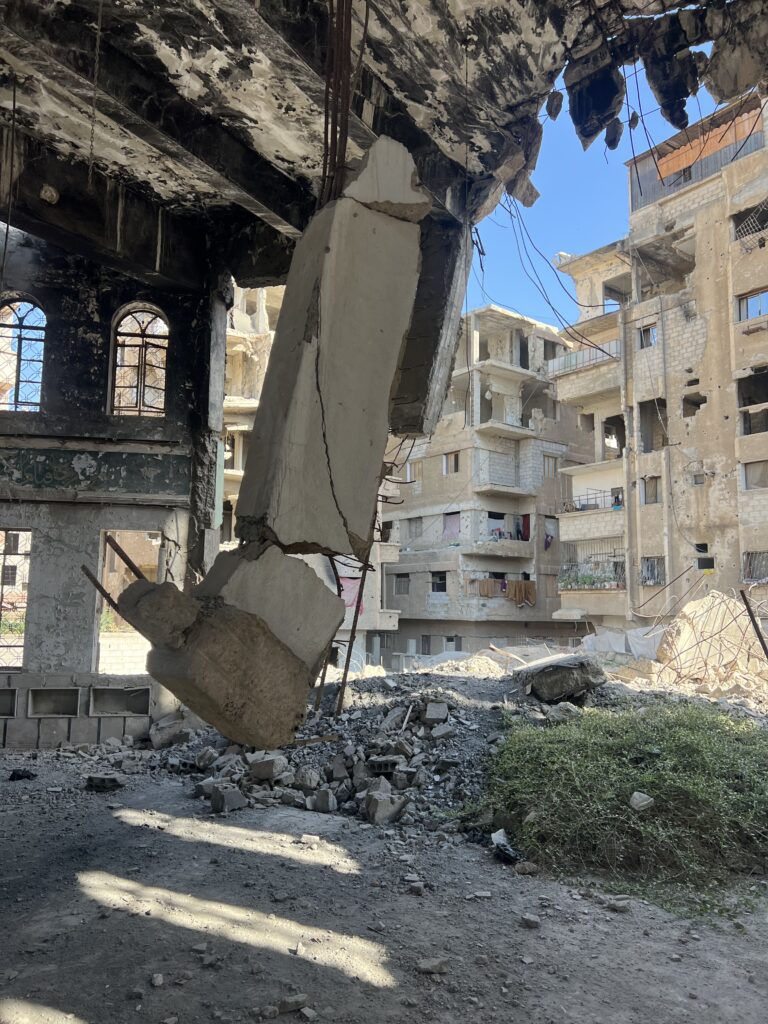
It should be a time of celebration, but for those living among the remnants of destruction, grief is pervasive. “Before the war, I would always wear white, but ever since the first death in our family, I’ve not taken off my black scarf,” Khadijah says. “I continue to be in mourning,”
Like so many others in Syria’s Zabadani region, Khadijah and her family hail from generations of experienced, hard-working farmers. But the land, once celebrated for its apple orchards, vineyards, and lush farmland that helped feed Damascus, endured one of Syria’s longest and most punishing sieges. Between 2015 and 2017, barrel bombs, airstrikes, and artillery shells rained down, destroying irrigation systems, flattening farmland, and contaminating the earth with heavy metals, TNT, and fuel residues. The blockade also choked off agricultural inputs—seeds, fertilizers, and clean water, leading to the collapse of a once-thriving rural economy.
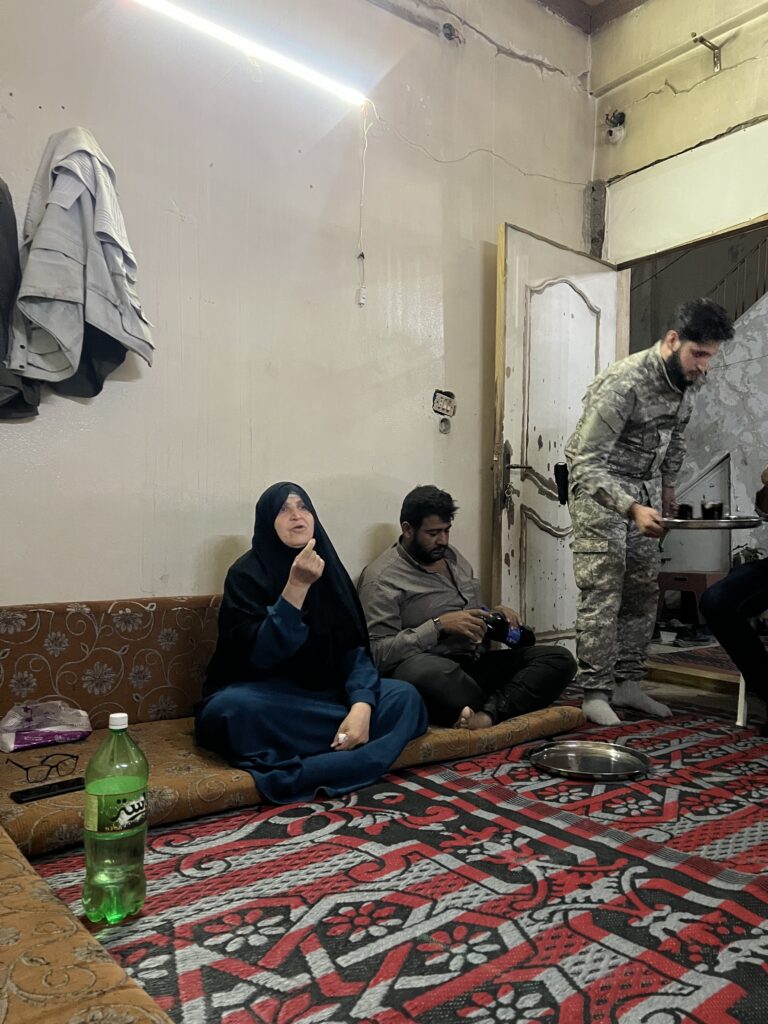
“We’d feed an entire town with our fruits and vegetables, but now, we barely have enough to feed our own family,” says Khadijah, whose grievances are evident when you visit her farm, where the soil is depleted and infrastructure destroyed.
“The only people whose farmland was spared were the people who cooperated with the Assad regime,” Khadijah explains. “We’re grateful to be alive, and we will rebuild, even though right now, we just don’t know how.” Later, she recalls the harrowing days in 2015 when she, her two daughters, and her then two-year-old grandson, Ammar, were displaced to nearby Madaya as the Assad army besieged Zabadani. Soon, those under siege in Madaya were facing severe food shortages and starvation under a blockade imposed by Assad’s forces and his allies Russia and Iran-backed Hezbollah.
“Ammar’s father [my son-in-law] was just killed…when we were forcefully moved to Madaya,” she says. “We had so much grief. “For the nearly two years that followed, we had nothing to survive on except rationed sugar, bread, and at times animal feed and grass.”
It wasn’t until 2017, following months of siege, that Khadijah and her family were relocated to opposition-held Idlib where they continued to live in displacement with little means to support the family.
Now 22, Ammar is studying to be a medical technician in Idlib—a city that remained the only lifeline for hundreds of thousands of displaced Syrians during the war. Visiting his grandparents in Zabadani, he brings in freshly made Arabic coffee and sits next to his grandmother and 37-year-old uncle Omar, who lost an eye in the war. Both men look at Khadijah with deep respect and endearment. “Every single mother in Syria has suffered tremendously, including my own mother and my grandmother; but we are of this land, and we’re happy to be back,” said Ammar.
The Flowers Still Bloom
Across Syria, the devastating impact of warfare is as environmental as it is emotional.
Just an hour’s drive from Damascus, 35-year-old Hiba walks through her hometown of Duma in Eastern Ghouta, stopping at a perfume shop to buy rose-scented oils—a defiant joy after surviving years of siege, bombardment, and chemical attacks. “Everything above ground was destroyed,” she says, recalling giving birth during the war in a half-collapsed clinic with no medicine, water, or electricity. Today, Hiba calls her 7-year-old daughter, Sally, her best friend and the person who makes life meaningful. “She loves riding her scooter and wants to be a pharmacist,” Hiba shares.
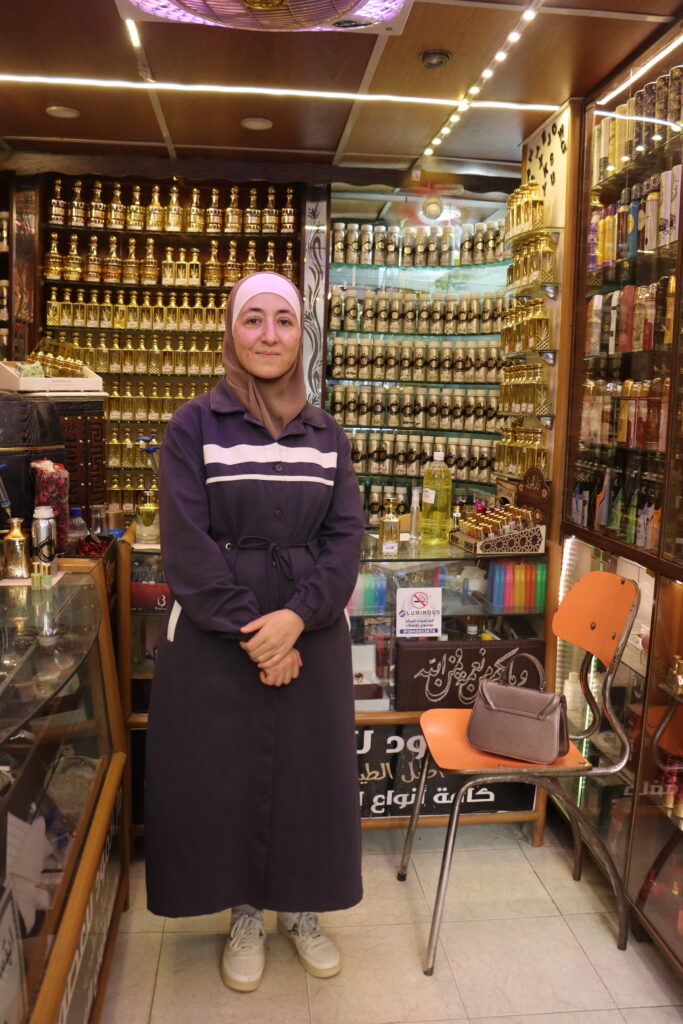
During the war, inspired by her family’s struggles caring for her younger brother with Down syndrome, Hiba began working with children with special needs—a profession she continues to this day, despite her own personal battles.
“People were disconnected from the world,” she says, pointing to what once was her house—a collapsed building lying under the weight of repeated barrel bombs and artillery strikes. “Our country is destroyed, but we mustn’t forget what happened to us. Our children must remember everything—so it doesn’t happen again.”
Both Zabadani and the Eastern Ghouta regions stand as stark evidence of how siege warfare and chemical weapons became tools of collective punishment—obliterating not just lives, but the ecosystems and livelihoods that sustained millions of ordinary civilians, including mothers, who are now searching for hope amidst rubble.
Back in Zabadani, 35-year-old Lana—a mother of two toddler boys—walks the grounds of her grandfather’s house and what was once her safe haven as a child.. She is a psychologist who has recently returned to her flattened town after years of life as a refugee in Lebanon. Today, along with her husband, she’s back “home,” doing what she once dreamed of doing for her own people and community.
“This is my grandfather’s home. My daddy grew up here,” she says. “We used to play here as children.”
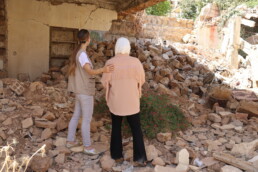
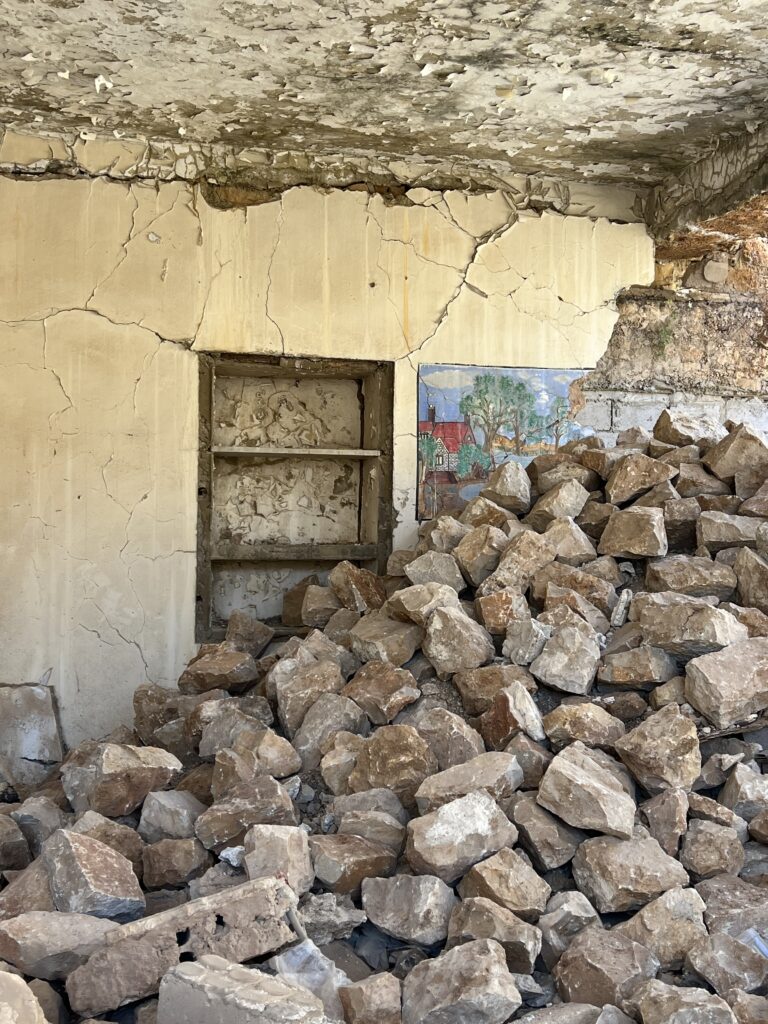
The building’s walls are pocked with shrapnel holes and its ceilings blown down into rubble, but as we climb up and walk into the remnants of the house, she suddenly turns around, tearing up. On a half-collapsed wall, a faint drawing survives—painted decades ago by Lana’s father as a child, and depicting a red house surrounded by trees and a bright blue lake—the last fragile trace of a family’s life before war.
“My daddy was an artist. I have to tell him this is still here.” She looks at the flowers growing from underneath a pile of stones and smiles: “See, even in the middle of this destruction, we still have flowers bloom. There is hope, Tara. We are here.”
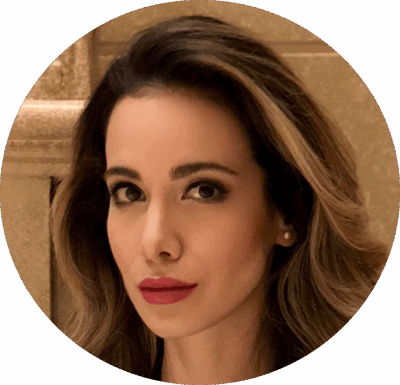
Tara Kangarlou is an award-winning Iranian-American global affairs journalist who has produced, written, and reported for NBC-LA, CNN, CNN International, and Al Jazeera America. She is the author of The Heartbeat of Iran, an Adjunct Professor at Georgetown University, and founder of the NGO Art of Hope.