
Serving Looks While Serving the Lord
Meet Flamy Grant, the drag queen with a chart-topping Christian music album.
BY BAILEY WAYNE HUNDL
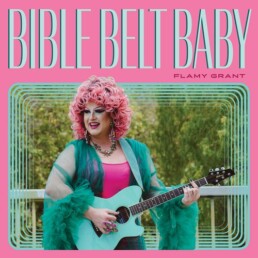
Flamy Grant is a “shame-slaying, hip-swaying, singing-songwriting” drag queen from western North Carolina. Her name is a reference to 90s Christian pop star Amy Grant, and her album Bible Belt Baby centers on her journey as a queer person of faith—which, apparently, some people aren’t too happy about.
On July 26, infamous MAGA pastor Sean Feucht angrily tweeted about Grant, lamenting that “these are truly the last days,” and that Christian music from a drag queen was the “end goal” of the progressive Christian movement.
“End goal?” Grant tweeted back. “Baby, we’re just getting started. 😘”
And she meant what she said. Feucht told Grant that “hardly anyone listens or cares what you do,” so she rallied her fans on social media to get her songs on the Christian music charts. And by the next morning, her album had reached No. 1 on iTunes.
As a drag queen/queer Christian myself, I had to sit down with this diva and get into it all: the drama, the trauma, and what she hopes to give any Christian—both queer and the other kind.
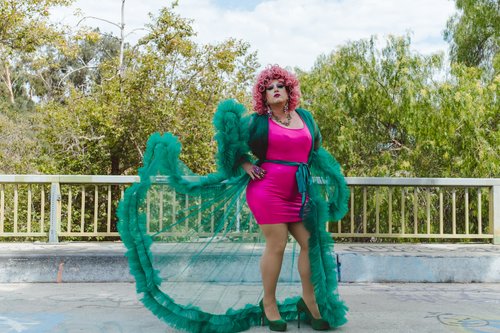
Bailey Wayne Hundl: Over the last ten days, you have been in People, Rolling Stone, Billboard—when you put out your album, did you ever envision something like this happening?
Flamy Grant: Not to this degree. You know, I saw what happened with Semler, a good friend of mine, and they're the first out queer artist to hit number one on the [Christian] iTunes charts. So I knew that it would be a big deal if a drag queen got on the iTunes charts. But I just thought it would be a cool moment of representation. I would've been happy with that, but like, my gosh, to have a Rolling Stone article that I can now point to… It's crazy. It's massive.
When you started doing drag and mixing that with Christian music, was that your intention—to get as many eyes on it as possible?
My intention has been to have a career, so whatever it takes to pay my bills. That's been my intention.
And that's just the first rule of drag. Get your bag.
(laughs) Exactly. Yes. My second purpose and intention is to— I always tell people that I write for queer folks, specifically queer folks who grew up in evangelicalism or other high-demand religions who will resonate to that story of having to unburden yourself of a whole heap of oppression that was dropped on you. And then finding freedom, finding liberation, finding your sparkle.
You’ve been a worship leader in church since high school. What led you to add drag to that?
Well, the pandemic, honestly. I got super into drag in my mid-thirties. I've always been a late bloomer at everything because, you know, religious trauma. I mean, I didn't even come out fully until I was 28. So it took a few more years to really become ingrained in queer culture. So once I fell in love with drag, I was just all about it.
And the pandemic gave me the time. I live [in] this house with some housemates who are also musicians. So we started a livestream, like many artists did during the pandemic, where we would just sing cover songs every Thursday night to, like, 30 people on Facebook. I started showing up to those in drag and really that's where Flamy developed her chops, if you will.
[One day] my pastor asked me to give the sermon in drag…so I made a TikTok video to practice and gave a little [uplifting message] in 60 seconds while I was painting my face. And I woke up the next morning and it had completely blown up and gone viral. And I was floored at the responses: “This makes me feel so seen.” “It makes me feel so safe.”
And that inspired you to release a Christian album.
First of all, my record feels like a spiritual record, and I come from the evangelical world, so why not call it a Christian record? It's telling a spiritual journey. It's speaking to people who are still in the church. It's speaking to people who have oppressed queer people in the church. That's the audience that it's for, really. So it just made sense to put it in the Christian category.
I struggled with that a lot because the word “Christian” is so loaded in America—because it's been co-opted by evangelicals. I always like to make this point: Evangelicalism is a sect of Christianity. It is not representative of the entire faith. What we understand to be mainstream Christianity in America is not actually, like, historically Christian.
https://www.youtube.com/watch?v=feSr8mlljzU
One thing that queer people of faith get asked a lot is, “How do you reconcile these two disparate worlds?” But I'm curious: Why do you continue to reconcile the two worlds?
Well, I mean, first and foremost, I think the main reason is simple: It's representation. I don't see anybody else who's intentionally trying to be a Christian in the [contemporary Christian music] genre, trying to do that as a drag queen in particular.
And then, because I grew up the way I did, I know what it's like to be a kid who has just nothing to look at that looks or feels like me—to feel like you are such an anomaly and to feel like you are such a broken thing.
So knowing that I can be there, present, especially in such a visible way—because that's the thing about drag: It's a very visibly queer art form. You know, we can see a picture of a drag queen, but then if you get to spend 45 minutes with her, listening to her heart…to hear a full record where I'm talking about this stuff…that's gonna make [an impact].
And a good record, too, if you don't mind me saying.
Thank you! I don't mind you saying it at all. You can say it many times. I'm very proud of it.
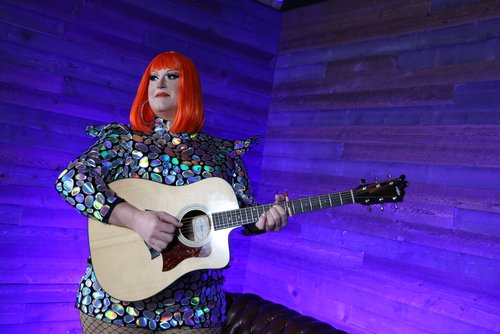
Last question: If you could get just one thing across to the church, what would that be?
My answer might be a little skewed right now, because the past two weeks I've just been inundated and saturated with comments from Christians on the internet who make wild assumptions.
But my encouragement to Christians would be to just listen a little bit. Go listen to three of the songs on my record. And if you don't wanna engage with me, at least take that posture to queer people in your life. And if you don't know any queer people in your life: Yes, you do. You just don't know that they're queer yet.
Just push pause for just a little bit. I know you feel righteously compelled to speak. You feel educated about it because you've read six Bible verses. But there's a whole life story in each of us that I promise if you really hear—it's gonna have an impact on you. And it may not change your mind about homosexuality, but it may give you a window into a life that you would otherwise roll your eyes at or type a vomit emoji at.
Just listen as hard as you can for as long as you can. And see what happens.

The one thing Barbie never was
  July 20, 2023 Come on, Meteor readers, let’s go party, After years of anticipation, debate, hot pink outfits, and hot pink lake water, the Barbie movie premieres tomorrow. In today’s newsletter, culture critic Scarlett Harris combs through the 64-year history of the controversial doll to understand the (potentially radical) reasons why she never became a mother. And because we know you are obsessed like we are, we’ve also assembled The Ultimate Barbie Reading Guide, covering everything from the doll’s accidental feminist legacy to her impact on Black and brown girls. But first, the news. Thinking pink, Bailey Wayne Hundl  WHAT'S GOING ON Texas women fight back: Three women testified yesterday as part of a 15-plaintiff lawsuit against the state of Texas for allegedly being denied life-saving abortion care due to the state’s draconian abortion ban. The ban, one of the most severe in the country, makes it a felony to perform an abortion, and doing so could result in a fine of up to $10,000, the loss of the doctor’s medical license, and up to a lifetime in prison. The suit brought by the Center for Reproductive Rights asks for the law to be temporarily blocked and for the state to clarify what constitutes a medical emergency that will allow for an abortion. One of the women who shared her harrowing experience on the stand was Amanda Zurawski, who first told her story to the Meteor last fall. Zurawski was denied the procedure, her life put at risk. “I survived sepsis, and I don’t think today was much less traumatic than that,” she said. Another plaintiff, Samantha Casiano, shared that she was forced to deliver her fetus even after learning it would not develop a skull or brainstem. As she told her story, she vomited on the stand, and the court had to go into recess. This hearing is nothing short of historic. According to the Texas Tribune, these women are likely the first to testify about the impacts of abortion bans on their bodies since 1973. Despite their courageous testimony, the state is pushing back, claiming the law doesn’t need to be amended and putting the onus instead on doctors. But that doesn’t change the fact that if these women win, Texans who need abortions will not have to go through what they did. AND:
 LIFE IN PLASTICBarbie, Child-Free IconBY SCARLETT HARRISThere's only one thing this doll hasn't done. Why, exactly?  A BARBIE DOLL LOUNGES IN HER PACKAGING. (PHOTO BY DAVID BENITO/GETTY IMAGES) The opening scene of Barbie, the much-anticipated movie event hitting cinemas tomorrow directed by Greta Gerwig and starring Margot Robbie, is a parody of Stanley Kubrick’s 2001: A Space Odyssey. In it, young girls smash their baby dolls in favor of Robbie’s Barbie. Outfitted in the fashion doll’s original get-up of a black-and-white-striped bathing suit, cat-eye sunglasses, and permed bangs, Robbie stands in the center, a glamazon, signaling the dawn of a new woman.  Barbie, the doll, was conceived by Ruth Handler, an executive at Mattel, in the 1950s. After observing her daughter, Barbara, for whom Barbie is named, assigning adult roles to her paper dolls, she came up with the idea—and modeled her creation after a doll based on a German comic strip chronicling the life of a sex worker, Bild Lilli. Before Barbie hit the market in 1959, dolls for girls were primarily babies meant to teach their owners the caregiving skills they would inevitably need for lives of housewifery and childrearing. But Barbie brought something new: She represented a wide range of fulfilling lifestyles outside of traditional feminine responsibilities. Barbie could be anything she wanted: an astronaut, an artist, even the President. But, in all these years, she’s never wanted to be a mother. Barbie’s impact has been widely debated, and Barbie leans into this. Is she a feminist icon or nightmare? But one thing cannot be denied: Since her inception, Barbie has been the main character of her own story. She was made to be someone rather than someone’s someone. And in keeping with Barbie tradition, the film’s fantastical Barbieland does away with traditional gender roles. Ken (launched as a boyfriend doll in 1961) lives in service of Barbie, even going so far as to be referenced as “and Ken” in his mugshot—a pure appendage, even if Ken doesn’t have one himself. In a reversal of the biblical creation myth, Ken is spawned from Barbie. “I only exist in the warmth of your gaze,” he says. And, unlike Barbie, he has no occupation—his job is literally described as “beach” in the film. The message was radical for its time: When the doll debuted, there were few images of female breadwinners. Women couldn’t even get a credit card in their own name without permission from a father or husband until 1974, almost twenty years after Barbie had enjoyed financial independence and career achievement in fields such as modeling (her first occupation), nursing (1961), space and aeronautics (1965 and 1966, respectively), surgery (1973) and Olympic gymnastics (1974). All those jobs become even more impressive when you consider that, canonically, Barbie is 19 years old. Maria Teresa Hart, the author of the book Doll, points out that her age at the time of her introduction would have put her on the precipice of two possible paths: marriage and babies or continuing her current lifestyle as a Career Girl with a bevy of friends. “That ambiguity is part of the attraction: she’s at this tipping point where she could make a variety of choices,” says Hart. “Every avenue is open to her.”  MARGOT ROBBIE AT A PRESS JUNKET FOR THE BARBIE MOVIE (PHOTO BY RODIN ECKENROTH/FILMMAGIC) And yet Barbie never travels down the avenue of parenthood, unless you count the amount of time she spent caring for her sisters, Stacey and Chelsea. (If, during your childhood, Barbie’s youngest sister was named Kelly: congratulations, you’re officially old and missed Kelly’s rebrand as Chelsea in 2011.) Barbie’s childlessness was intentional: Handler wanted to show her daughter that fulfillment can exist outside of the home. In the film, her open-plan, multi-story dream house is a dwelling for one—no child safety, no doors. “It’s very definitely a house for a single woman,” production designer Sarah Greenwood told Architectural Digest. Barbie’s other accessories weren’t made with would-be kids in mind, either—the Barbie Porsche convertible I had as a child definitely didn’t have a car seat, and the only baby in sight belonged to the much-maligned Midge, a visibly pregnant doll who was discontinued as Barbie’s bestie in 1967, only to reappear later as Barbie’s married mother friend sans baby bump (though she still angered conservative parents who thought she wasn’t coded strongly enough as a married woman). Documentary filmmaker Therese Schechter, who most recently directed the child-free doco My So-Called Selfish Life, expresses incredulity about Midge’s predicament. “No one has children in that world; why is Midge going to have a baby?” For some, Barbie might still just be a silly doll with an eternally perky and unattainable body. But, as Willa Paskin wrote, Barbie being child-free “remains one of the most radical things about her.” And in a country hell-bent on forcing more and more people to give birth, her childlessness takes on a new and refreshing meaning. As Robbie noted in Vogue, Barbie doesn’t have reproductive organs—which is probably why the elected representatives of Barbieland haven’t tried to police what she does in the Dreamhouse bedroom. Scarlett Harris is a culture critic and author of the book A Diva Was a Female Version of a Wrestler: An Abbreviated Herstory of World Wrestling Entertainment. You can follow her on Twitter @ScarlettEHarris and read her previously published work at her website, The Scarlett Woman.  WEEKEND READSTomorrow is the official premiere of the Barbie movie, so we’ve put together The Ultimate Barbie Reading Guide for everyone who loves—and hates!—the world’s most famous doll.
FOLLOW THE METEOR    Thank you for reading The Meteor! Got this from a friend?
|


Barbie, Child-Free Icon
There's only one thing this doll hasn't done. Why, exactly?
By Scarlett Harris
The opening scene of Barbie, the much-anticipated movie event hitting cinemas tomorrow directed by Greta Gerwig and starring Margot Robbie, is a parody of Stanley Kubrick’s 2001: A Space Odyssey. In it, young girls smash their baby dolls in favor of Robbie’s Barbie. Outfitted in the fashion doll’s original get-up of a black-and-white-striped bathing suit, cat-eye sunglasses, and permed bangs, Robbie stands in the center, a glamazon, signaling the dawn of a new woman.
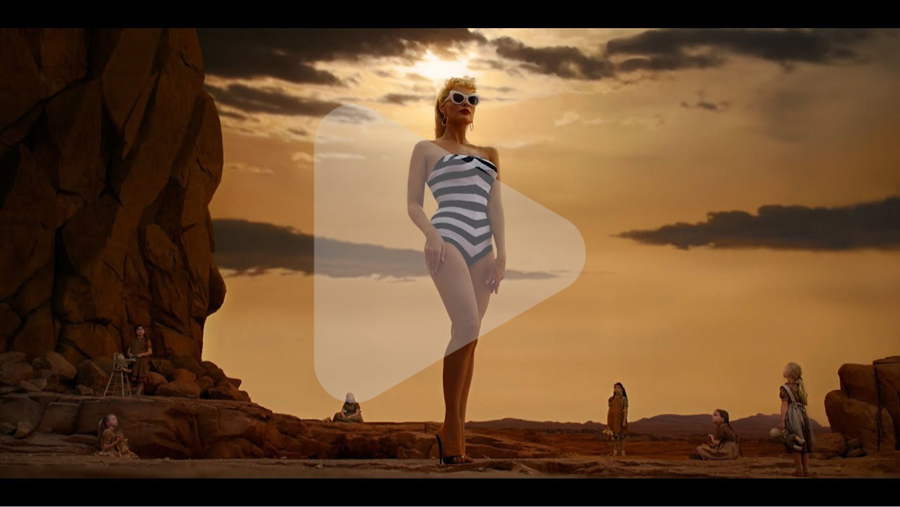
Barbie, the doll, was conceived by Ruth Handler, an executive at Mattel, in the 1950s. After observing her daughter, Barbara, for whom Barbie is named, assigning adult roles to her paper dolls, she came up with the idea—and modeled her creation after a doll based on a German comic strip chronicling the life of a sex worker, Bild Lilli.
Before Barbie hit the market in 1959, dolls for girls were primarily babies meant to teach their owners the caregiving skills they would inevitably need for lives of housewifery and childrearing. But Barbie brought something new: She represented a wide range of fulfilling lifestyles outside of traditional feminine responsibilities. Barbie could be anything she wanted: an astronaut, an artist, even the President. But, in all these years, she’s never wanted to be a mother.
Barbie’s impact has been widely debated, and Barbie leans into this. Is she a feminist icon or nightmare? But one thing cannot be denied: Since her inception, Barbie has been the main character of her own story. She was made to be someone rather than someone’s someone. And in keeping with Barbie tradition, the film’s fantastical Barbieland does away with traditional gender roles. Ken (launched as a boyfriend doll in 1961) lives in service of Barbie, even going so far as to be referenced as “and Ken” in his mugshot—a pure appendage, even if Ken doesn’t have one himself. In a reversal of the biblical creation myth, Ken is spawned from Barbie. “I only exist in the warmth of your gaze,” he says. And, unlike Barbie, he has no occupation—his job is literally described as “beach” in the film.
The message was radical for its time: When the doll debuted, there were few images of female breadwinners. Women couldn’t even get a credit card in their own name without permission from a father or husband until 1974, almost twenty years after Barbie had enjoyed financial independence and career achievement in fields such as modeling (her first occupation), nursing (1961), space and aeronautics (1965 and 1966, respectively), surgery (1973) and Olympic gymnastics (1974).
All those jobs become even more impressive when you consider that, canonically, Barbie is 19 years old. Maria Teresa Hart, the author of the book Doll, points out that her age at the time of her introduction would have put her on the precipice of two possible paths: marriage and babies or continuing her current lifestyle as a Career Girl with a bevy of friends. “That ambiguity is part of the attraction: she’s at this tipping point where she could make a variety of choices,” says Hart. “Every avenue is open to her.”
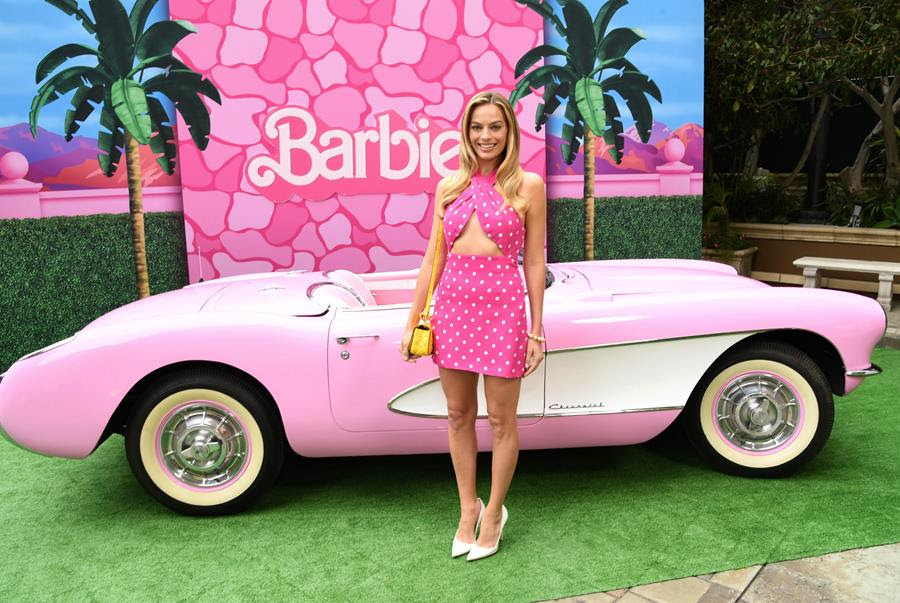
And yet Barbie never travels down the avenue of parenthood, unless you count the amount of time she spent caring for her sisters, Stacey and Chelsea. (If, during your childhood, Barbie’s youngest sister was named Kelly: congratulations, you’re officially old and missed Kelly’s rebrand as Chelsea in 2011.) Barbie’s childlessness was intentional: Handler wanted to show her daughter that fulfillment can exist outside of the home. In the film, her open-plan, multi-story dream house is a dwelling for one—no child safety, no doors. “It’s very definitely a house for a single woman,” production designer Sarah Greenwood told Architectural Digest.
Barbie’s other accessories weren’t made with would-be kids in mind, either—the Barbie Porsche convertible I had as a child definitely didn’t have a car seat, and the only baby in sight belonged to the much-maligned Midge, a visibly pregnant doll who was discontinued as Barbie’s bestie in 1967, only to reappear later as Barbie’s married mother friend sans baby bump (though she still angered conservative parents who thought she wasn’t coded strongly enough as a married woman). Documentary filmmaker Therese Schechter, who most recently directed the child-free doco My So-Called Selfish Life, expresses incredulity about Midge’s predicament. “No one has children in that world; why is Midge going to have a baby?”
For some, Barbie might still just be a silly doll with an eternally perky and unattainable body. But, as Willa Paskin wrote, Barbie being child-free “remains one of the most radical things about her.” And in a country hell-bent on forcing more and more people to give birth, her childlessness takes on a new and refreshing meaning. As Robbie noted in Vogue, Barbie doesn’t have reproductive organs—which is probably why the elected representatives of Barbieland haven’t tried to police what she does in the Dreamhouse bedroom.
Scarlett Harris is a culture critic and author of the book A Diva Was a Female Version of a Wrestler: An Abbreviated Herstory of World Wrestling Entertainment. You can follow her on Twitter @ScarlettEHarris and read her previously published work at her website, The Scarlett Woman.

What the Hollywood strike means for labor
  July 18, 2023 Hello hello, Meteor readers, As you may be acutely aware right now: We’re currently having the hottest summer of all time. In fact, yesterday was the hottest day the entire Northern Hemisphere has had in recorded history. (Mondays, am I right?)  In today’s newsletter, we’re looking at what the joint writer's/actor's strike means for the rest of us, as well as the largest oral history of activism from young girls. Cranking that fan, Bailey Wayne Hundl  WHAT'S GOING ONHot labor summer, cont.: The Writers Guild of America (WGA), representing more than 11,000 film and TV writers, has been on strike since May 2. And last Thursday, July 13, those writers were joined by the 160,000 members of the Screen Actors Guild (known as SAG-AFTRA). That’s right: Hollywood is looking at a double strike for the first time in 63 years. No Teds will be Lassoed and no Things will be Strangered—not until the networks are willing to negotiate with their workers (and not just kill trees to deny them shade). It could be easy to write off the actors’ strike as symbolic as actors are already mega-rich. But that is not so, hypothetical dissident! Michelle Hurd, vice president of SAG-AFTRA’s Los Angeles chapter, says that the number of SAG-AFTRA members who do not have consistent work has risen to 98 percent. “There’s a perception out there that everyone is doing great, that this career choice is lucrative for everyone, when that’s just not true,” Hurd told actor/writer Amber Tamblyn last weekend. “In reality, most SAG members are worried about making rent, let alone buying a home.” In order to make the rent between jobs, actors and writers rely on residuals, recurring payments based on a share of the profits earned by a particular TV show or movie—or at least, that’s how it works in theory. Historically, this led to even minor actors on major hit films and television shows receiving reasonable residuals for years after their projects had wrapped. But things look different in the streaming era. For example, Kimiko Glenn, who played Brook Soso in one of the first big streaming hits on Netflix, “Orange is the New Black,” shared one of her recent residual statements on TikTok; for all 44 episodes she appeared in, her residual compensation was $27.30. For comparison, Ben Haist, who appeared for two minutes as a background actor in 2011’s “Pitch Perfect,” shared that he still receives a residual check for $200-300 per quarter. In other words, the economics have become more challenging for workers in this industry. But that’s before the rise of AI, which threatens to make things worse: SAG-AFTRA Chief Negotiator Duncan Crabtree-Ireland shared that during negotiations, the networks proposed “that background actors should be able to be scanned, get paid for one day’s pay, and their company should own that scan...to be able to use it for the rest of eternity.” This would, presumably, include generating new scenes based on that character’s likeness—all for a paycheck of less than $200. All of this is just part of the reason these strikes matter to all of us, whether or not you’ve got anything to do with the entertainment industry. For one thing, the arts are a necessary part of a healthy and functioning society. (What would the pandemic have been without streaming TV?) But also, at a time when tensions around AI in the workplace are already rising, the writer’s/actor’s strike could be a watershed moment for all workers’ equity, one that lets employers know that employees deserve—and will demand—compensation for the labor that makes AI systems work. Studio executives have already claimed that their plan is to wait until union members “start losing their apartments and losing their houses.” If you’d like to keep that from happening, you can donate to the Entertainment Community Fund to keep striking workers afloat. Let’s hear it for the girls: An important report just dropped from UN Women at the Women Deliver conference in Rwanda—and the findings are jarring. Of the 114 countries surveyed, researchers found that not one had achieved true gender parity. What’s worse: Less than 1 percent of women and girls around the world live in a country with high women’s empowerment or a reduced gender gap—and on average, women only reach 60% of their potential in crucial categories like health, education, decision-making, and freedom from violence. (So maybe we can drop the idea that the fight for gender equality has gone too far, hm?)  If you need a shot of hope after reading this, you might consider looking at the next generation of girls, who are increasingly vocal and visible right now—as you know if you spotted a picture of Greta Thunberg flipping off members of the European Parliament in your Instagram feed last weekend. Now this powerful and passionate demographic have a history book of their own: The largest-ever oral history of girls’ activism comes out this week, and it was feted Sunday by Malala in Kigali, Rwanda. Stories of Girls’ Resistance chronicles 150 activists from 90 countries—from Mamta in Fiji, who resisted arranged marriage (“stop marrying me off!” she exclaims), to Naomi in Kenya, who joined a strike on behalf of political prisoners when she was 17. The book is timely: “At a moment when we are seeing rising authoritarianism and attacks on human rights across the world,” co-author Jody Myrum and creative strategist Laura Vergara told the Meteor, “we need to invest in [girls’] resistance more than ever—both because girls’ rights are deeply under attack and because they hold the vision, strategies, and tactics to lead us to our collective liberation.” And—like Mattie Kahn, whose new book Young and Restless warns of the dangers of glamorizing young female leaders as singular figures without supporting them more meaningfully—the oral history sends a message that celebrating girls’ heroism isn’t enough. “Girls do not need any more ‘fame,’ ” said Myrum and Vergara, “but rather clear accountability and support for their work…They need to be meaningfully funded rather than treated as beneficiaries. Specifically for funders – it is time to take girls’ resistance seriously. Move significant resources directly to girls, not thousands but billions.” AND:
  FOLLOW THE METEOR Thank you for reading The Meteor! Got this from a friend?
|

A historic day for the pill
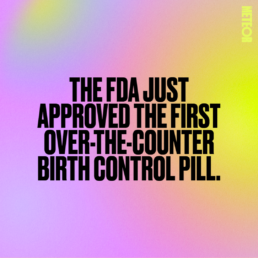
  July 13, 2023 Hello again, Meteor readers, We are officially less than ten days away from the Barbie movie opening, and I don’t know about you, but I’m stoked. My boyfriend and I got matching outfits for the premiere, and today’s newsletter will actually be a 50,000-word essay unpacking the feminist significance of everyone’s favorite plastic doll. 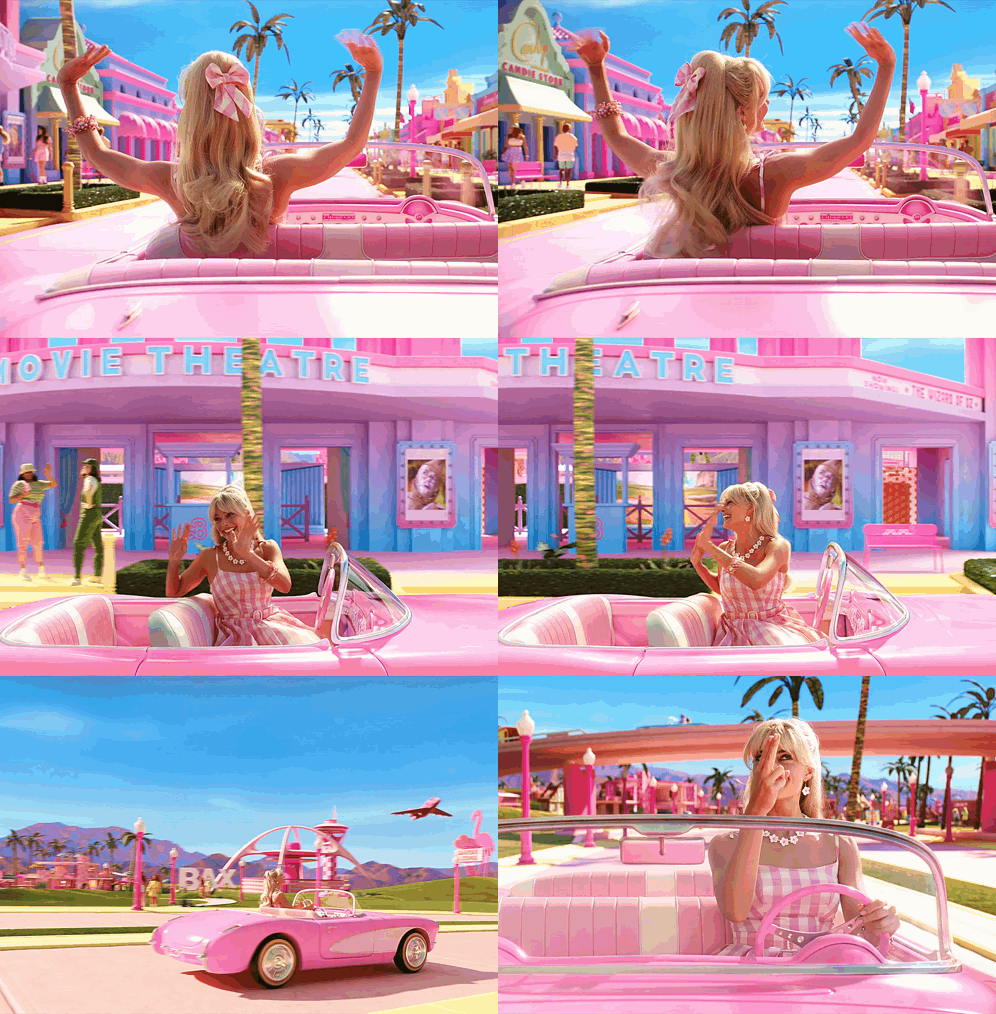 Kidding! Today’s newsletter actually features a monumental step forward for reproductive rights, studio executives exhibiting “Christmas Carol” levels of villainy, trans people winning (what else is new?), and Justice Clarence Thomas’ latest ethics issues. Trying on every shade of pink I can find, Bailey Wayne Hundl  WHAT'S GOING ONA huge birth-control victory: For the first time ever, the FDA has approved a birth control pill for all-ages use without a prescription. Opill, a progestin-only pill to be taken once daily, is set to be available for over-the-counter purchase by early 2024, according to Perrigo, the pill’s manufacturer.  How did this feel for contraceptive experts? “Like Christmas!” said Dr. Heather Irobunda, an OB-GYN and one of the founders of Obstetricians for Reproductive Justice. “I’m very happy this happened. It’s an important step in destigmatizing reproductive health meds.” And it’s hardly a radical step: Birth control pills are already sold over-the-counter in over 100 other countries. But this victory serves as a powerful message that birth control is safe and popular—at a time when conservatives are beginning to target contraception, both culturally and politically. As the director of the FDA's Center for Drug Evaluation and Research, Dr. Patrizia Cavazzoni, pointed out, Opill is “safe and is expected to be more effective than currently available nonprescription contraceptive methods.” This decision does, however, raise questions we don’t yet have answers to:
And putting the pill—varieties of which have been safely used for five decades—on store shelves makes sense, says Dr. Irobunda. Keeping it prescription-only, she notes, signaled that “they didn’t trust us to know how to take it. This is a safe drug and can be easily managed, but ‘behind the counter’ made it something that we needed to consult with someone ‘who knows our bodies better’” in order to take. But as reproductive rights advocates have been saying this whole time, who knows our bodies better than us? AND:

 WEEKEND READSOn abortion rights: Last election cycle, all six states with abortion on the ballot scored a win for abortion access. This cycle’s game plan: Do it again, but even better. On (un)fair pay: “Orange is the New Black” was huge for Netflix—so why wasn’t it huge for all the people who worked on it? On positive masculinity: Toxic male gender roles can be like quicksand for young men. But there’s a way out. On “doing the work”: The Meteor’s Samhita Mukhopadhyay explores how social justice organizations can be as active in supporting their staffs as they are in supporting their causes.  FOLLOW THE METEOR    Thank you for reading The Meteor! Got this from a friend?
|


The cops are sliding into your DMs
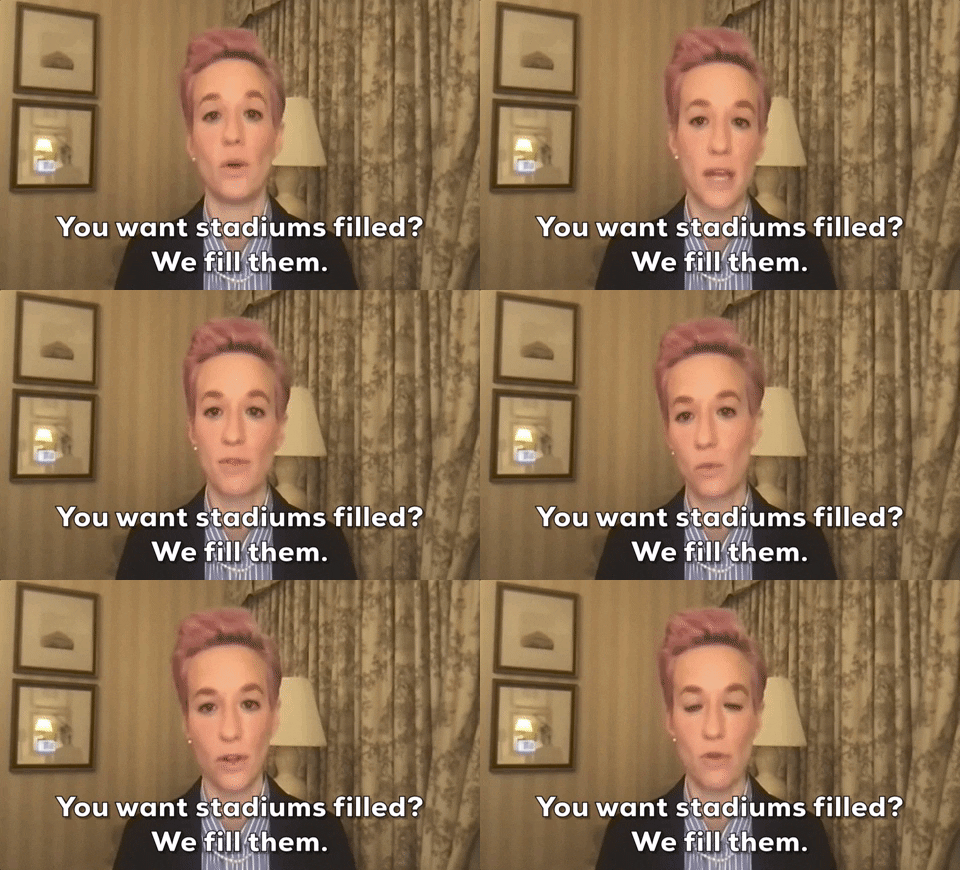
  July 11, 2023 High vibrations, Meteor readers, It’s 7/11! All my numerology girlies just nodded while the rest of you are wondering why I feel the need to state the date. But ~mystically speaking~ when those two numbers appear together, they become a powerful and affirming “angel number,” which numerologists say can serve as a reminder to move forward within your intuition and a sign that the universe is open to providing you with new opportunities.  Meanwhile, here on earth: we’ve got a troubling update on a Nebraska abortion case, an AI lawsuit, and a fond almost-farewell to Megan Rapinoe. Reading the stars, Shannon Melero  WHAT'S GOING ONPrivacy: Last week, a mother in Nebraska pled guilty to helping her daughter obtain an illegal abortion and discard the fetus after it was expelled. Now Jessica Burgess and her daughter Celeste, 18, are both looking at jail time for their actions. You may remember Jessica and Celeste’s case from last August, shortly after the overturn of Roe v Wade, when charges were first filed against them. What made the case unique was not simply the fact that two women were going to be tried for acquiring and using abortion pills in a state where it was newly illegal—but also the questions the case raised about data privacy. A refresher: After Celeste found out she was pregnant, she and her mother communicated via Facebook messages and came up with a plan to end the pregnancy and discard the fetus so as not to leave behind any evidence. Because Celeste was already 20 weeks pregnant and Nebraska bans abortion after 12 weeks gestation, the two knew they could not go to a medical provider to do any of this—hence the secrecy. They thought the messages they shared about the ordeal were private. But Facebook’s parent company, Meta, turned over their correspondence to the police after being served with a search warrant (pertaining to a different investigation)—and the police had what they needed to charge the mother and daughter. The case was among the first to highlight just how vulnerable abortion seekers, many of whom rely heavily on online searches for care, had become in the immediate aftermath of Dobbs. As Shamira Ibrahim wrote for The Meteor last year, apps that use location data and cookie tracking “help law enforcement investigate and prosecute abortion-seekers and their respective networks of support.” That’s exactly what happened in the Nebraska case. Now the women face up to two years in prison, and a man who helped them bury the fetus was also charged and given probation. If you or someone you know lives in an abortion-ban state and needs care, Ibrahim suggests visiting the Digital Defense Fund, which provides steps for protecting your abortion-related data privacy—from Facebook, the phone company, and anyone else you don’t want to know your business. AND:
  FOLLOW THE METEOR Thank you for reading The Meteor! Got this from a friend?
|

Are legacy admissions inherently racist?
  July 6, 2023 G’day mates, It’s been a busy few days this week. First off, Wimbledon is underway. I’m trying to turn my infant into a tennis prodigy by osmosis, so we’re really getting into these matches together. Once it’s over, we’ll be hitting the court to see what she’s learned. 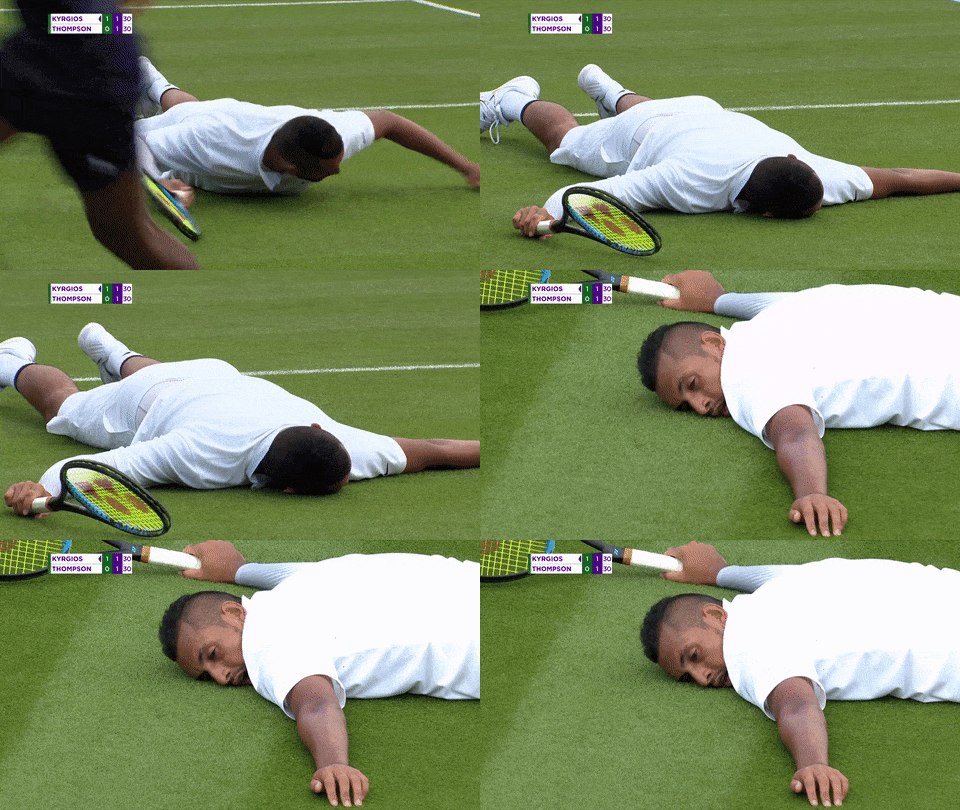 Also having a busy week: Mark Zuckerburg, who launched his latest offensive in the battle of the billionaires in the form of a new social media platform called Threads. Elon clapped back by threatening a lawsuit. Keeping all of the social media managers I know in my prayers tonight. If you’re one of the 10 million people who signed up for Threads in its first hours of life, give us a follow! In today’s newsletter, we’re chatting about college admissions, the attack on Jenin, and checking in on Greta Thunberg. Working on my forehand, Shannon Melero  WHAT'S GOING ONOut of your (Ivy) league: The Supreme Court’s decision to eliminate affirmative action in college admissions is only seven days old. But Harvard, one of the schools at the center of the decision, won’t be getting any breathing room. On Monday, three civil rights groups came together to file a complaint with the Department of Education (DOE) against the school, challenging its use of legacy and donor-based admissions. The groups are arguing that these practices are in direct violation of Title VI of the Civil Rights Act and “are not justified by any educational necessity.” Quick refresher on what legacy admissions are: If Biff Moneysworth graduated from Harvard in 1999, then that means Biff Jr. will get special consideration when his application hits the admissions desk. Because Jr. is more likely to get in, that means one less spot for someone like Joanna, a first-generation applicant who has the grades but not the family connections. Considering that people of color weren’t allowed to even apply to Harvard (let alone any other Ivy league school) until after World War II, who is most likely to benefit from the maintenance of legacy admissions?  Harvard’s response to the SCOTUS decision and this latest complaint leaves much to be desired: “The University will determine how to preserve our essential values, consistent with the Court’s new precedent.” Yes girl, give us nothing. Obviously, this doesn’t mean that people of color will never get into Harvard, but the barriers just got a lot higher. And while affirmative action was an imperfect Band-Aid to the institutional racism that spawned legacy admissions, it was something. The groups behind the complaint are asking the DOE to investigate Harvard’s use of legacy admissions and decide whether or not it violates Title VI. They’re also asking the DOE to cut federal funding to Harvard unless the school removes legacy and donor considerations from the admissions process. If successful, this could once again change the landscape of college admissions—or at least force the courts to treat all forms of “preference” equally. But in such a secretive and subjective process, racism will always find a way through. As Dr. Anne A. Cheng told us last week, “The problem with college admissions is that it is itself such a vague process; it takes into consideration many factors, and every factor itself has the potential to hold racial and gender bias.” AND:
 WEEKEND READSOn immigration: How Trauma Migrates tells the story of migrant women’s journeys across America’s southern border and the untreated trauma that lingers once they make it. On SCOTUS: Did the Robed Ones quietly legalize stalking? Sort of. On sports: The iconic Venus Williams was defeated in the first round of Wimbledon this week, but her legacy reaches beyond even her 11 previous title wins. On parenthood: Diaper legislation? It’s a thing. And with the loss of abortion access, the once invisible problem of “diaper need” is more glaring than ever.  FOLLOW THE METEOR Thank you for reading The Meteor! Got this from a friend?
|

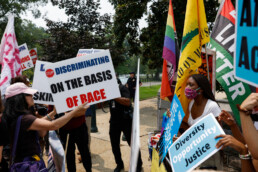
SCOTUS v. Affirmative Action
 June 29, 2023 Greetings, Meteor readers, It’s an unfortunate day for higher education. This morning, the Supreme Court handed down a ruling that will effectively end affirmative action in the college admissions process, rolling back what Justice Sonia Sotomayor, dissenting, called “decades of…momentous progress” and presenting yet another barrier for students of color. As a Latina from one of the poorest counties in the state of New York, the process of getting into college was grueling—years of Latin to help me perform better on the SAT, endless extracurriculars, the pressure to get high grades, the money my mother shelled out for an exorbitant prep-school tuition bill. All based on the understanding that I would only succeed if I was extraordinary. Only to finally make it and get called a “spic” by a stranger who wrote it on my dorm room door. It’s laughable that affirmative action was seen as preferential treatment when, for many of us, it was simply a way to gain access to a historically white institution and then spend four years proving you earned your way in. In today’s newsletter, Samhita Mukhopadhyay talks to Princeton University professor Dr. Anne A. Cheng about the ways students of color have been pitted against one another in this debate. Thinking of all the multicultural student unions today, Shannon Melero  WHAT'S GOING ON
 SCOTUSCutting Race-Based Admissions Will Not Help Asian American Students“Why do we assume that if you keep down the number of Asian Americans, you'll get more African Americans?” BY SAMHITA MUKHOPADHYAY  (IMAGE BY BILL CLARK VIA GETTY IMAGES) Today, the Supreme Court struck down the practice of affirmative action in college admissions. In two cases—one against Harvard and another against the University of North Carolina—the plaintiffs argued that considering race in the admissions process was a discriminatory practice, violating the Equal Protection Clause of the Constitution. The decision has been looming for months, but its implications are yet to be seen. That’s partly because the cases themselves are complicated, bringing to the surface core tensions in affirmative action—who it includes, who it leaves out, and why we ultimately need it. I spoke to Dr. Anne A. Cheng—a scholar of Asian American and African American literature and cultural theory at Princeton University—about all of it. Samhita Mukhopadhyay: What were your thoughts when you first heard the Supreme Court would be looking at race-based admissions in colleges? Dr. Anne A. Cheng: It is very complicated. Affirmative action is an imperfect and yet still necessary solution to a very broken social system in America. I am stunned by how persistent the debate is around affirmative action. I remember a long time ago, when I was a graduate student at Stanford, I was stopped on campus by someone wanting to take a photo of me because they wanted it to go with an article about some scandal about Asian American admission at Stanford and other elite institutions. That was several decades ago, and it's like we are still there. The thing that I've been trying to parse out in understanding the implications of this case are narratives like the myth of the model minority and how often immigrant communities are pitted against the African American community. Some of the plaintiffs in this case are Asian American students who believe that Black and Latine students were picked above them. Do you think there is validity to that anxiety? There are two different anxieties that I always see around this issue. One is Asian Americans feel like…there's a quota on them. [The Harvard case argued that Asians were discriminated against because race-conscious admissions led to Asian applicants scoring lower marks on traits like likeability, whereas the UNC case argued that Asian and white students were denied admission, their spots taken by Black and Latine students]. But there is [an] anxiety about Asian Americans overrunning American universities. And so, you're right...Somehow, affirmative action—at least race-based affirmative action—always seems to imply that it can only benefit African Americans, not also Asian Americans. College admissions, as you can probably guess, is an extremely closely guarded practice, and faculty are kept far out of it. We know nothing about undergraduate admission. The admission office [doesn’t] ask us for counsel. They don't ask for opinions. They don't even tell us anything. Would I be surprised to find out that there is a quota? No, I would not be surprised. It’s such a complicated process. Even if you say something like, ‘We're not looking at race at all, we're looking at a well-rounded individual.’ Well, what constitutes well-roundedness, right? Some Asian American or Asian students might say if you are an applicant and you are Asian American and, let's say, you are interested in science—you are immediately pegged as this nerd that's not well-rounded. There are all these stereotypes at play. And so I think that part of the problem with college admissions is that it is itself such a vague process; it takes into consideration many factors, and every factor itself has the potential to hold racial and gender bias.  BLACK AND ASIAN STUDENTS PROTESTING ON DIFFERING SIDES OF THE AFFIRMATIVE ACTION DEBATE JUST THIS MORNING. (IMAGE VIA ANNA MONEYMAKER VIA GETTY IMAGES) I think that's why this case is so complicated. One of the things the plaintiff is arguing is that Asian American students were more likely to be ranked as not being well-rounded or having lower marks in personality or certain softer skills, which is a type of implicit bias. Yes, it's a very, very, very stubborn and old bias. There's a psychology study done by a psychologist called Susan Fiske. It's called a warm competency test, where she interviewed a bunch of people about their perceptions of Asians and Asian Americans in America along two vectors. One is, are they warm or are they cold? Like: likability. The other question is, are they competent? As you can exactly guess the answer, most people—that is to say, most non-Asian people—found Asians to be competent but unlikeable. This unspoken, unconscious bias is not just Asian Americans, but African Americans and Latinos, too. When you talk about a well-rounded person, we're also talking about, in many cases, the question of class. If you're from a middle-class family, then yes, you had the opportunity to take cello lessons and play soccer and do whatever. But if you come from a lower-income household, there's much less opportunity for you to be a tennis player and a chess player. That kind of well-roundedness has a class dimension. How do I say this? From my reading, there may be validity to the idea that Asian American students applying to Ivy League schools experience some kind of discrimination. But the solution is not to strike down affirmative action—it could also be to expand affirmative action implementation so as also to include Asian Americans. Because ostensibly, it's supposed to, right? Well, there's been a lot of debate about that. I think that [sometimes] affirmative action does not include Asian Americans because they're not considered minorities in certain places. The other thing that's sort of very vexing is that there's a sense often that the so-called “too many Asian Americans” [are] taking spots away from other racial minorities, rather than the fact that they're taking spots away from whites! Why do we assume that if you keep down the number of Asian Americans, you'll get more African Americans? It's weird. Right. I mean, that's why it's a red herring. It's not real. It's a total red herring. All it does is, I think, drive the wedge between Asian Americans and other racialized minorities. It doesn't actually acknowledge that when it comes to elite institutions, I think the anxiety should be much less about how many Asians there are and much more about how they are treated once they are here. That’s true for African American students and Latine students, too—admissions is only one part of this. Yeah, absolutely. It's not just about letting them in. It's about creating a culture in which they can thrive. What do you think is the best strategy for universities to retain the most diverse talent they can? I wish that institutions would think about diversity as a genuine intellectual project and not as a numbers game. Because if they thought it was a genuine intellectual project... The number games mean that you try to get the numbers up so you look like you are an anti-racist institution. But if you're serious about it, it means not only making sure diverse people get in, but also that you are ready to foster these diverse people. You're ready to meet them where they are and then nourish them and help them grow. Do you feel anxious about the outcome of this case? I do…Young people, what they really need is a chance, an opportunity. That's what affirmative action does: give an opportunity to someone who may not otherwise get it.
 FOLLOW THE METEOR Thank you for reading The Meteor! Got this from a friend? Sign up for your own copy, sent Tuesdays and Thursdays. |

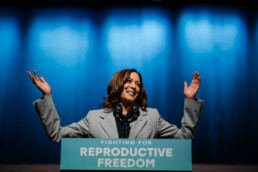
Brittany Packnett Cunningham Talks to Vice President Kamala Harris After a Year Without Roe
  June 21, 2023 Good morning, friends! Coming to you with something big today, so let’s get straight to it. Kamala Harris’s vice presidency was always going to be historic—she is, of course, this country’s first Black, first AAPI, and first female vice president. But a year ago this week, when the Supreme Court overturned Roe v. Wade, the administration she represents was also faced with history of a different kind: millions of its citizens stripped of their bodily freedom after an unprecedented Supreme Court decision. How has she responded? What does she plan to do next? And, in the words of podcast host Brittany Packnett Cunningham, “Are you mad? Because I'm mad, so I know you gotta be mad!” To find out, Brittany sat down with the Vice President last week. Their conversation comes to you today as a special episode of UNDISTRACTED (listen here); in it, they talk about everything from the urgency of this moment to the advice Shyamala Gopalan Harris would have for her daughter now. Here, Brittany tells us all about their sit-down. 
First things first—why did you want to talk to the Vice President for this particular anniversary? Brittany Packnett Cunningham: We’ve been intentional at UNDISTRACTED to speak to people from all angles on this issue—people who’ve had abortions, organizers, folks who defend the clinics…I wanted to talk to a person who has more power than most to do something about this. And to have a woman in the VP role—I thought it was especially important to hear from her. I’ve known the VP for a long time…when she was in the Senate, she would call to hear my POV on issues of policing, of race, of gender…I’ve been very candid with her. What I heard in our conversation in the podcast is similar to what I’ve heard in private conversations with her: a lot of justified concern, and frustration, and a very clear fight. Yeah, there’s a moment when you say to her, I feel like I’m seeing that Senate Judiciary Committee fire from you. You’re talking about the questions she asked in the Brett Kavanaugh confirmation hearings. Why was that on your mind? I remember her bringing such a real clear-eyed drive to get at the truth in those hearings. That energy is what people saw from her even before she became the VP nominee, and it’s something that even people who don’t agree with her politically appreciate about her. I wanted to see how she was bringing that fire to this fight. Of course, everybody does not like the way fight and fire look on Black and Asian women—and the stereotype that goes along with that, especially for Black women, can be undermining to the work that she’s trying to do and the people she has to persuade to do it. She spoke to having to navigate that, and it was revealing to see behind the curtain a bit. There’s a science to it that she’s had to figure out that no one else has had to in that job. So how do you measure up what the administration is actually doing on abortion? The Vice President was pretty honest that the Women’s Health Protection Act is not going to pass this session. Listen, especially knowing the history that Joe Biden has of wanting to work in a bipartisan manner, I’m realistic about how far he is willing to go. But on a number of issues the filibuster is going to continue to be a thorn in the side of the American people, and there is no way forward unless we get rid of it. I don’t get the sense that [President] Biden is willing to upset his Republican colleagues in order to do that—even though they would not give him the same consideration. So, while we work long-term to get a filibuster-proof congressional majority, we still have to push him on the filibuster and court reform. What else would you like to see the administration doing on this issue, especially as we head into 2024? They should be following the Vice President’s and organizers’ lead in being unafraid to say the word abortion—and to destigmatize this medical procedure. The administration should be getting behind candidates up and down the ballot who are pro-bodily autonomy. And they need to be pushed to be unafraid to explore all options, including expanding the Supreme Court. Speaking of 2024: Republicans are already coming at Harris hard with racism and misogyny. How can we all counter that? We need to not fall for the bait. The bait is going to be the perpetuation of culture wars, including banning abortion and banning gender-affirming medical care, and banning Black history. And the bait is also going to be a messaging strategy that tries to convince us that that’s not happening. We’re gonna continue to be gaslit. It’s going to be up to candidates who want to stand on the right side of history and who, as my mother would say, won’t fall for the okeydoke. And it’s going to be up to voters to remain on fire. The challenge is that Republicans have dispersed [the abortion] fight, so it’s happening locally and at state levels and it’s easy to get distracted and forget how important this is, this year and next year. Listen to the interview with Vice President Kamala Harris now.  THIS EPISODE OF UNDISTRACTED IS SPONSORED BY:  Hey Jane is health care, on your own terms. As the most-trusted virtual clinic offering telemedicine abortion care, we’re proudly putting the power back in people’s hands by providing care that’s private, safe, supportive, accessible, and convenient—for less than the average in-clinic cost of a medication abortion. Learn more about our services here, and how you can support Hey Jane here.  FOLLOW THE METEOR Thank you for reading The Meteor! Got this from a friend?
|

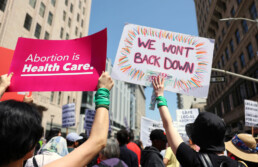
A Year of Abortion, Every Day
  June 20, 2023 Dear Meteor readers, When I think about culture-shifting moments of the past, I always wonder if the people living through them actually knew how profound the change was. In the case of June 24, 2022, I think many of us did know. That morning, when the United States Supreme Court published its decision in the case of Dobbs v. Jackson Women’s Health Organization and in a single day undid five decades’ worth of hard earned abortion rights, I heard the news from my husband in the simplest of sentences, “They did it.” This week we’re suspending our regular programming to take a step back and reflect on what has happened in the year since they did it. Leading up to the one year anti-versary on Saturday, we’ll be bringing you daily stories from the front lines, and the reality of what birthing people have been forced to endure in A Year Without Roe. Today, we hear from a journalist who’s covered all of it; tomorrow, one of the most powerful leaders in the world reflects on what’s next. And we’ll also be thinking about the future and the possibility of making history once again in the fight to win back our reproductive freedom. To paraphrase The Beatles, there’s nothing they can do that can’t be undone. Taking it one day at a time, Shannon Melero  REPORTER'S NOTEBOOKA Year of Abortion, Every DayJournalist Jessica Valenti has published over 300 abortion stories since Roe v. Wade fell last year. Here’s what she’s learned. BY SAMHITA MUKHOPADHYAY  Jessica Valenti has been doing feminist work for over two decades. She was one of the founding editors of the blog Feministing and has written or edited seven books on feminism, sexual consent, and more. But this year, she has been relentlessly focused on one topic: abortion. Her daily newsletter, Abortion, Every Day, has become an essential resource for anyone who cares about the issue, and the title doesn’t lie: She has taken only one day off since she began publishing last summer. I wanted to talk to my friend about what she's learned—but first, we had to reminisce. Samhita Mukhopadhyay: We've known each other for a long time—25 years! I remember the first thing we worked on together was the Vagina Monologues in college. You were making T-shirts. Jessica Valenti: That's right! That's right! The bedazzled clitoris. …that we wore to watch the Vagina Monologues, and then probably also to Take Back the Night. Oh my God. True nineties. Well, I share this to establish a little context here. You've been doing feminist work for a long time. It's your way of calling me old. I understand. Well, if you're old, I'm old too. Do you consider yourself a feminist journalist or an activist? Both—but if I had to choose one, I would choose activism, especially now. For me, feminism and journalism [are] natural allies because of the way that journalism is supposed to be about making things accessible to people, telling the truth, and holding powerful institutions and people accountable. 
Like most feminists, I have felt like this for at least the last 10 to 15 years because even with Roe existing, the attacks were ongoing, and restrictions were being implemented. Abortion has not been available in many parts of the country for a very, very long time. But, obviously, now that it's nationwide that folks have lost the right, there's a different kind of attention being paid, rightfully so. And it's always been really frustrating. I'm sure you feel this way, too, when you're like, "Hey, look at this thing. Look at this thing. Look at this thing!" And to you, it's this very clear picture, and you're pointing it out over and over again, and you're constantly being patted on the head and told not to worry. We were told we were delusional. So take us back to a year ago. Where were you when the Dobbs decision came down? That day is almost blocked [for me] because my moment was after the decision was leaked [in May 2022]. I was sobbing. And I just kept saying, “My daughter.” I just kept thinking about her. It hit me in the pit of my stomach. By the time the decision was actually released [on June 24, 2022], I was far gone. I had switched from denial to anger. How have things changed for you in the last year? I just naturally started writing about abortion all the time. I just couldn't stop tracking things, and researching things, and looking at things. It made me feel more in control of a generally uncontrollable situation. What’s your goal with Abortion, Every Day? We're trying to put out comprehensive reports that track everything but also provide a throughline of information because one of the biggest strategies for the anti-abortion movement is to make us feel completely inundated and overwhelmed into inaction. And so the hope is that if people understand what is happening, they'll feel like they're informed and empowered to do whatever they have to do. Have you learned anything new from just being in the weeds this much in the last year? I have learned that the anti-choice movement actually gives away the game constantly. They are laying [out] what they're going to do, in all sorts of ways, if you know where to look and how to listen. They are so much more ignorant than people realize. And they say the wildest stuff and put their strategy out there in this very explicit way. It's just that it's not being seen, and it's not being reported on. You’ve broken a lot of stories. What’s been the most shocking thing you've reported so far? It's all shocking. It's all awful. I published something last week about a young woman in Texas who couldn't get an abortion even though her fetus had no head. And in Texas, they are manufacturing abortion complication data. Everything that they're doing is shocking. What is it actually going to take to get these stories to penetrate the mainstream in some way? I think we're going to be at a point soon where you're not going to find a single person in America who hasn't been touched by an abortion restriction or an abortion ban in some way. Whether it's themselves, a family member, or a member of their community, it is not going to take long for this to impact everyone. And I think part of what we need to do, and what Democrats need to do, and the mainstream media needs to do, is to start treating the issue for what it is—which is a winning issue. It's something that Americans are not split on, not polarized about. Americans overwhelmingly support abortion rights, and it's just a small group of extremist legislators who are imposing their will on the majority of voters. And the more that we talk about that, the better off we're going to be. It sounds like you're hopeful. I am hopeful in the long run, but that doesn't take away from the everyday suffering that's happening. That's the hard bit. It's like, yeah, we probably will win this, eventually. But in the meantime, a lot of people are going to be hurt. 
Samhita Mukhopadhyay is a writer, editor, and speaker. She is the former Executive Editor of Teen Vogue and is the co-editor of Nasty Women: Feminism, Resistance and Revolution in Trump's America and the author of Outdated: Why Dating is Ruining Your Love Life, and the forthcoming book, The Myth of Making It. (Photo by Heather Hazan)  THIS TIME LAST YEARA year ago today, Renee Bracey Sherman spoke with Samhita on what people could do after SCOTUS ruled on Roe. Her prediction: “It’s going to be fucking chaos.” She was right.  FOLLOW THE METEOR Thank you for reading The Meteor! Got this from a friend? Sign up for your own copy, sent Tuesdays and Thursdays. |
