
Three Questions About…This Year’s Winter Olympics
The trailblazers to watch, and the ICE of it all
By Shannon Melero
Jamie Mittleman has the kind of job that, if it were explained in a Netflix rom-com, would sound entirely made up: She talks to Olympic and Paralympic athletes all day. Fine, it’s more than that; she’s the CEO and founder of Flame Bearers, a media company centered around women Olympians and their stories. But the fun part of her job is working with athletes and traveling to the Games.
The summer Olympics usually get all of the shine, but this year, the roster for Team USA is, as I think the kids say, bussin’. Two-time gold medalist Chloe Kim is back chasing a third podium. Figure skater Alysa Liu is out of retirement at the ripe old age of 22 and skating better than ever. Lindsey Vonn plans to compete on a totally destroyed ACL (girl, please don’t do that) and, of course, we’re all ready to get our Heated Rivalry on and cheer for the women’s ice hockey team captained by the incomparable Hilary Knight.
Ahead of her travels to the Milan/Cortina Olympics, Mittleman took some time to talk to us non-Olympians about what to expect.
The Olympics have always had political undertones. As someone working closely with so many women athletes ahead of Milan/Cortina, are there themes you’re seeing pop up?
A major theme I’m hearing from athletes is access. Who gets into winter sports? Who can afford it? Who sees themselves in it?
Winter sports remain some of the least diverse athletic spaces in the world, and athletes are acutely aware of that. They talk about the cost of equipment – how expensive is a ski pass? Hockey gear? A bobsled? [Plus] the lack of local facilities. Do they have to drive to get to the track? What if they don’t have a car? Nobody from my community competes in this sport…and how all of these compound over time.
There’s also a strong thread of athletes wanting to use their visibility to widen the doorway for the next generation. I’ve now worked with just shy of 400 Olympians and Paralympians from 55 countries, and many are navigating being “firsts” in their sport—first from their country, first openly queer, first Black athlete in their discipline. They’re proud, but they’re also very aware of the weight of representation they carry. It’s a privilege, but it’s also a responsibility they didn’t necessarily sign up for.
Speaking of firsts, Team USA has two major ones on the roster this year with Amber Glenn, the team’s first openly queer figure skater, and Laila Edwards, the first Black woman to play ice hockey for the U.S. What are you hoping viewers can take from watching them compete?
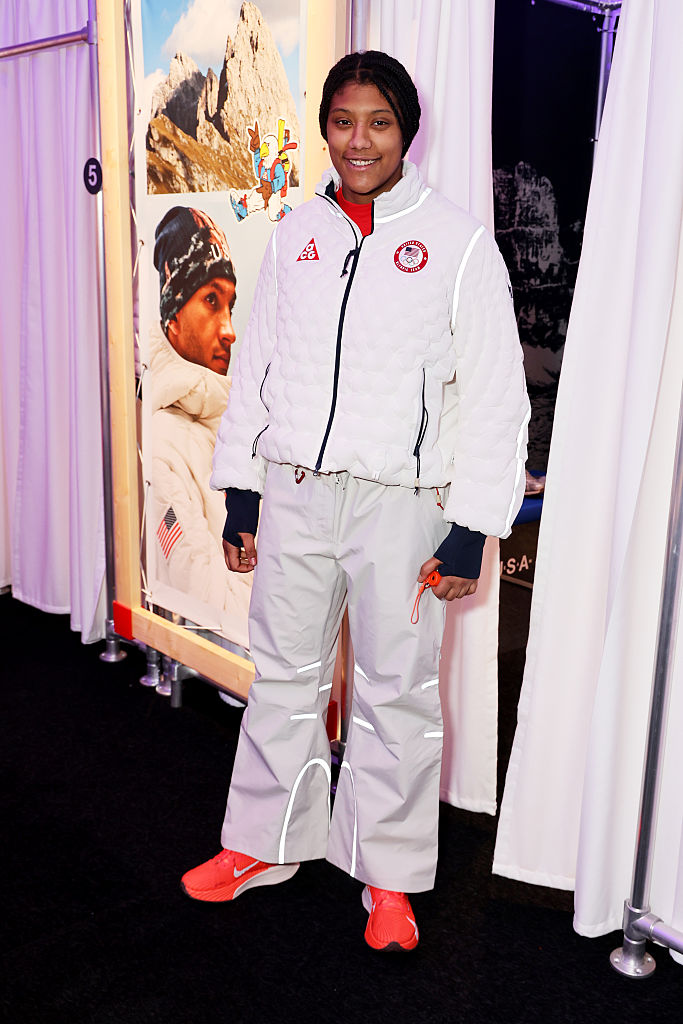
Seeing Amber Glenn and Laila Edwards on this stage matters far beyond medals. I hope young viewers see that there is no single mold for who belongs in sport. In her “Making It To Milan” interview, Hilary Knight mentioned, “There is a place for everyone in sport.” You can be openly queer and compete at the highest level. You can be a Black woman in a sport that has historically excluded you. You don’t have to shrink yourself to fit into a system.
For many young people watching, this may be the first time they see someone who looks like them, loves like them, or comes from a background like theirs on Olympic ice and snow. That moment of recognition matters. It’s often the first spark of belief: Maybe I belong there too. That belief is why my company exists—to make it clear that you do.
It’s also important to mention that just as many “firsts” exist in the Paralympics, which begin immediately after the Olympics—and I highly recommend tuning in.
We recently learned that ICE is also going to Milan with Team USA—which as an Olympic fan, fills me with embarrassment during a time I’d normally be feeling a rare moment of national pride. Does that change the viewing experience for you at all?
ICE traveling with the U.S. delegation is fundamentally at odds with the spirit of the Olympic Games, a hollow stunt of performative power. While hidden under the guise of ‘protection’, this move reads less as a safety measure and more as a PR maneuver—an attempt by the Trump administration to reclaim international relevance and authority at a moment when the US is increasingly isolated and losing credibility. Coming on the heels of Davos, where international leaders such as Canadian Prime Minister Mark Carney signaled clear resistance to Trump’s agenda, ICE’s presence is an attempt to project strength at a time when US influence has clearly decayed.
Outside the US, the context is very clear: ICE is not relevant, nor wanted. The International Olympic Committee has said their presence is ‘distracting and sad.’ The Mayor of Milan explicitly said they are not welcome. Since the announcement of their presence, several organizations have moved to disassociate from the word “ICE.” The Milan hospitality suite, once called the “Ice House” has already been renamed.
[But their presence] reinforces why the athletes’ stories—and their humanity—matter even more. The athletes are showing up to compete after lifetimes of work. This is about them. Their journeys. Many come from immigrant families, from underrepresented communities, from places where sport was their pathway to opportunity. The geopolitical backdrop is real, but what I see up close is athletes trying to hold onto the purity of why they do this in the first place.