

"The world stopped paying attention"
  August 3, 2023 Hola, Meteor readers, I recently caught up on “And Just Like That,” and finally saw the episode where Steve gives Miranda a piece of his mind regarding their much-stalled divorce. As a SATC fan, one of my biggest issues with AJLT is the mistreatment of Steve’s character, and it really felt like his “This is my house” speech was vindication for the hours of Steve-slander I’ve had to endure. Give that man an Emmy. But more importantly, give the writer who penned that monologue a fair wage. In today’s newsletter, we take a look at Lizzo’s response to the lawsuit against her, offer some good reading for your weekend, and hear from an actual hero, Farkhunda Muhtaj, who helped evacuate teen soccer players from Afghanistan. Typing from Steve’s house, Shannon Melero  WHAT'S GOING ONTruth hurts: As you’ve certainly been made aware of by now, on Tuesday, three of Lizzo’s former dancers filed a lawsuit against the singer, her production company, and her dance captain. The lawsuit painted a picture of a hostile work environment, rife with racist and fat-phobic comments, an “excruciating” 12-hour audition in which one dancer soiled herself, and the now-infamous instance in which a dancer was allegedly pressured to eat a banana out of a nude performer’s genitals. Lizzo posted her response this morning, and the messaging was…well, pretty much exactly what we’ve come to expect from celebrities called out on their behavior. In fact, there’s already a term for it, coined by Dr. Jennifer J. Freyd—DARVO: Deny, Attack, and Reverse Victim and Offender. Here are some examples straight from Lizzo’s post:
This is a well-worn roadmap. But seeing it used by this person, this time, stings. Lizzo represented so many things that felt new: self-celebration, body positivity, sexual liberation—wonderful qualities that people on the right have tried to “cancel” her for time and time again. She had a chance to do something different and new in her response, too—like address the charges with empathy and humility, rather than taking a page from the DARVO playbook and putting her hurt feelings first. But as a singer once sang, people are only great until they’ve gotta be great. AND:

 FLEEING AFGHANISTAN“The World Has Stopped Paying Attention”The soccer captain behind We Are Ayenda is still working to free the women of her home country.BY THE METEOR TEAM  FARKHUNDA MUHTAJ SPEAKING TO PRESS AFTER MEMBERS OF THE AFGHANISTAN YOUTH TEAM WERE GRANTED ASYLUM IN PORTUGAL. (IMAGE BY HORACIO VILLALOBOS VIA GETTY IMAGES) In August 2021, with the world’s eyes on Afghanistan, the teenage soccer players on that country’s Under-18 Women’s National Team left their homes and began a weeks-long journey to evacuate from their country. The experience of these players—many of whom now live in Portugal and compete as Ayenda, which means “future” in Farsi—is the subject of not one but two films this month, the first of which, We Are Ayenda, is out now on Amazon Prime. The second, Ayenda, will be available on Peacock later this summer. We talked to the extraordinary person who led the girls through the rescue process—not an intelligence officer, but a then-23-year-old Afghan-Canadian soccer player, Farkhunda Muhtaj, the captain of the Afghan Women’s National Team. The Meteor: The film shows your day-by-day work evacuating the youth team from Afghanistan. How did you come to be the person entrusted with the job to begin with? Farkhunda Muhtaj: Because I was the captain [of the women’s national team] and I also lived abroad…I was very much trusted from individuals within Afghanistan. And so I think immediately when they needed help, they turned to me. The women's department secretary...reached out and said to me that Canada was supporting 20,000 Afghans and could I help get the families to either Canada or any other kind of safe nation. What impressed you the most about the girls as they navigated the process of trying to leave the country? I would say their courage and determination and resilience for sure. The girls really went through hell. They were trusting me blindly—they didn't know what the next move was, where they were headed, why they were headed [to] a certain location, who they were waiting for, and how they were going to get into the airport and out of the country. But they risked everything and…whether it took them ten tries, 20 tries, traveling all over the region in order to [find a safe way out], they were doing that. And it's not easy for a 15- or 16-year-old girl to…convince their family that this is the best way out. At the time there was a lot of fraud; it was hard to trust anyone. And what really impressed me was their sisterhood as well, the fact that they recognized that they weren't the only ones trying to leave Afghanistan.  MEMBERS OF THE YOUTH TEAM ALONG WITH THEIR FAMILY MEMBERS IN PORTUGAL. (IMAGE BY HORACIO VILLALOBOS VIA GETTY IMAGES) You’re now living in Europe, and because the Taliban has banned women from playing sports, you’re not allowed to play for your home country. What are your hopes for your own future, and for the future of other Afghan women athletes? Just to quickly give you some context: I was a student-athlete in university. I was the captain of the women's soccer team there. And afterward I wanted to continue my education, so I completed my Bachelor of Education [at] a teacher's college in Canada, and became a science and high school teacher. Now I’ve decided to go pro [and play for Fortuna Sittard in the Netherlands]—it's something I've wanted to do since I was younger, but I realized that the girls saw me as a role model. And so I [went pro] just to show the girls that, you know, it doesn't matter that we're from Afghanistan, a war-torn country; we're just as capable as any other European, any other American or Canadian. And what I want for other Afghan women athletes is the same journey that I took: They deserve to be educated. They deserve to have the right to play football, and we deserve to represent our country. I want us to be able to represent and officially compete in FIFA competitions once again. Of course, since the Taliban took over, they have banned that. Beyond sport, I hope that Afghan women can be educated again. But we're kind of out of time. It's been two years already. The situation in Afghanistan is only getting worse, not better. Yes—there's a moment in We Are Ayenda when you say that you knew [in 2021] that you had to get the girls out quickly because the world was paying attention—and that it might stop. Two years later, has the world stopped paying attention? Absolutely. The world has stopped watching. Right when the Taliban had taken over Afghanistan, people cared—partly because the U.S.’s reputation was on the line as well. People cared and were very anxious about what the future of Afghanistan might look like. But after the war in Ukraine happened—and nothing against Ukraine, they deserve all the attention and care—everyone forgot about Afghanistan. And you really saw how Afghans were treated compared to Ukrainians…When I was trying to help [evacuate] Afghans and vulnerable communities [after evacuating the players], no country seemed to have space. But as soon as other issues around the world happened, they had the budget; they had the space; they had the time. It was really disheartening for me. It was something I didn't expect from the global community. And so the world has stopped paying attention. In Afghanistan, women are just there trying to [gain access to] education. I think the most powerful tool is education. Once you're educated, you're aware of your rights and responsibilities, and the fact that women cannot be educated shows that they're trying to silence them. And if our mothers, our sisters, our daughters are not being educated, then what can we expect for the future generations of Afghanistan? I don't think it's going to turn out well at all. But Afghanistan has been in a desperate situation for decades. And regardless of that, our generations continue to thrive. So although we want the global community to act and be a part of the change and help us, we are also very much trying to do our best to help from within.  WEEKEND READS 📚On the NFL: “It’s not every day a group of women defeat a white billionaire man.” But for the women who sued former Commanders’ owner Dan Snyder, that day is here. (The Athletic) On cool kids: A 10-year-old girl threw a water balloon at a local politician from 100 feet away. She got him right in the back of the head and he was so impressed, he suggested she should be playing for the Yankees. So the Yankees invited her for a game. (The Washington Post) On BookTok: Smutty. Hockey. Drama. Need we say more? (The Cut) On climate: The heat isn’t only on land. Unda the sea, an “astonishing” heat wave has been lethal for marine life. (The New York Times)  This newsletter was written by Shannon Melero and Bailey Wayne Hundl. FOLLOW THE METEOR    Thank you for reading The Meteor! Got this from a friend? Sign up for your own copy, sent Tuesdays and Thursdays.
|


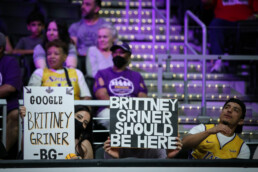
Why did it take so long to care about Brittney Griner?
  August 5, 2022 Morning glorious Meteor readers, We hope you are having a great weekend! The news has been heavy this week, but a quick housekeeping announcement before we get into all of that. Starting next week, we’re going to be coming to you every Tuesday and Thursday instead of on Wednesdays and Saturdays. Change is fun! Now on to the news. With love, The Meteor  WHAT'S GOING ONIt took us too long to pay attention to Brittney GrinerBY SHANNON MELERO  SHE SHOULD BE HERE. (IMAGE BY MEG OLIPHANT VIA GETTY IMAGES) On Thursday, after she submitted a guilty plea, a Russian court sentenced Brittney Griner to nine years in prison on drug-related charges. The WNBA star has been wrongfully detained in Russia since February when officials found cannabis oil in her luggage. According to Griner’s testimony, she was not made aware of her rights during her arrest and did not intentionally bring the oil—which was prescribed to her by a doctor and was found to be less than one gram—into the country. “I still don’t understand to this day how they ended up in my bags,” Griner told the court during her trial. The two questions that continue to arise from folks unfamiliar with Griner and her career are Why was she there in the first place? and Why plead guilty? To answer the first question: Many WNBA players compete overseas during the American off-season to make up for the money they’re not being paid to play stateside. And as Connecticut Sun forward Jonquel Jones explained to the Washington Post, it’s not just the money luring American players—it’s how well they’re treated and the level of international competition compared to the lackluster provisions in the U.S. Jones said playing in Russia “felt like the first time I arrived as a basketball player.” Before the attack on Ukraine, huge names from the WNBA had played multiple seasons in Russia, including Jones, Diana Taurasi, Sue Bird, and Breanna Stewart. And to answer the second question: Griner’s guilty plea submitted in early July was a defense tactic partially aimed at securing a reduced sentence. After the plea, her defense team released a statement that reads in part: “She decided to take full responsibility for her actions as she knows that she is a role model for many people. Considering the nature of her case, the insignificant amount of the substance, and BG’s personality and history of positive contributions to global and Russian sport, the defense hopes that the plea will be considered by the court as a mitigating factor and there will be no severe sentence.”  BRITTNEY GRINER'S REACTION AS HER SENTENCE WAS HANDED DOWN (VIA CNN) But as we learned this week, she was not met with leniency; her sentence is only one year short of the maximum for this offense. Now Griner’s only hope for freedom is a prisoner swap, coordinated by the Biden administration, which has been offering platitudes but has made only one concrete offer to the Russians over the last 100+ days. According to The Athletic, Russia is “ready to discuss” the prisoner swap offer, which would also include the return of Paul Whelan, another American detainee. The Brittney Griner story is a reminder of why sports should matter to feminists (and not only when there’s a story of pay disparity or sexual assault). I’ve often heard It’s just basketball, or Who cares about football? or There are bigger things for Serious Intellectuals to worry about. But Brittney Griner is an underpaid, Black, queer basketball player from a league that severely lacks cultural and economic investment. Like many women and trans athletes, Brittney Griner has devoted the majority of her life to her sport and giving back to her community—only to be largely ignored by media outlets that turn their noses up at athletes whose last name isn’t James, Manning, or Brady. It’s unfortunate that it’s taken an international fiasco for media outlets to take note of the WNBA and the work its players have done in social justice and pay equity. Finally, some justice for Breonna Taylor’s familyBY SAMHITA MUKHOPADHYAY  SHE HAD HER WHOLE LIFE AHEAD OF HER. (IMAGE BY LEIGH VOGEL VIA GETTY IMAGES) When 26-year-old Breonna Taylor, a medical worker, was killed by police at the beginning of the pandemic, justice didn’t seem possible. Her family’s legal recourse was limited—the Louisville police claimed to have a no-knock warrant because they believed Taylor's house was receiving drug packages (it wasn’t) making their actions legal. Later, the Kentucky attorney general, Daniel Cameron, grossly mishandled the case, claiming he did not want to cave to “mob justice.” In 2020, one of the officers had been fired, but no one had been charged. But this week, news that was a long time coming finally arrived: The Department of Justice announced federal charges against the officers involved in the murder. While none of the officers have been charged with directly causing Taylor’s death, enough evidence has been found to suggest that three of them violated her rights by executing a search warrant without probable cause—and then “fabricating a story to evade responsibility.” The fourth officer, Brett Hankison, is facing a federal charge of “unconstitutional excessive force” after he shot ten rounds into Taylor’s apartment and that of a neighbor. It’s worth noting that these charges didn’t just “happen.” Department of Justice watchers saw the handiwork of Assistant Attorney General Kristen Clarke—one of two DOJ appointees last year who were notable for their commitment to criminal justice reform (the other is Vanita Gupta). In her remarks on the charges, Clarke said: “Community safety dictates that police officers use their weapons only when necessary to defend their own lives or the lives of others, and even then, that they must do so with great care and caution. Today, after a full and comprehensive investigation, the facts and law have brought us here, to these indictments.”  THE INCOMPARABLE KRISTEN CLARKE. (IMAGE BY ANNA MONEYMAKER VIA GETTY IMAGES) When Clarke was nominated, Fatima Goss Graves, president of the National Women’s Law Center, praised her appointment as “powerful and historic.” This week, she told The Meteor, she saw that power in action.“Kristen Clarke’s civil rights track record and deep experience have made her exactly the right person to lead the civil rights division in these times,” says Goss Graves. “And each time her leadership is tested—and as the first Black woman to lead the division, it happens often—she rises to meet the moment. We’ve learned again and again that elections matter and leadership matters. It requires courage, clarity, skills, and empathy. It gives me such hope that we will finally see justice for Breonna Taylor, and the country will be comforted by [Clarke’s] leadership.”  A FEW MORE THINGS:
 FOLLOW THE METEOR    Thank you for reading The Meteor! Got this from a friend? Sign up for your own copy, sent Tuesdays and Thursdays.
|
