
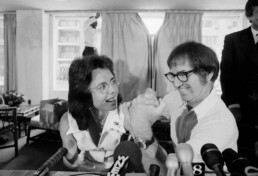
Just Let Everyone Play
Women’s leagues, men’s leagues, and an all-gender league? A new book explores the possibilities.
By Scarlett Harris
In 1902, British figure skater Madge Syers won the silver medal in what was, at the time, an all-men’s World Figure Skating Championships. Until then, women competed only in elite sports perceived as feminine, such as tennis, croquet, and horseback riding, but weren’t explicitly prohibited from competing against men, perhaps because the thought seemed so outlandish. So in 1906, the International Skating Union created the women’s category, which Syers dominated that year and the next, eventually winning gold at the 1908 Olympics.
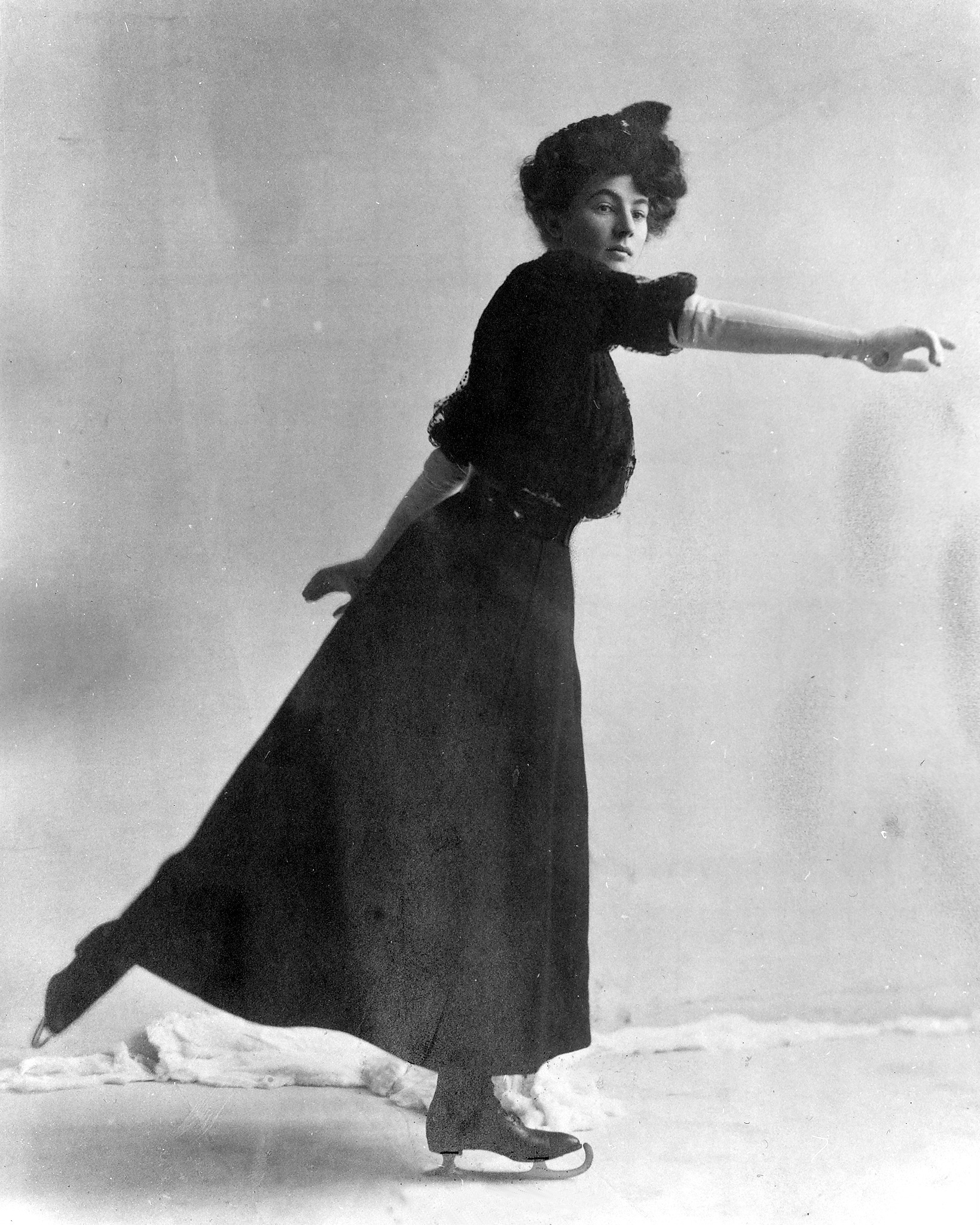
Syers is widely credited as the reason a “women’s” category in sports competition came to exist—and eventually became the highly lucrative yet highly underestimated women’s leagues of today. Women’s sports are more popular than ever, with viewership rising and even surpassing the men’s league at times, including at last year’s women’s March Madness. Athletes such as Dijonai Carrington, Angel Reese, and Caitlin Clark are now household names. Women’s soccer is the fastest-growing sport in the U.S. and a far more riveting watch than men’s. But—and stay with me here—are sex-segregated leagues the best we can do for gender equality in sports?
In Sheree Bekker and Stephen Mumford’s thought-provoking new book Open Play: The Case for Feminist Sport, the authors argue that women’s sport isn’t necessarily the ultimate feminist goal we’ve been led to believe it is. “It’s rather a form of segregation and control of women to keep them in their own category so that they never beat men or participate on the same footing as them,” charges Bekker, associate professor of health at the University of Bath.
Sex-segregated sports were created so that “women have a chance at winning based on the assumptions that they could never beat men” and to “keep them physically safe in the case of contact sports,” explains Mumford, a philosophy professor at Durham University. “But it’s not really a protected category; it’s a segregated one. Protected categories exist for the protection of those within those categories, whereas segregation exists for the benefit of those outside the segregated group. In other words, the group benefiting is men. “There’s this fear that one day women might actually be able to catch up to and beat men,” Bekker explains. Hence the reason the women’s category was invented in the first place. (Madge Syers, after all, did just that.)
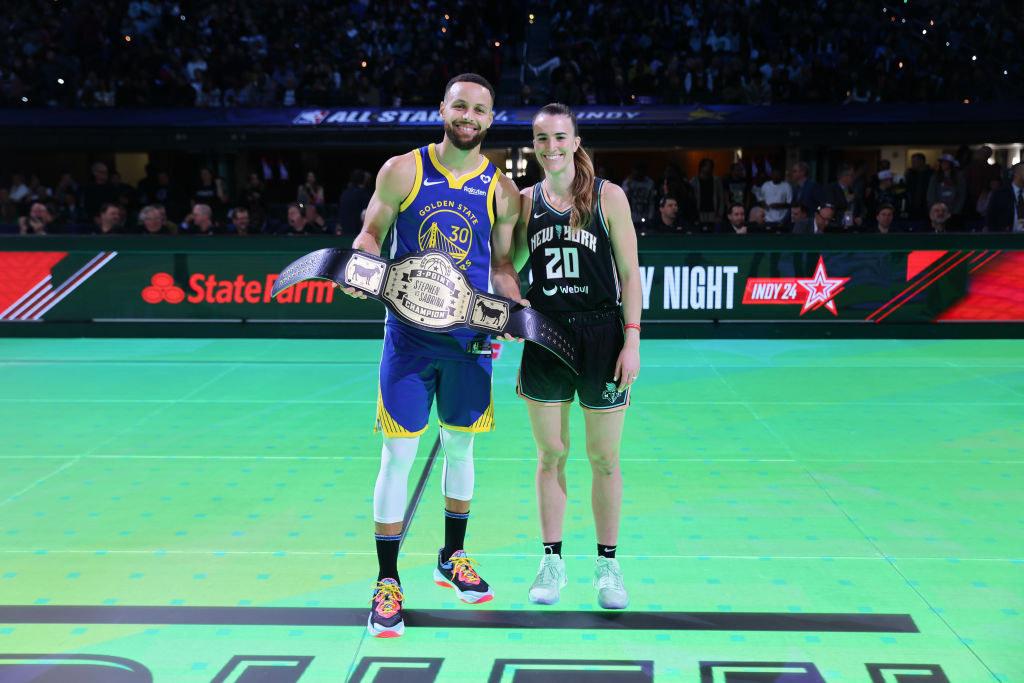
In Open Play, Bekker and Mumford propose the idea of an egalitarian system where competitors are grouped by weight, power, and ability—rather than sex. There are valid concerns that leagues solely based on weight or power may end up suppressing women’s visibility, since, for instance, with basketball, the format would favor men. Still, if Muggsy Bogues was able to keep up with Larry Johnson there’s no reason Sabrina Ionescu couldn’t keep up with Steph Curry. (After all, she already did.)
Succeeding at sport threatens the patriarchy.
Arriving at a time when right-wing lawmakers are using the idea of protecting women athletes for their own political goals, Open Play is much-needed food for thought. President Trump’s two-sex executive order barred the vanishingly small number of trans athletes in this country from participating in women’s sports. “Trans women are not dominating women’s sport at all,” says Mumford. “It’s a manufactured scare. It’s almost at the point where being good at sport is grounds to question someone’s gender because it challenges the perception of how a woman ‘should be.’ Succeeding at [sport] threatens the patriarchy.”
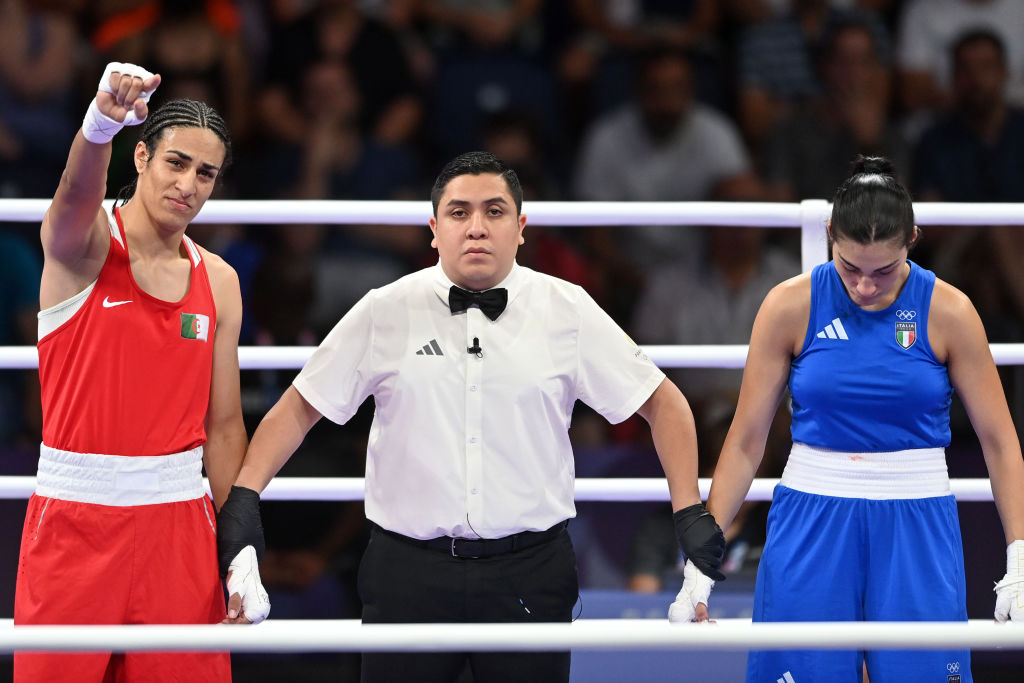
Consider, for instance, the case of Algerian boxer Imane Khelif, a cisgender woman who had her gender called into question during the 2024 Paris Olympics after her opponent forfeited, chargingthat Khelif’s punches were too hard. Or think of South African runner Caster Semenya, who was made to undergo sex verification testing in 2009. Sex testing in sports appears perennially throughout history, from the “nude parades” of the 1950s and ‘60s to chromosomal testing, which World Athletics just announced it would be reintroducing. “We’re starting to see the reemergence of the idea of ‘who is a real woman,’” says Bekker.
But ultimately, gender policing in sport isn’t just about politics—it’s also about money.
Women’s sports get a fraction of the funding, attention, and visibility that men’s sports do. Without sufficient funding, women are working with subpar facilities, which, as the U.S. Women’s National Team argued during their equal pay dispute, can shorten their careers. Under current women’s-league pay conditions, many women athletes also have to work full-time jobs to supplement their paychecks. While elite male athletes are restoring their bodies to squeeze another winning season onto their resume, women like Ilona Maher are running themselves ragged just to keep the lights on. A theory called the 10% gap, which Bekker and Mumford believe to be flawed, posits that men are roughly 10% stronger, faster, and better at sports than women. But “it’s not as if men’s sport is getting 10% more of the funding than women’s sport,” says Mumford. “It’s usually 90% of funding.” Imagine how much better women athletes could perform if they were given access to the degree of training and resources those dollars can buy.
So, would it work for fans? A modern-day Battle of the Sexes might feel like a feminist win, but the rising popularity and viewership of women’s sports could indicate that some people just aren’t interested in watching men compete, regardless of the gender of their opponent. I am a fan of professional wrestling, and while I’m a champion for intergender wrestling and have written about it widely, I still prefer to watch women’s wrestling only. So while a desegregated athletics landscape might be an ultimate goal—at least as an option—for the time being many competitors would likely choose to stay in their current categories.
Non-binary athletes might offer us a glimpse of a more inclusive future, though. USA Gymnastics doesn’t have a specific category for non-binary competitors, and Australian Athletics offers the option to compete in the binary category they feel most comfortable in. And many nonbinary athletes gravitate towards non-traditional sports like roller derby, in which play is often not sex-segregated.
“Non-binary people are showing us the way forward,” Bekker says. “Traditional sports organizations right now are not on top of this and they’re going to lose more people coming into their sport as younger generations, who are more diverse, grow up.”
In the meantime, we’ll have to content ourselves with sportswomen kicking ass in gendered categories—and waiting for the men to be just as interesting to watch.

Scarlett Harris is a culture critic, author of A Diva Was a Female Version of a Wrestler: An Abbreviated Herstory of World Wrestling Entertainment, and editor of The Women Of Jenji Kohan.

The “Recurring Lies” We Learn in School
As our country marks Black History Month by banning books about race from classrooms, writer Eve L. Ewing looks at the long, complex “miseducation” of Black and Native children.
BY REBECCA CARROLL
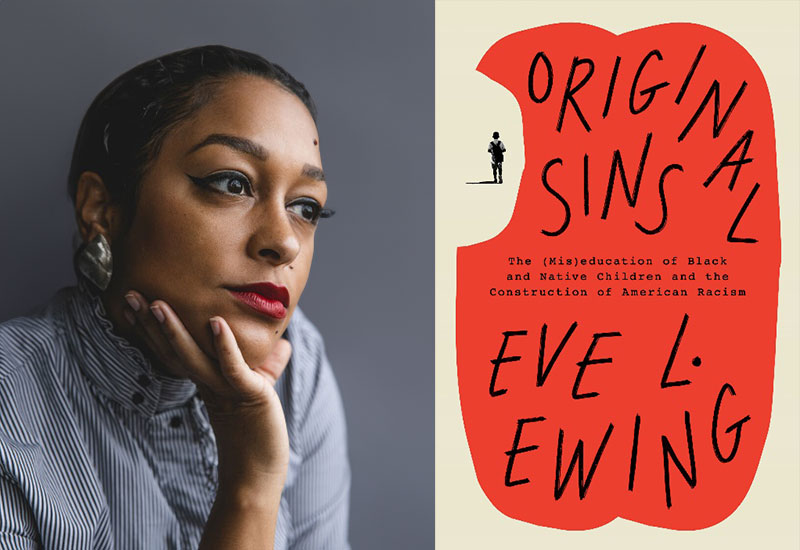
AUTHOR EVE L. EWING WANTS YOUNG PEOPLE TO “UNDERSTAND THEIR OWN RADICAL POWER."
It’s been less than a month of the second Trump administration, and already in its crosshairs is the Department of Education. Trump has pledged to abolish it, issued an executive order threatening to defund schools engaging in discussions around race and oppression, and has empowered Elon Musk, a white male billionaire who grew up under the racist apartheid system of South Africa, to cancel $900 million in research grants. If there is a next level of “hope,” we need it now—and no one embodies hope, especially when it comes to education, more than poet and scholar Eve L. Ewing. Her new book, Original Sins: The (Mis)education of Black and Native Children and the Construction of American Racism, approaches the issue of disparity in education—specifically for Black and Native students—with the revelatory question of, “What if American schools are doing exactly what they are built to do?”
From the earliest efforts to offer schooling to formerly enslaved Black people—efforts that were met consistently with questions of whether or not Black people were human enough to be educated—to the compulsory boarding school attendance of Native children with the aim of “civilizing” them, Original Sins unearths the DNA of America’s education system, and lays bare the ways in which our knowledge has “been impacted, and to some degree, severed by colonialism.” And as Trump cuts DEI initiatives in American universities and colleges, one note from the book resonates: Schools, Ewing writes, “have never been for us.” But, she continues, regarding the education system as a whole, “The good news is that people made it, and people can unmake it—and make new things.”
Rebecca Carroll: It seems that from the start, the educational attitude toward Black folks was: We’ll give you subpar resources, but will (mostly) leave you alone as long as you stay away from us (white folks). While for Native Americans, it was: We’re going to steal your children, and destroy all their cultural ties to you. Why were the educational strategies used against Black folks and Native Americans so different from one another? Or were they?
Eve L. Ewing: The United States was founded on land that was violently stolen from the Native people who had lived here since time immemorial, and that land was tilled by enslaved Africans who were stolen from their homelands, degraded, and treated as property. Those foundational thefts enriched the nation at the expense of the lives, land, and dignity of Black and Indigenous peoples. And those actions didn’t happen in one discrete moment—they continue to reverberate in the world we live in today.
So in order for the country to sustain itself, it has required an intellectual underpinning that justifies those evils. It requires a set of recurring lies, to make it all seem okay. And that’s where schools come in: a place to make the lies seem real. Three of those lies that I talk about in the book are: the lie that Black people and Native people are intellectually inferior, the lie that our bodies and our children’s bodies inherently require more discipline and control, and the lie that we are destined for economic subjugation, that it’s our fate in life to lie at the bottom of a capitalist hierarchy.
There are ways that anti-blackness and anti-indigeneity use the same weapons, but there are indeed ways that the strategies diverge. And the reason for that is that white supremacy has historically needed different things from us. It has needed Black people to be subservient, and it has needed Native people to be gone. That’s how I would put it simply.
RC: What do you think is the responsibility of educators who began their careers when the official default was white supremacy? Is there a process of undoing (not a punishment) that needs to occur for teachers of all races who, for perhaps decades, taught children of all races through the lens of racial hierarchy?
ELE: It’s a hard question. I think it’s important to begin by centering ourselves in relationships. All of us—in our personal lives, in our work lives—have had moments when we thought we were doing our best, and it’s made clear to us that the people we loved were not served by our choices. When that happens, we have a choice to make: Do we choose to be defensive, or do we take the opportunity to be reflective? If someone takes the time to try to teach you to do better, to be better, that’s an act of love. Are you able to receive that love, or not? Are you able to be accountable for your actions? That’s a question for folks to ask themselves. At the same time, we need to be making space for people who are radically caring and transformative to enter the profession.
RC: Speaking of undoing racist teachings, you cite the work of scholars Eve Tuck and K. Wayne Yang, who disparage the “easy use” of the word “decolonize.” They note that in recent years, social justice activists have suggested “decolonizing” certain spaces and ideology…but in doing so have actually trivialized the word. Is it not possible, though, for an easy use of a term to also be effective?
ELE: I think the question has to be, effective for what? …Real decolonization is not easy, and if a violent colonial institution continues to profit from harms against Indigenous peoples, having a single book or training or workshop or affinity group and then saying that that is “decolonizing” could be not only misleading—it could be actively dangerous, because it gives people a facile representation of what decolonization is. It reminds me of a moment in 2020 when the university where I work declared that they were committed to anti-racism, which could not have been further from the truth. So I see it as less of a scholarly conversation, and more of a “say it with your chest” conversation, or a “don’t just talk about it, be about it” conversation.
RC: In a recent piece for In These Times, you wrote: “It’s not enough to be afraid of the laws and rules we don’t want to see in schools.…Who are the young people you love most….What are the values you hold dear that you want desperately for them to understand, to inherit?” To your young beloveds, or simply to your readers, what are the values you hold dear that you want desperately for them to understand, and to inherit?
ELE: Thank you for that question! I want the young people in my life to understand their own radical power to love: to love themselves, to love others, to love the lands and waters and more-than-human relatives, and to understand how strong we are collectively when we turn that love into action. I want them to voraciously seek out stories in all forms and to see themselves as storytellers. And I want them to understand Chicago history and the history of great Black artists who shaped culture as we know it.
